The Asia Pacific Out-of-band (OOB) Authentication Market would witness market growth of 16.4% CAGR during the forecast period (2025-2032).
The China market dominated the Asia Pacific Out-of-band (OOB) Authentication Market by Country in 2024, and would continue to be a dominant market till 2032; thereby, achieving a market value of $280.6 Million by 2032. Japan market is showcasing a CAGR of 15.6% during (2025 - 2032). Additionally, The India market would showcase a CAGR of 17.2% during (2025 - 2032). The China and Japan led the Asia Pacific Out-of-band (OOB) Authentication Market by Country with a market share of 27.5% and 17.7% in 2024. The Singapore market is expected to witness a CAGR of 18.2% during throughout the forecast period.
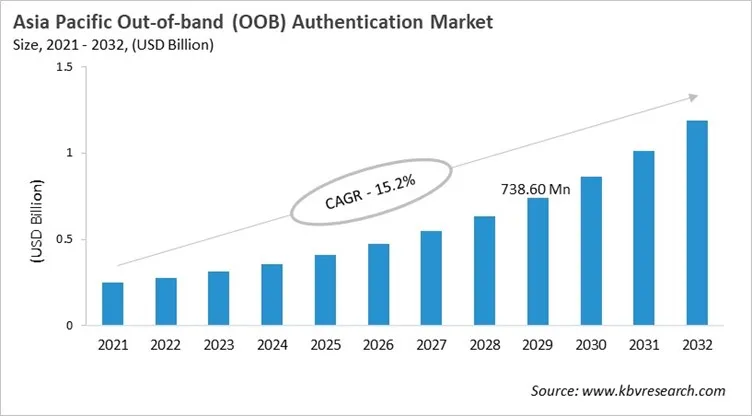
The Asia Pacific Out-of-Band (OOB) Authentication market has grown along with the region's rapid digitalization, wider access to the internet, and higher cyber risks. OOB authentication was first used in Japan, Australia, Singapore, and South Korea to protect against fraud and phishing. Government-led efforts to improve cybersecurity and digital identity in countries like India and Singapore sped up the process even more. SMS, app-based authenticators, and push notifications could be used and scaled because so many people had mobile phones. Over time, OOB authentication evolved from simple one-time passwords (OTPs) to more complex models that work on mobile devices and in the cloud. It is now a key part of digital trust frameworks in government, healthcare, business IT, and financial services.
Current trends show that there is a lot of demand from the government for secure digital identity frameworks and multi-factor authentication. Mobile-first and cloud-based OOB authentication models are growing quickly. They help people work from home and use the cloud in both developing and developed markets. Companies are slowly moving away from SMS-based methods and toward app-based and push-notification solutions that are more secure and less likely to be used for phishing. Market leaders care about things like scalability, following the rules, and working with mobile ecosystems. Risk-based and adaptive authentication features are becoming more important to find a balance between security and ease of use. There are global vendors, regional providers, and telecom-backed solutions in the competitive landscape. Flexibility and compliance with local laws are two important things that set them apart.
Based on Components, the market is segmented into Software and Services. The Software market segment dominated the China Out-of-band (OOB) Authentication Market by Components is expected to grow at a CAGR of 13.9 % during the forecast period thereby continuing its dominance until 2032. Also, The Services market is anticipated to grow as a CAGR of 14.8 % during the forecast period during (2025 - 2032).
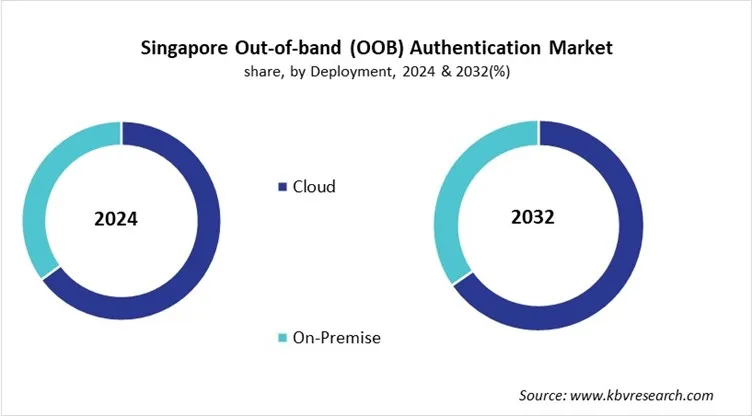
Based on Deployment, the market is segmented into Cloud and On-Premise. With a compound annual growth rate (CAGR) of 18.3% over the projection period, the Cloud Market, dominate the Singapore Out-of-band (OOB) Authentication Market by Deployment in 2024 and would be a prominent market until 2032. The On-Premise market is expected to witness a CAGR of 18% during (2025 - 2032).
Free Valuable Insights: The Out-of-band (OOB) Authentication Market is Predicted to reach USD 4.59 Billion by 2032, at a CAGR of 15.8%
China's Out-of-Band (OOB) authentication market is growing quickly because the country has a big digital economy and a lot of online financial, e-commerce, and government transactions. A lot of people use OOB methods like SMS, mobile app approvals, and hardware-backed authentication to keep their digital identities and payments safe. The government's strong focus on cybersecurity and fraud prevention makes people more likely to use multi-factor authentication. High smartphone uses and super-app ecosystems make it easy to verify things on mobile devices. The market is moving away from SMS and toward biometric, app-based, and AI-enabled authentication models. Increasingly, integration with real-time fraud detection and cloud security is happening. Domestic tech companies and telecom companies are the main competitors, with scalability and compliance with regulations being the main differences.

By Components
By Deployment
By Authentication Channel
By End-User Industry
By Country
Our team of dedicated experts can provide you with attractive expansion opportunities for your business.



 Unique Offerings