The Asia Pacific Offshore Structural Analysis Software Market would witness market growth of 9.1% CAGR during the forecast period (2025-2032).
The China market dominated the Asia Pacific Offshore Structural Analysis Software Market by Country in 2024, and would continue to be a dominant market till 2032; thereby, achieving a market value of $116.6 Million by 2032. The Japan market is registering a CAGR of 8.2% during (2025 - 2032). Additionally, The India market would showcase a CAGR of 10.2% during (2025 - 2032). The China and Japan led the Asia Pacific Offshore Structural Analysis Software Market by Country with a market share of 28.9% and 15.2% in 2024.The Singapore market is expected to witness a CAGR of 11% during throughout the forecast period.
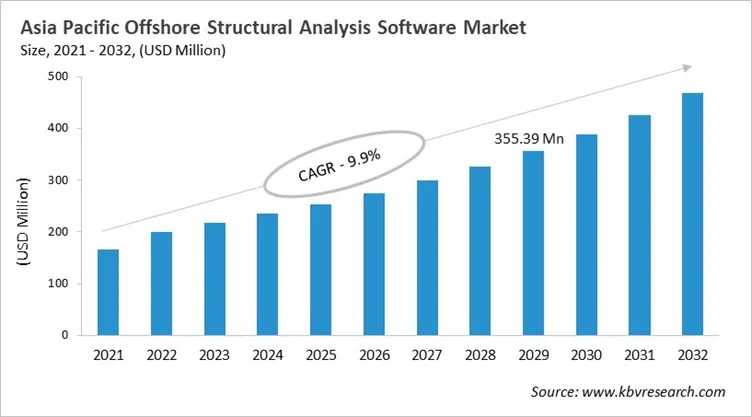
The Asia Pacific offshore structural analysis software market has changed a lot since the days when companies made their own tools. Now, there are advanced commercial packages that combine structural, hydrodynamic, fatigue, and soil-foundation analyses into easy-to-use workflows. The market started to grow because oil and gas companies were exploring deeper waters and harsher metocean conditions in the region. Recently, it has grown even faster because of offshore wind developments in China, Taiwan, Japan, Korea, and Australia. Modern software now supports nonlinear, time-domain, and probabilistic analyses. It also follows classification society rules and lets you do parametric studies that speed up design iterations. Regulatory alignment and industry collaborations have led to the widespread use of validated, certified workflows. Lifecycle management, which includes everything from design to decommissioning, has also increased the use of software beyond just initial structural assessments.
One of the most important trends is the merging of multi-discipline simulations that combine structural FEA with hydrodynamics, mooring dynamics, aeroelasticity, and soil-structure interaction to create a single model that can show how complex offshore systems respond. More people are using cloud and high-performance computing to run big probabilistic studies and simulations that require a lot of processing power. This makes it possible to do scalable, cost-effective analysis on projects of all sizes. Strong partnerships with classification societies, research institutions, and major owners make it easier to develop modules together, get them approved by regulators, and get them into the market. Localized training, support hubs, and cloud delivery models are examples of regional enablement efforts that make it easier for people to adopt new technologies and speed up growth. There is a lot of competition in the market, with global OEMs, niche specialists, and engineering consultancies all competing on solver fidelity, interoperability, and service capabilities. Getting into the market is hard because algorithms need to be validated and certified. Overall, the market in Asia Pacific is growing because of a mix of new technologies, cooperation between regulators, and flexible delivery methods that consider both the region's long history of oil and gas activity and its growing offshore renewable energy sector.
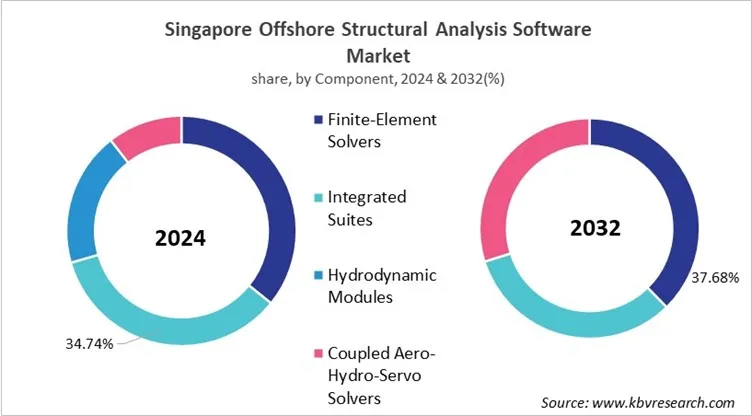
Based on Component, the market is segmented into Finite-Element Solvers, Integrated Suites, Hydrodynamic Modules, and Coupled Aero-Hydro-Servo Solvers. The Finite-Element Solvers market segment dominated the Singapore Offshore Structural Analysis Software Market by Component is expected to grow at a CAGR of 10.2 % during the forecast period thereby continuing its dominance until 2032. Also, The Hydrodynamic Modules market is anticipated to grow as a CAGR of 11.7 % during the forecast period during (2025 - 2032).
Free Valuable Insights: The Global Offshore Structural Analysis Software Market is Predict to reach USD 1.55 Billion by 2032, at a CAGR of 8.6%
Based on End-use Industry, the market is segmented into Oil and Gas, Offshore Wind, Marine and Naval, and Wave and Tidal Energy. Among various China Offshore Structural Analysis Software Market by End-use Industry; The Oil and Gas market achieved a market size of USD $35.5 Million in 2024 and is expected to grow at a CAGR of 6.6 % during the forecast period. The Marine and Naval market is predicted to experience a CAGR of 8.1% throughout the forecast period from (2025 - 2032).
China is a major market for offshore structural analysis software, driven by its extensive offshore oil and gas activities, rapid offshore wind expansion, and deepwater infrastructure development. Complex environmental conditions in areas like the South China Sea and stringent national regulations necessitate advanced simulation tools for design validation, fatigue analysis, and predictive maintenance. Government emphasis on energy security and renewables boosts software adoption, particularly for digital twins and coupled aero-hydro-servo simulations. Market trends include integration of high-performance computing, AI analytics, and cloud-based collaboration. Both global and domestic vendors compete by offering validated, regulation-compliant solutions tailored to local needs. Strategic partnerships with state-owned firms and research institutions strengthen market presence amid China’s dual push for oil continuity and renewable growth.

By Deployment Model
By Structure Type
By Component
By End-use Industry
By Country
Our team of dedicated experts can provide you with attractive expansion opportunities for your business.








 Unique Offerings