The Asia Pacific Multi-access Edge Computing Market would witness market growth of 47.3% CAGR during the forecast period (2025-2032).
The China market dominated the Asia Pacific Multi-access Edge Computing Market by Country in 2024, and would continue to be a dominant market till 2032; thereby, achieving a market value of $9,232.4 million by 2032. The Japan market is registering a CAGR of 46.1% during (2025 - 2032). Additionally, The India market would showcase a CAGR of 48.5% during (2025 - 2032). The China and Japan led the Asia Pacific Multi-access Edge Computing Market by Country with a market share of 34.9% and 15.2% in 2024. The Malaysia market is expected to witness a CAGR of 50.8% during throughout the forecast period.
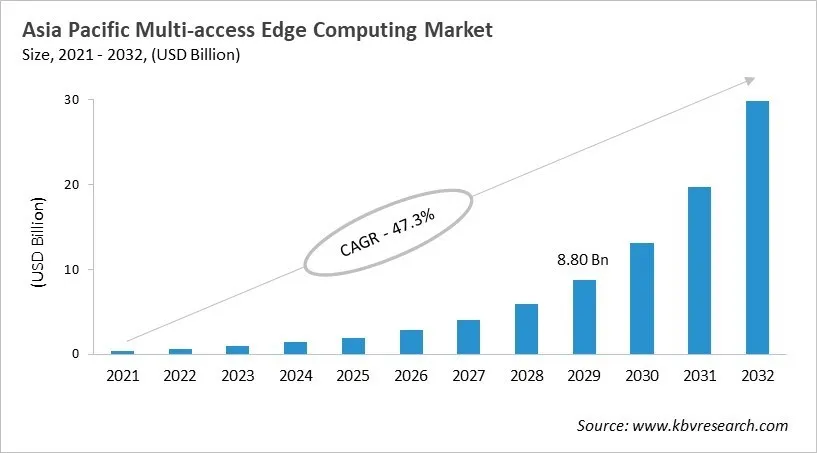
The Multi-Access Edge Computing (MEC) landscape in the Asia Pacific has grown quickly along with the widespread rollout of 5G networks, thanks to strong government policies, partnerships between telecom and cloud companies, and ongoing standardization in the industry. China, India, and South Korea see MEC as important digital infrastructure and encourage the use of micro-data centers, private 5G networks, and edge nodes through incentives and government support. Telecom companies, cloud providers, and original equipment manufacturers (OEMs) like Huawei and HPE are all working together to create platforms that combine telecom network functions with cloud-native compute. This will make it possible for ultra-low-latency applications like industrial IoT, cloud gaming, smart transport, and real-time analytics. ETSI's changing MEC architecture and GSMA's regional programs that promote interoperability and multi-operator edge frameworks are helping to move things forward.
Three big trends are driving market momentum even more: deep 5G–MEC integration for enterprise edge services, the growth of distributed edge data centers, and fast innovation through MEC APIs that let developers access network capabilities. Operators in APAC are turning MEC into managed services, and ecosystem partnerships in OpenLabs speed up the development of industry-specific solutions for manufacturing, cities, and consumer applications. In a fragmented but fast-growing market, global OEMs, regional telcos, private network builders, and system integrators are all trying to get their share of the value. MEC is becoming a key part of APAC's digital transformation in business, cities, and consumer areas as enterprise pilots grow and orchestration platforms get better.
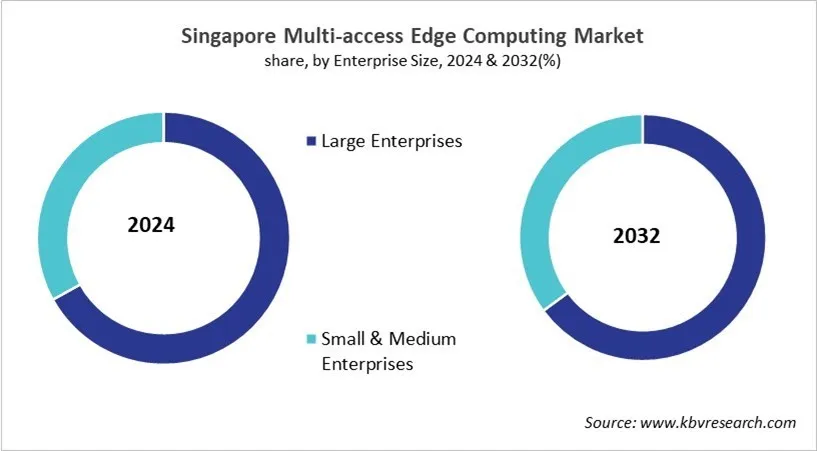
Based on Enterprise Size, the market is segmented into Large Enterprises and Small & Medium Enterprises. With a compound annual growth rate (CAGR) of 48.8% over the projection period, the Large Enterprises Market, dominate the Singapore Multi-access Edge Computing Market by Enterprise Size in 2024 and would be a prominent market until 2032. The Small & Medium Enterprises market is expected to witness a CAGR of 50.4% during (2025 - 2032).
Based on Solution Type, the market is segmented into Hardware, Software and Services. The Hardware market segment dominated the China Multi-access Edge Computing Market by Solution Type is expected to grow at a CAGR of 44.2 % during the forecast period thereby continuing its dominance until 2032. Also, The Services market is anticipated to grow as a CAGR of 46.8 % during the forecast period during (2025 - 2032).
Free Valuable Insights: The Multi-access Edge Computing Market is Predicted to reach USD 104.46 Billion by 2032, at a CAGR of 46.6%
China's Multi-access Edge Computing (MEC) market has grown thanks to the faster rollout of 5G and the government's focus on smart cities, digital infrastructure, intelligent manufacturing, and self-driving cars. Strong government support, large 5G networks from national telecom companies, and a well-developed domestic hardware ecosystem have all made it easier for many industries to adopt MEC. Some important trends are the use of private 5G networks in industrial areas, the integration of IoT in factories for real-time decision-making, and the growth of cloud-native platforms that let edge applications grow. The growing need for AI-driven automation in logistics, utilities, and manufacturing makes the move toward localized processing even stronger. There is a lot of competition, and major operators and domestic OEMs stand out by using edge platforms, private network solutions, and end-to-end orchestration tools. This makes partnerships and ecosystem capabilities very important for being the best in the market.

By Enterprise Size
By Solution Type
By Network Type
By End-Use
By Country
Our team of dedicated experts can provide you with attractive expansion opportunities for your business.



 Unique Offerings