The Asia Pacific MicroLED Interconnect Market would witness market growth of 19.2% CAGR during the forecast period (2025-2032)
The China market dominated the Asia Pacific MicroLED Interconnect Market by Country in 2024 and would continue to be a dominant market till 2032; thereby, achieving a market value of $50.7 Million by 2032. The Japan market is registering a CAGR of 18.5% during (2025 - 2032). Additionally, The India market would showcase a CAGR of 20.4% during (2025 - 2032).
The Asia Pacific region is a world leader of the MicroLED interconnect technology, due to robust manufacturing infrastructure, high consumer demand, and publicly funded R&D. Nations like Japan, South Korea, China, Singapore, and Taiwan play important role across domains like end-to-end chain, from making panels to designing interconnects to putting the whole system together. Asia Pacific is the leader in both innovation and mass production when it comes to consumer electronics, AR/VR, and automotive displays. Fan-out wafer-level packaging (FOWLP), through-silicon vias (TSVs), and the use of high-speed protocols like HDMI 2.1, MIPI D-PHY, and DisplayPort 2.1 are all becoming more popular. At the same time, Japan and South Korea are looking into optical interconnects for immersive systems.
Prominent players like LG, Samsung, BOE, AUO, and Sony, in alliance with semiconductor giants such as ASE, TSMC, and JCET, are modernizing customize, high- performance interconnects. The region is rising up mass manufacturing, promoting home grown packaging, and making strategic worldwide collaboration. Some of the projects are building 2.5D and 3D packaging facilities, using AI to improve alignment, and making low-dielectric materials to reduce signal loss.
Free Valuable Insights: The Global MicroLED Interconnect Market is Predict to reach USD 555.7 Million by 2032, at a CAGR of 18.4%
MicroLED interconnect market in China is rising swiftly due to strong support from government, proficiency in manufacturing of display, and increasing homegrown semiconductors production. Furthermore, national and provincial programs are facilitating interconnect bonding, epitaxy, and mass transfer which will support the rising of cars, consumer electronics and AI systems. As per the State Council of the Peoples Republic of China, from January to September 2024, China's auto production totalled about 21.47 million units, up 1.9% year on year. Auto sales stood at 21.57 million units, an increase of 2.4% from the same period last year. This steady growth shows that there is strong demand for cars in the US and that companies are still investing in making new cars and improving existing ones, especially electric and smart cars. The growth path isn't just for traditional combustion engine vehicles; it also includes next-generation automotive technologies like self-driving cars and display systems inside cars.
Japan’s proficiency in the precision engineering, its robust display production, and rich past of manufacturing semiconductor are some reasons behind the growth of the country’s MicroLED interconnect market. Furthermore, the growth of the market in Japan is closely tied to the strength of the semiconductor equipment market in Japan. MicroLED technology needs very precise fabrication and bonding processes. As per the Invest Tiwan, Japan exports most of the semiconductor equipment it manufactures. In 2022 alone, Japan had US$8.35 billion in domestic demand for equipment, accounting for 7.8% of the globally. Japan is strategically important because it is not only a major supplier of advanced semiconductor tools around the world, but it also has a growing demand for cutting-edge fabrication technologies within its own borders. More money is being put into semiconductor infrastructure and equipment in the US, which is a sign of a bigger push toward making more advanced electronics, such as new display technologies.
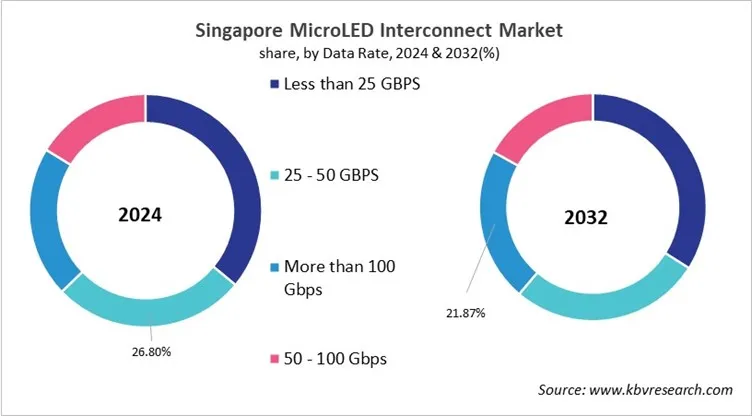
Based on Product Type, the market is segmented into Chip-to-Chip, GPU-to-GPU, and GPU-to-Memory. Based on Data Rate, the market is segmented into Less than 25 GBPS, 25 - 50 GBPS, More than 100 Gbps, and 50 - 100 Gbps. Based on Distance, the market is segmented into Less than 1 meter, 1 - 5 meter, and More than 5 meter. Based on countries, the market is segmented into China, Japan, India, South Korea, Singapore, Malaysia, and Rest of Asia Pacific.

By Product Type
By Data Rate
By Distance
By Country
Our team of dedicated experts can provide you with attractive expansion opportunities for your business.



 Unique Offerings