The Asia Pacific Medical Imaging Informatics Market would witness market growth of 6.8% CAGR during the forecast period (2025-2032).
The China market dominated the Asia Pacific Medical Imaging Informatics Market by Country in 2024, and would continue to be a dominant market till 2032; thereby, achieving a market value of $420.3 million by 2032. The Japan market is registering a CAGR of 6.2% during (2025 - 2032). Additionally, The India market would showcase a CAGR of 7.6% during (2025 - 2032). The China and Japan led the Asia Pacific Medical Imaging Informatics Market by Country with a market share of 31.5% and 22.7% in 2024. The Malaysia market is expected to witness a CAGR of 10% during throughout the forecast period.
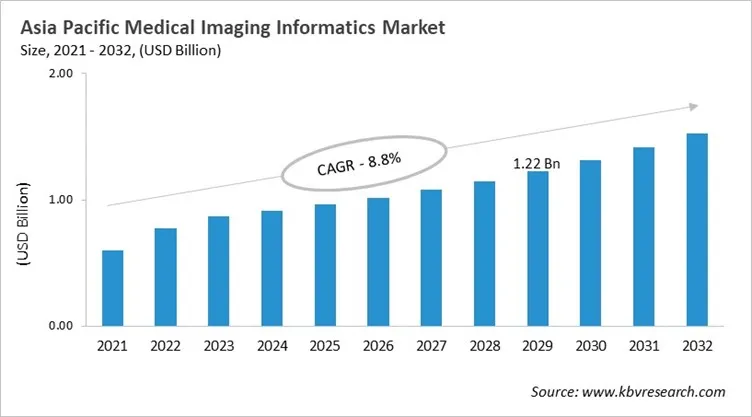
The Asia Pacific medical imaging informatics market is changing quickly as healthcare systems use digital tools to handle more imaging and make better clinical decisions. Governments and industry groups push for digital health, interoperability, and cybersecurity frameworks, which speeds up their use in hospitals and diagnostic centers. The region is very diverse, with some countries like Japan and South Korea having well-established digital health ecosystems and others like India and China having markets that are growing quickly. The COVID-19 pandemic sped up the use of telemedicine, remote diagnostics, and digital imaging even more. Imaging informatics has changed from simple storage to enterprise platforms that are connected to the cloud. These systems let people work together, share data, and get insights from AI. In general, imaging informatics has become an important part of modernizing healthcare in APAC.
The main trends in the market are the use of artificial intelligence, cloud-based deployment, and the growth of teleradiology services. AI-enabled tools help clinicians handle large imaging datasets by automatically finding problems, prioritizing workflows, and improving diagnostic accuracy. Cloud and hybrid platforms let you store a lot of data, work together with people in different locations, and make sure that different IT systems can talk to each other. Teleradiology is growing quickly, especially in rural and underserved areas, making it easier for people to get specialist help. Competition is always changing, with global and regional companies focusing on AI innovation, cloud capabilities, following the rules, and making strategic partnerships. Interoperability, workforce support, and value-driven digital healthcare outcomes are all important to the market.
Based on Component, the market is segmented into Software, Services, and Hardware. With a compound annual growth rate (CAGR) of 4.5% over the projection period, the Software Market, dominate the China Medical Imaging Informatics Market by Component in 2024 and would be a prominent market until 2032. The Hardware market is expected to witness a CAGR of 5.9% during (2025 - 2032).
Free Valuable Insights: The Medical Imaging Informatics Market is Predicted to reach USD 5.42 Billion by 2032, at a CAGR of 6.0%
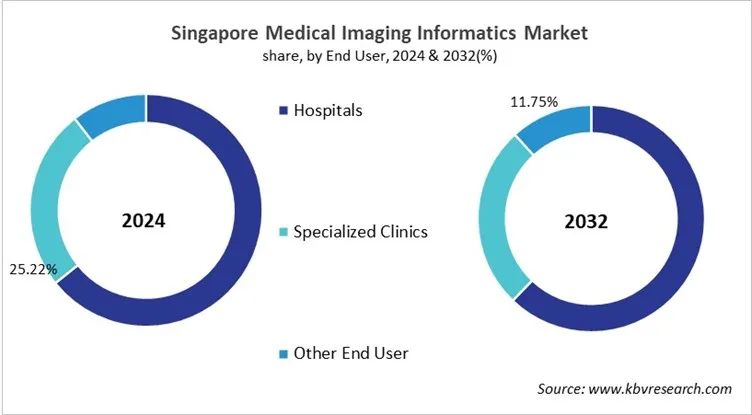
Based on End User, the market is segmented into Hospitals, Specialized Clinics, and Other End User. The Hospitals market segment dominated the Singapore Medical Imaging Informatics Market by End User is expected to grow at a CAGR of 8.6 % during the forecast period thereby continuing its dominance until 2032. Also, The Other End User market is anticipated to grow as a CAGR of 10.6 % during the forecast period during (2025 - 2032).
The medical imaging informatics market in China is growing quickly because of the large number of images being taken, the rise in chronic diseases, and the government's strong support for digitizing healthcare. More hospitals are using PACS, RIS, VNAs, and AI-enabled analytics to handle complicated diagnostic workflows. National efforts to promote data standards and the sharing of health information help the market grow, but there are still problems with regional integration. Some important trends are the faster use of AI for image analysis and the growing use of cloud-based informatics platforms. Cloud and tele-radiology solutions help specialists reach areas that don't have enough of them. There is a lot of competition between global vendors and domestic tech companies. Interoperability, AI capability, scalability, and clinical usability are all important parts of market differentiation.

By Deployment Mode
By Component
By End User
By Application
By Country
Our team of dedicated experts can provide you with attractive expansion opportunities for your business.



 Unique Offerings