The Asia Pacific Marketing Automation Market would witness market growth of 11.9% CAGR during the forecast period (2025-2032).
The China market dominated the Asia Pacific Marketing Automation Market by Country in 2024, and would continue to be a dominant market till 2032; thereby, achieving a market value of $3,751.3 million by 2032. The Japan market is registering a CAGR of 11.2% during (2025 - 2032). Additionally, The India market would showcase a CAGR of 12.7% during (2025 - 2032). The China and Japan led the Asia Pacific Marketing Automation Market by Country with a market share of 21.9% and 17.4% in 2024.The Australia market is expected to witness a CAGR of 13.2% during throughout the forecast period.
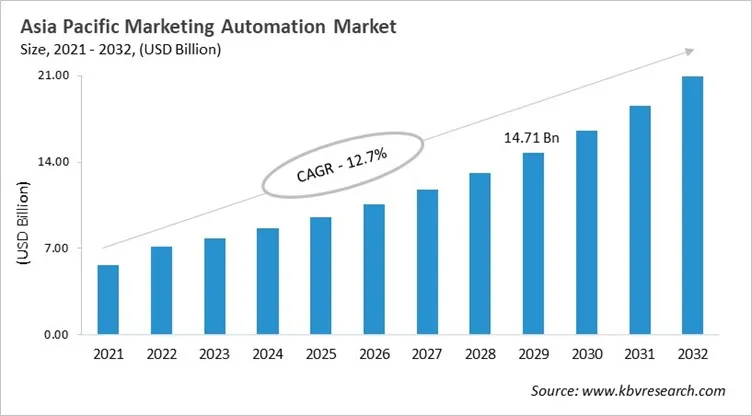
Marketing automation in Asia Pacific has come a long way in a short amount of time, going from basic email tools to complex, AI-powered, multichannel systems. This is because more people are using mobile devices and the internet, governments are working to digitize their services, and automation is making more money in industries like banking, retail, and telecom. Countries like Australia, Japan, India, and Singapore were among the first to adopt, while mobile-first markets like Southeast Asia pushed vendors to create workflows that are lightweight, fast, and easy to use on mobile devices. Cloud computing, the growing use of AI/ML for personalization and predictive analytics, and tech OEMs' integrated offerings are some of the most important factors that make this possible. The COVID-19 pandemic sped up adoption even more, especially in digital commerce and remote engagement.
There are three main trends that shape the market: omnichannel experiences that work best on mobile, hyper-personalization through AI, and stricter rules about data privacy and trust. Top vendors concentrate on modular platforms customized for local market requirements, allocate resources to AI for real-time optimization, and develop ecosystems via collaborations with local platforms, carriers, and agencies. Following changing privacy laws—through consent tools, data residency, and transparency—has become a way to stand out from the competition. Regional vendors compete by providing affordable, mobile-friendly solutions that are tailored to the local infrastructure. Global players, on the other hand, use their size, research and development, and integration skills to serve enterprise clients in many different APAC markets.
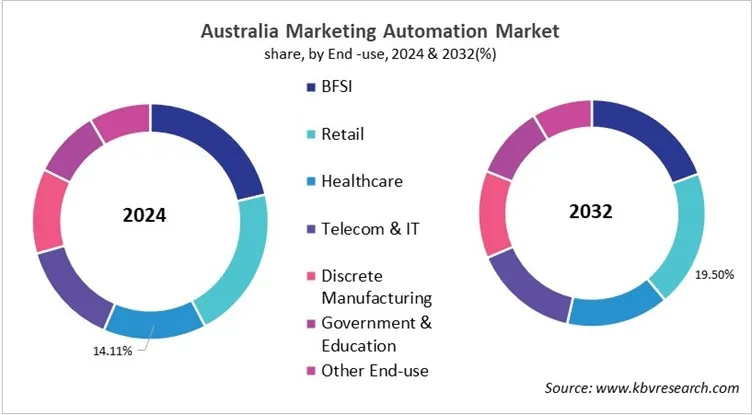
Based on End-use, the market is segmented into BFSI, Retail, Healthcare, Telecom & IT, Discrete Manufacturing, Government & Education, and Other End-use. The BFSI market segment dominated the Australia Marketing Automation Market by End-use is expected to grow at a CAGR of 11.8 % during the forecast period thereby continuing its dominance until 2032. Also, The Discrete Manufacturing market is anticipated to grow as a CAGR of 14.2 % during the forecast period during (2025 - 2032).
Free Valuable Insights: The Global Marketing Automation Market is Predict to reach USD 82.14 Billion by 2032, at a CAGR of 11.2%
Based on Enterprise Size, the market is segmented into Large Enterprises and Small & Medium Enterprises (SMEs). With a compound annual growth rate (CAGR) of 8.6% over the projection period, the Large Enterprises Market, dominate the China Marketing Automation Market by Enterprise Size in 2024 and would be a prominent market until 2032. The Small & Medium Enterprises (SMEs) market is expected to witness a CAGR of 9.8% during (2025 - 2032).
China's marketing automation market is changing quickly because of its huge digital economy, advanced e-commerce, and customers' desire for quick, personalized experiences. Companies are moving to first-party data and private traffic ecosystems like WeChat because of stricter data privacy laws (like PIPL) and the end of third-party cookies. Key factors are regulatory pressure, the dominance of super-platforms, and the need to lower CAC while increasing retention. AI-driven personalization, mobile-first messaging, and native integration with local platforms are all growing quickly. Cloud-based tools are the most popular, especially with small and medium-sized businesses that want things to be easy to use and get help close to home. There is a lot of competition between global vendors who adapt to local needs and domestic providers who have strong ties to the ecosystem. At the same time, in-house automation capabilities are becoming more important.

By Deployment
By Enterprise Size
By End-use
By Solution
By Country
Our team of dedicated experts can provide you with attractive expansion opportunities for your business.




 Unique Offerings