The Asia Pacific Manufacturing Operations Management Software Market would witness market growth of 19.2% CAGR during the forecast period (2025-2032).
The China market dominated the Asia Pacific Manufacturing Operations Management Software Market by Country in 2024, and would continue to be a dominant market till 2032; thereby, achieving a market value of $5,345.1 million by 2032. The Japan market is registering a CAGR of 18.4% during (2025 - 2032). Additionally, The India market would showcase a CAGR of 20.2% during (2025 - 2032). The China and Japan led the Asia Pacific Manufacturing Operations Management Software Market by Country with a market share of 33.9% and 18.2% in 2024. The Malaysia market is expected to witness a CAGR of 22.7% during throughout the forecast period.
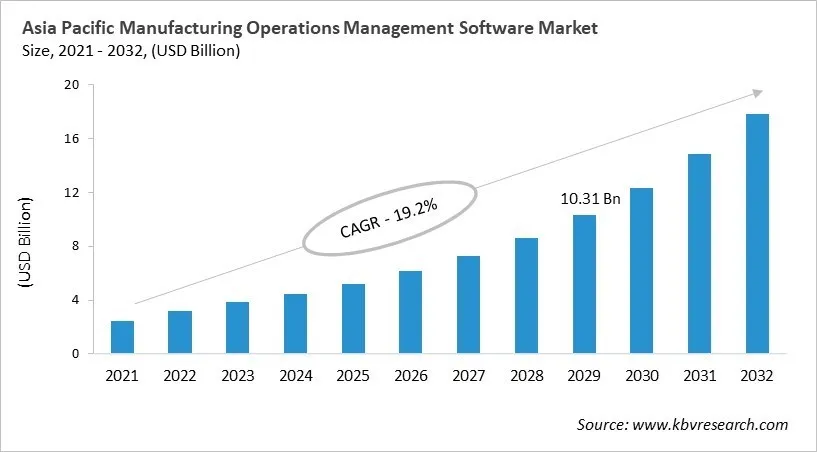
The Asia Pacific manufacturing operations-management (MOM) software market has changed a lot over the past 20 years. It has gone from simple ERP and MES systems to integrated, intelligence-driven platforms that connect the virtual enterprise and the real production floor. The region's quick shift to digital manufacturing, the use of Industry 4.0 ideas, and government programs like China's "Made in China 2025," which encourage smart manufacturing, automation, and digitalization, have all helped bring about this change. In the Asia Pacific, modern MOM solutions now include real-time execution, quality management, production scheduling, and digital-twin capabilities. These solutions are often powered by cloud, IoT, and AI technologies, which help manufacturers of all sizes achieve operational visibility, agility, and resilience in a global manufacturing environment that is both competitive and unstable.
The market is changing in important ways, such as the faster deployment of smart factories, the growth of modular and cloud-native MOM architectures that are popular with small and medium-sized businesses, and the addition of AI, analytics, and digital-twin features to make production more responsive and predictive. Leading global vendors like Siemens, Dassault Systèmes, ABB, and SAP use strategies like regional localization, ecosystem partnerships, modular product offerings, and services-led transformation to gain market share. Regional players, on the other hand, compete on cost-effectiveness, quick deployment, and flexible cloud/SaaS models. Vertical-specific tailoring, hybrid deployment options, and alignment with national digital initiatives all have an impact on the competitive landscape. This makes MOM software not just an operational tool, but also a strategic enabler of efficiency, innovation, and competitive differentiation across Asia Pacific's diverse manufacturing ecosystem.
Based on Deployment, the market is segmented into Cloud and On-Premise. The Cloud market segment dominated the China Manufacturing Operations Management Software Market by Deployment is expected to grow at a CAGR of 17.5 % during the forecast period thereby continuing its dominance until 2032. Also, The On-Premise market is anticipated to grow as a CAGR of 17 % during the forecast period during (2025 - 2032).
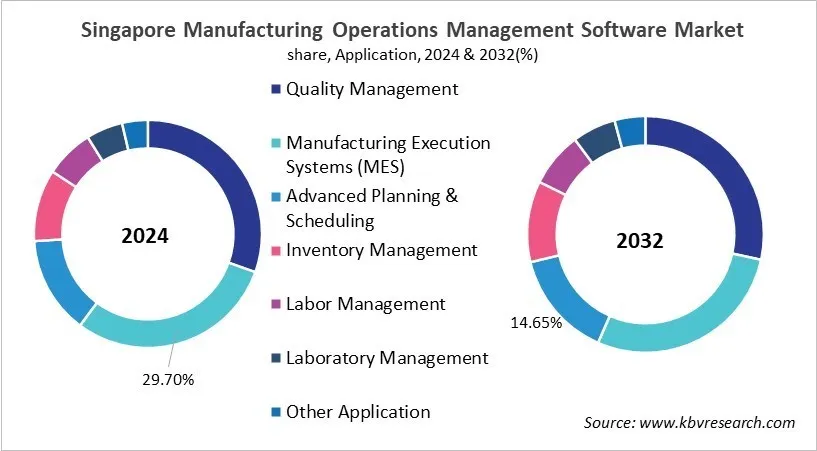
Based on Application, the market is segmented into Quality Management, Manufacturing Execution Systems (MES), Advanced Planning & Scheduling, Inventory Management, Labor Management, Laboratory Management and Other Application. With a compound annual growth rate (CAGR) of 20.4% over the projection period, the Quality Management Market, dominate the Singapore Manufacturing Operations Management Software Market by Application in 2024 and would be a prominent market until 2032. The Labor Management market is expected to witness a CAGR of 22.6% during (2025 - 2032).
Free Valuable Insights: The Manufacturing Operations Management Software Market is Predicted to reach USD 63.22 Billion by 2032, at a CAGR of 18.7%
As the Asia Pacific's top manufacturing center, China is moving away from low-cost production and toward high-value, innovation-led manufacturing. This makes Manufacturing Operations Management (MOM) software an essential part of modern factory operations. Adoption is driven by government-backed industrial digitalisation strategies, rising labor costs, global export demand, and the rapid expansion of the Industrial Internet of Things (IIoT), whereas challenges involve uneven digital maturity, legacy equipment, and a lack of skilled professionals. More and more, MOM platforms work with AI analytics, predictive maintenance, digital twins, and cloud-based solutions. This lets you see what's going on in real time on the shop floor, integrate different parts, and keep an eye on sustainability. There are global vendors targeting high-end industries, domestic companies offering localized, low-cost solutions, and system integrators offering consulting and implementation support. This shows that the ecosystem is changing quickly and is driven by innovation. This is what is driving China's shift toward intelligent, automated, and data-driven manufacturing.

By Enterprise Size
By Component
By Deployment
By Application
By End User
By Country
Our team of dedicated experts can provide you with attractive expansion opportunities for your business.



 Unique Offerings