The Asia Pacific Mainframe Modernization Market would witness market growth of 10.1% CAGR during the forecast period (2025-2032).
The China market dominated the Asia Pacific Mainframe Modernization Market by Country in 2024, and would continue to be a dominant market till 2032; thereby, achieving a market value of $844.4 million by 2032. The Japan market is registering a CAGR of 9.4% during (2025 - 2032). Additionally, The India market would showcase a CAGR of 10.8% during (2025 - 2032). The China and Japan led the Asia Pacific Mainframe Modernization Market by Country with a market share of 23.4% and 19.2% in 2024. The South Korea market is expected to witness a CAGR of 11.7% during throughout the forecast period.
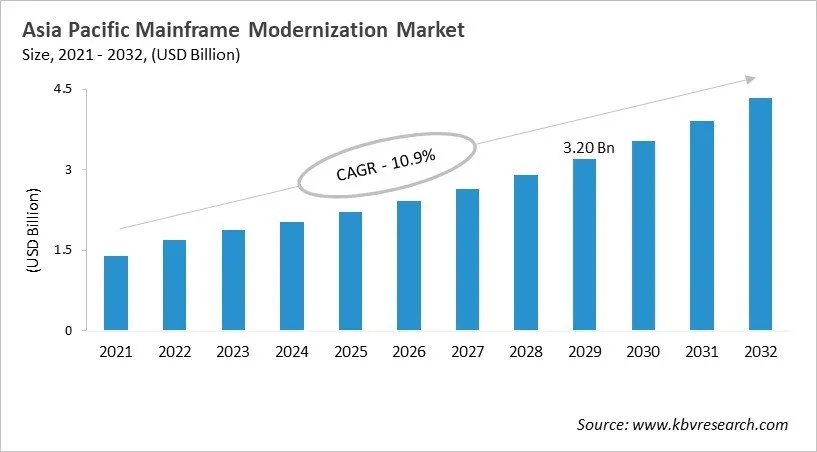
In the Asia-Pacific region, modernizing mainframes has gone from being something that needs to be done to something that helps digital transformation by connecting old systems with new, flexible, cloud-based, and analytics-driven environments. In the past, industries like banking, government, telecommunications, and manufacturing relied on IBM Z and z/OS platforms for mission-critical tasks. However, organizations have had to modernize because of rising maintenance costs, integration issues, and a shrinking talent pool. Modernization projects now focus on hybrid cloud integration, application refactoring, workload optimization, and using automation, DevOps, open-source tools, and AI-driven code transformation. This lets businesses add to the capabilities of their mainframes while keeping them reliable, secure, and fast.
In the APAC region, some important market trends are the ability for hybrid cloud and mainframe systems to work together, the use of continuous modernization pipelines, and modernization that is driven by operational risk, a lack of skilled workers, and cost pressures. The best technology companies and service providers are coming up with new ways to use hybrid-cloud technology, automation, generative AI, and outcome-focused modernization programs. They often do this in stages or with managed approaches. There are a lot of different companies that compete in the market, including established platform providers, cloud vendors, and service integrators. They all have different strengths, such as industry knowledge, local delivery, integration skills, cost-effectiveness, and the ability to deliver real business results. Modernization in the region has become an ecosystem focused on transformation, with a focus on digital agility, regulatory compliance, and business innovation instead of just replacing old systems.
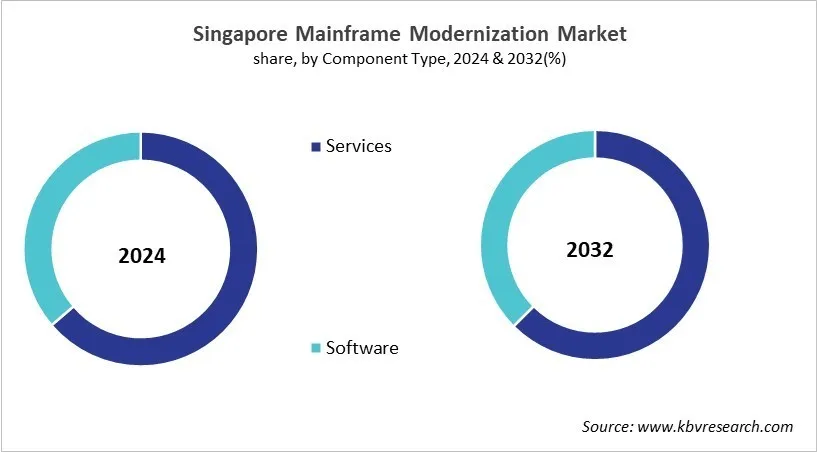
Based on Component Type, the market is segmented into Services and Software. With a compound annual growth rate (CAGR) of 11.2% over the projection period, the Services Market, dominate the Singapore Mainframe Modernization Market by Component Type in 2024 and would be a prominent market until 2032. The Software market is expected to witness a CAGR of 11.9% during (2025 - 2032).
Free Valuable Insights: The Global Mainframe Modernization Market is Predicted to reach USD 15.91 Billion by 2032, at a CAGR of 9.5%
Based on Vertical, the market is segmented into BFSI, IT & ITeS, Healthcare, Retail, Manufacturing, Media & Entertainment, Education and Other Vertical. Among various India Mainframe Modernization Market by Vertical; The BFSI market achieved a market size of USD $87.4 Million in 2024 and is expected to grow at a CAGR of 9.6 % during the forecast period. The Media & Entertainment market is predicted to experience a CAGR of 12.5% throughout the forecast period from (2025 - 2032).
In China, the legacy mainframe modernization market is driven by big state-owned companies, commercial banks, insurance companies, telecommunications companies, and public-sector infrastructures, all of which need high-throughput, mission-critical back-end systems. Some of the main things that are driving modernization efforts are rising maintenance costs, a lack of skilled legacy technologists, pressures to follow the rules, and the national focus on digital infrastructure and cybersecurity. Companies are using more and more hybrid and cloud strategies that combine old workloads with AI, analytics, and cloud-native modules. They are also using open-source, DevOps, automation, and managed services. There are both global companies like IBM and Accenture, and strong domestic service providers that can help with localization and regulatory issues. Most modernization strategies focus on changing existing systems instead of replacing them completely. This strikes a balance between reliability, security, and flexibility. Overall, the Chinese market has a lot of room to grow because it has a lot of old estates, strong drivers for modernization, and a growing ecosystem of global and local players.

By Organization Size
By Component Type
By Vertical
By Country
Our team of dedicated experts can provide you with attractive expansion opportunities for your business.



 Unique Offerings