The Asia Pacific Maca Extract Market would witness market growth of 9.2% CAGR during the forecast period (2025-2032).
The China market dominated the Asia Pacific Maca Extract Market by Country in 2024, and would continue to be a dominant market till 2032; thereby, achieving a market value of $56.8 million by 2032. The Japan market is showcasing a CAGR of 8.3% during (2025 - 2032). Additionally, The India market would register a CAGR of 10% during (2025 - 2032). The China and Japan led the Asia Pacific Maca Extract Market by Country with a market share of 37.4% and 16.4% in 2024.The Malaysia market is expected to witness a CAGR of 11.8% during throughout the forecast period.
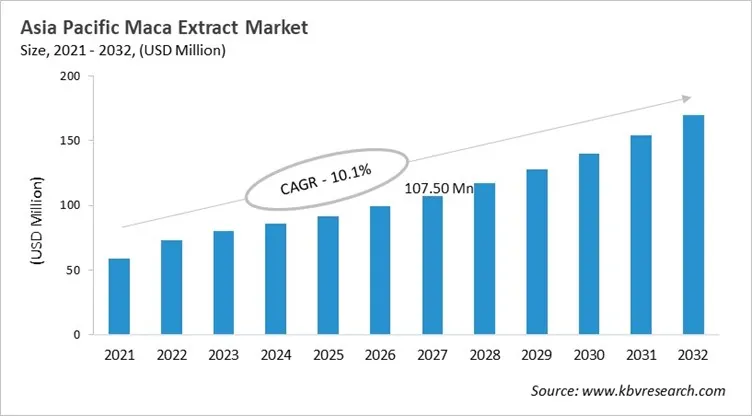
As people learned more about Andean botanicals and became more interested in natural and plant-based health solutions, the Asia Pacific maca extract market grew. Maca was able to enter the food and supplement markets because it got the green light from governments in China, Japan, Australia, and India. People were quick to accept maca as an adaptogen for energy, vitality, and hormonal balance because they were already familiar with herbal medicine. Peruvian OEM suppliers made sure that the products were of high quality and consistent. Local brands mix maca with traditional ingredients to fit the tastes of the area. Maca went from being a niche product to a common wellness ingredient thanks to the growth of health retail and e-commerce sites. By the early 2020s, maca had become a well-known ingredient in health and nutrition products across Asia Pacific.
Strong demand for functional wellness products, quick expansion into beverages, blends, and fortified foods, and a growing focus on sustainability and traceability are all important trends that are shaping the market. People like maca extracts that are clean-label, certified, and come from ethical sources. Companies respond by working with Peruvian suppliers for a long time, making sure they follow the rules, and teaching customers through clear advertising. Omnichannel retail strategies help businesses reach more customers. The Asia Pacific maca extract market is always changing and growing because of competition based on quality, innovation, certification, and real sourcing.
Based on Product Form, the market is segmented into Powder, Capsules, Liquid Extracts, Tinctures, and Functional Foods. The Powder market segment dominated the China Maca Extract Market by Product Form is expected to grow at a CAGR of 7 % during the forecast period thereby continuing its dominance until 2032. Also, The Tinctures market is anticipated to grow as a CAGR of 9 % during the forecast period during (2025 - 2032).
Free Valuable Insights: The Maca Extract Market is Predicted to reach USD 572.62 Million by 2032, at a CAGR of 8.4%
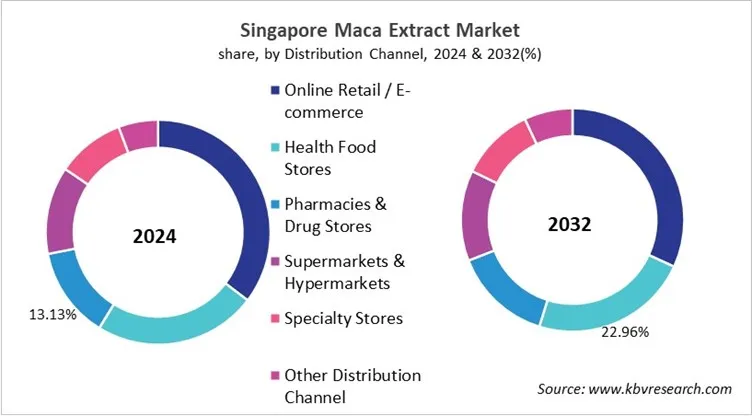
Based on Distribution Channel, the market is segmented into Online Retail / E-commerce, Health Food Stores, Pharmacies & Drug Stores, Supermarkets & Hypermarkets, Specialty Stores, and Other Distribution Channel. With a compound annual growth rate (CAGR) of 9.7% over the projection period, the Online Retail / E-commerce Market, dominate the Singapore Maca Extract Market by Distribution Channel in 2024 and would be a prominent market until 2032. The Specialty Stores market is expected to witness a CAGR of 12.5% during (2025 - 2032).
Based on End-User Demographics, the market is segmented into Health-Conscious Consumers, Athletes & Fitness Enthusiasts, General Consumers, Older Adults, and Vegetarians & Vegans. Among various South Korea Maca Extract Market by End-User Demographics; The Health-Conscious Consumers market achieved a market size of USD $2.6 Million in 2024 and is expected to grow at a CAGR of 10.3 % during the forecast period. The Vegetarians & Vegans market is predicted to experience a CAGR of 12.5% throughout the forecast period from (2025 - 2032).
China is the biggest and most important market for maca extract in the Asia Pacific region. This is because there is a lot of demand for herbal, vitality-boosting, and functional nutrition products. Maca is a popular health supplement for energy, reproductive health, and hormonal balance. This is because more people are interested in plant-based health. High e-commerce penetration, rising disposable incomes, and acceptance of imported botanicals, especially Peruvian maca, are some of the most important factors driving growth. The NMPA's regulatory oversight strengthens standards for quality and labeling. Market trends show that more people are using capsules, drinks, and nutritional mixes, with a preference for premium and gelatinized versions. Influencer marketing and online platforms are very important for sales. There is still a lot of competition between brands in the US and around the world, which leads to new ideas and growth in the market.

By Product Form
By Application
By Ingredient Type
By End-User Demographics
By Distribution Channel
By Country
Our team of dedicated experts can provide you with attractive expansion opportunities for your business.




 Unique Offerings