The Asia Pacific Learning Management System Market would witness market growth of 20.5% CAGR during the forecast period (2025-2032).
The China market dominated the Asia Pacific Learning Management System Market by Country in 2024, and would continue to be a dominant market till 2032; thereby, achieving a market value of $8,291.1 million by 2032. The Japan market is showcasing a CAGR of 19.5% during (2025 - 2032). Additionally, The India market would register a CAGR of 21.2% during (2025 - 2032). The China and India led the Asia Pacific Learning Management System Market by Country with a market share of 28.9% and 17% in 2024.The Singapore market is expected to witness a CAGR of 22.1% during throughout the forecast period.
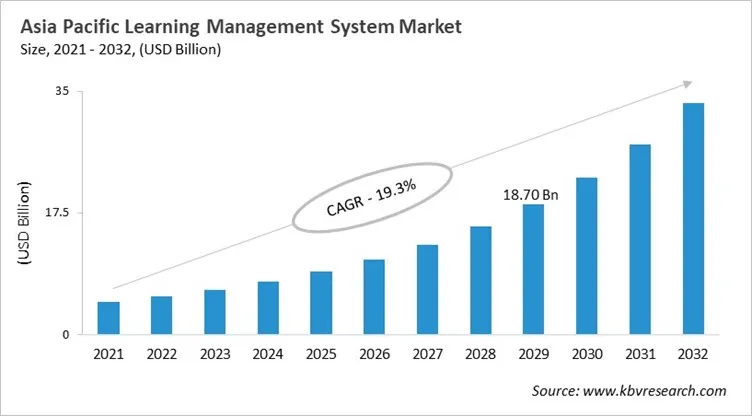
The Asia Pacific LMS market has grown quickly because of strong government-led digital education programs, more people being able to access the internet, and the widespread use of cloud computing. National e-learning missions and regional policy support helped schools and businesses start using LMS early on. The rise in mobile phone use made digital learning available to everyone, especially in developing countries. Companies wanted more digital skills and a more competitive workforce, which led to more demand from businesses. Cloud providers around the world supported deployments that could grow and work in many languages on different types of infrastructure. The COVID-19 pandemic sped up the widespread use of LMS platforms, which are now necessary. Hybrid learning models are still growing in the region today.
Digital learning ecosystems on a national level, LMS platforms that work best on mobile devices and in the cloud, and AI-driven personalized learning are all popular right now. Increasingly, governments use LMS systems to run programs for digital literacy, vocational training, and public education. Mobile learning is very important for reaching people who live in remote or rural areas. More industries are using skills-based and competency-based training. Vendors focus on platforms that can grow, work with other systems, and follow government rules. Pricing, localization, cloud capabilities, and partnerships all affect competition, which is always changing.
Based on End-use, the market is segmented into Higher Education, K-12, IT & Telecommunication, Government & Defense, Banking, Financial Services, and Insurance (BFSI), Manufacturing, Healthcare, Retail and Other End-uses. Among various Japan Learning Management System Market by End-use; The Higher Education market achieved a market size of USD $281 Million in 2024 and is expected to grow at a CAGR of 17.1 % during the forecast period. The Retail market is predicted to experience a CAGR of 20.8% throughout the forecast period from (2025 - 2032).
Free Valuable Insights: The Learning Management System Market is Predicted to reach USD 108.30 Billion by 2032, at a CAGR of 19.9%
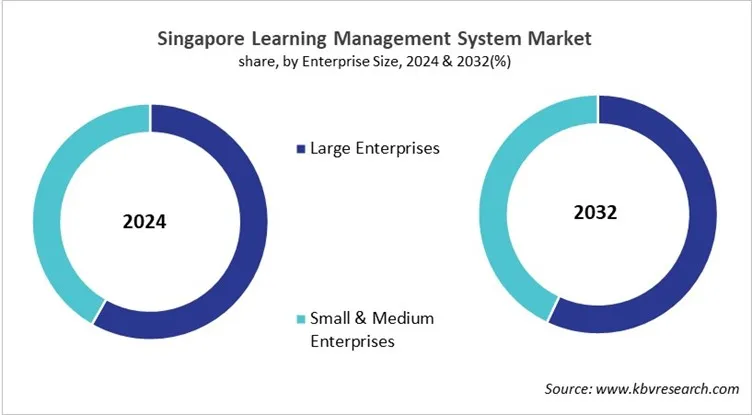
Based on Enterprise Size, the market is segmented into Large Enterprises and Small & Medium Enterprises. The Large Enterprises market segment dominated the Singapore Learning Management System Market by Enterprise Size is expected to grow at a CAGR of 21.7 % during the forecast period thereby continuing its dominance until 2032. Also, The Small & Medium Enterprises market is anticipated to grow as a CAGR of 22.5 % during the forecast period during (2025 - 2032).
China's use of LMS has grown quickly thanks to strong government support, a nationwide digital infrastructure, and a growing need for online education. Long-standing networks in education make it possible for universities and regions to offer remote learning on a large scale. Smart education programs, along with more people using the internet and mobile phones, are making it more popular. The market is mostly made up of cloud-based and mobile-first LMS platforms. More people are using advanced technologies like AI, analytics, and immersive learning. Competition is good for domestic platforms because they are more localized and follow the same rules. Even though there are problems with infrastructure and digital literacy, long-term market growth is still possible thanks to ongoing policy support.

By Component
By Deployment
By Enterprise Size
By Delivery Mode
By End-use
By Country
Our team of dedicated experts can provide you with attractive expansion opportunities for your business.







 Unique Offerings