The Asia Pacific IT Security Market would witness market growth of 13.4% CAGR during the forecast period (2025-2032).
The China market dominated the Asia Pacific IT Security Market by Country in 2024, and would continue to be a dominant market till 2032; thereby, achieving a market value of $49,852.2 million by 2032. The Japan market is registering a CAGR of 12.6% during (2025 - 2032). Additionally, The India market would showcase a CAGR of 14.1% during (2025 - 2032). The China and Japan led the Asia Pacific IT Security Market by Country with a market share of 28.9% and 18.9% in 2024. The Malaysia market is expected to witness a CAGR of 15.6% during throughout the forecast period.
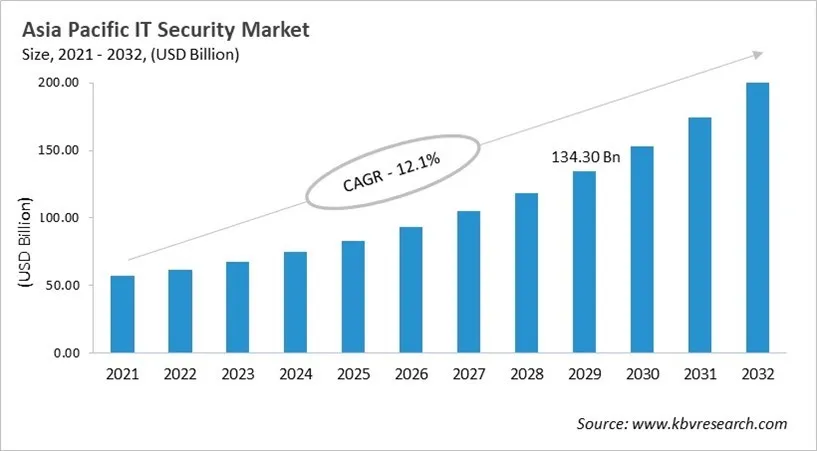
The APAC IT security market has quickly changed from simple perimeter-based tools to complex, multi-layered cyber defense architectures. This is because of the rise of cloud computing, the Internet of Things (IoT), digital payments, and more advanced threats. Cybersecurity has become a top priority for governments in this area. They have put in place cyber strategies, data protection laws, critical infrastructure mandates, and sovereign security requirements. The rise in APT attacks, ransomware, supply-chain vulnerabilities, and identity-based intrusions, along with this regulatory momentum, has sped up the need for zero-trust frameworks, AI-driven detection, cloud-workload protection, and OT/industrial-security capabilities. The region is very different, with mature economies like Japan, Singapore, and Australia, and markets in Southeast and South Asia that are quickly going digital. This makes for a wide range of threat profiles, compliance expectations, and levels of technology adoption.
In response, security vendors and service providers are focusing on strategies that include localization, platform integration, and ecosystem partnerships. Global OEMs are adapting their solutions to the different rules and regulations in APAC and setting up regional SOCs and partnerships with telcos and system integrators. At the same time, regional players are using language localization and cost-effective models to enter new markets. Managed detection and response, consulting, and co-managed security models are becoming more popular because there aren't enough skilled workers, and operations are getting more complicated. In addition, security companies are working with governments, schools, and businesses to improve cyber-skills and provide solutions that are specific to the manufacturing, telecom, smart-cities, and critical infrastructure sectors. This is creating a competitive, fast-growing, and innovation-driven cybersecurity landscape.
Based on Enterprise Size, the market is segmented into Large Enterprises, and SMEs. The Large Enterprises market segment dominated the China IT Security Market by Enterprise Size is expected to grow at a CAGR of 10.9 % during the forecast period thereby continuing its dominance until 2032. Also, The SMEs market is anticipated to grow as a CAGR of 11.9 % during the forecast period during (2025 - 2032).
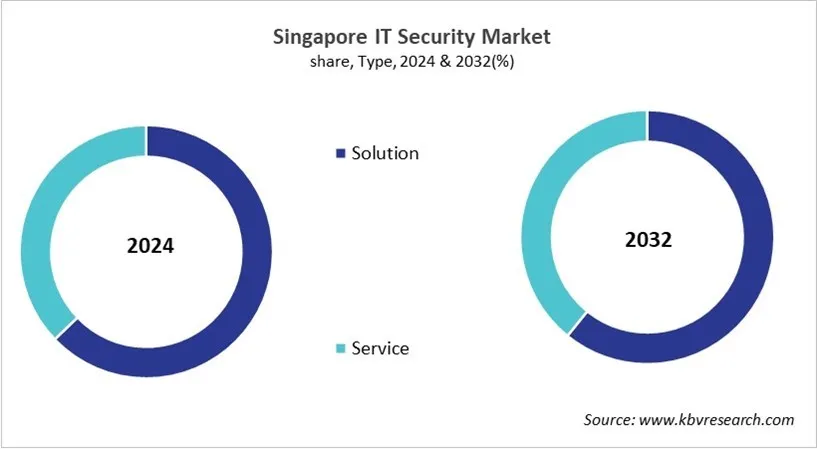
Based on Type, the market is segmented into Solution, and Service. With a compound annual growth rate (CAGR) of 14.4% over the projection period, the Solution Market, dominate the Singapore IT Security Market by Type in 2024 and would be a prominent market until 2032. The Service market is expected to witness a CAGR of 15.6% during (2025 - 2032).
Free Valuable Insights: The IT Security Market is Predicted to reach USD 734.02 Billion by 2032, at a CAGR of 12.5%
China's IT security market is growing quickly because of strong government priorities, the country's digitalization, and rules that closely link cybersecurity to national security. The Cybersecurity Law, Data Security Law, and PIPL, which are enforced by CAC and MIIT, require data localization, strict compliance, and security controls that are in line with the risks under MLPS 2.0. Cloud computing, AI, and the Internet of Things (IoT) have made the attack surface bigger, which has led to big investments in threat intelligence, SOCs, and homegrown encryption. Domestic companies like Qi-Anxin and Venustech are in charge of most government and critical sector projects. Global companies, on the other hand, mostly work with multinational clients because of data sovereignty rules. China's market is moving toward AI-driven analytics, zero-trust models, and secure 5G integration. This makes cybersecurity a key part of the country's digital strategy and sovereignty.

By Enterprise Size
By Type
By Security
By Vertical
By Country
Our team of dedicated experts can provide you with attractive expansion opportunities for your business.



 Unique Offerings