The Asia Pacific Industrial Automation Services Market would witness market growth of 10.5% CAGR during the forecast period (2025-2032).
The China market dominated the Asia Pacific Industrial Automation Services Market by Country in 2024, and would continue to be a dominant market till 2032; thereby, achieving a market value of $48,030.3 million by 2032. The Japan market is registering a CAGR of 9.7% during (2025 - 2032). Additionally, The India market would showcase a CAGR of 11.4% during (2025 - 2032). The China and Japan led the Asia Pacific Industrial Automation Services Market by Country with a market share of 35.4% and 17.2% in 2024.The Malaysia market is expected to witness a CAGR of 13.4% during throughout the forecast period.
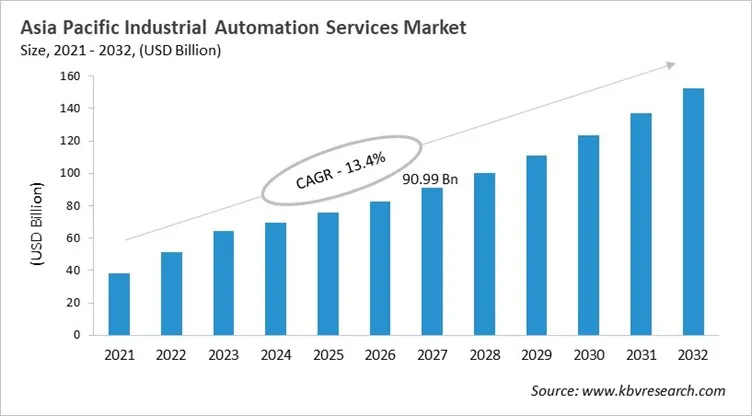
Since the 1980s, the Asia Pacific industrial automation services market has changed quickly. This is because of government-led industrialization, strong manufacturing growth, and early leadership in robotics and automation, especially in Japan, South Korea, and later China. National programs like Japan's METI programs, China's Made in China 2025, and Singapore's smart manufacturing policies sped up the use of smart manufacturing in the automotive, electronics, semiconductors, and heavy industries. Over time, automation shifted from basic factory controls to integrated digital solutions supported by system integration, maintenance, training, and lifecycle services. The market has entered a phase of smart and connected manufacturing in the last few years. AI, IIoT, cloud automation, digital twins, and services that focus on sustainability have become central to modernization in the region.
Today, Asia Pacific is the world leader in adopting automation. This is thanks to AI-powered predictive maintenance, smart and connected factories, and energy-efficient automation solutions. The need for green automation and energy management services is growing quickly because of sustainability goals and carbon reduction targets. Mitsubishi Electric, Fanuc, Siemens, ABB, Yokogawa, Rockwell Automation, and Schneider Electric are all expanding their digital service offerings, opening local R&D centers, and forming partnerships to meet the needs of different regions. Localization, service-based business models, and building ecosystems are some of the most important ways to compete. The market is still very competitive, with global OEMs, strong Japanese companies, and fast-growing Chinese automation companies pushing innovation, cost competition, and service growth in many fields.
Based on Product Type, the market is segmented into DCS, SCADA, PLC and Other Product Type. The report also covers geographical segmentation of Industrial Automation Services market. With a compound annual growth rate (CAGR) of 7.5% over the projection period, the DCS Market, dominate the China Industrial Automation Services Market by Product Type in 2024 and would be a prominent market until 2032. From 2025 to 2032 The PLC market is expected to witness a CAGR of 9.5% during (2025 - 2032).
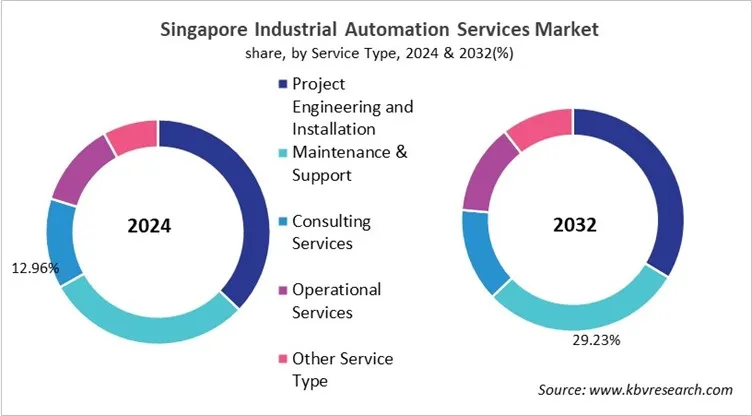
Based on Service Type, the market is segmented into Project Engineering and Installation, Maintenance & Support, Consulting Services, Operational Services and Other Service Type. Among various Singapore Industrial Automation Services Market by Service Type; The Project Engineering and Installation market achieved a market size of USD $1255.4 Million in 2024 and is expected to grow at a CAGR of 11.3 % during the forecast period. The Consulting Services market is predicted to experience a CAGR of 13.3% throughout the forecast period from (2025 - 2032).
Free Valuable Insights: The Industrial Automation Services Market is Predicted to reach USD 373.92 Billion by 2032, at a CAGR of 10.4%
China is the biggest market for industrial automation services in Asia-Pacific. This is because it has a lot of factories, focuses on exports, and the government wants to improve the country's industrial capabilities so that they can be more independent. The shift from labor-intensive production to automated, high-precision manufacturing is speeding up because of rising labor costs, sustainability mandates, and smart manufacturing policies. Automation services help businesses in a wide range of fields, including electronics, automotive, chemicals, and logistics, improve productivity, quality, and the resilience of their global supply chains. Some of the most important trends are the quick growth of robotics, industrial IoT, cloud-based factories, AI-driven predictive systems, and automation that works with 5G. Investing in smart warehouses, autonomous logistics, and integrated industrial parks is making more people want to use these services. Increasingly small and medium-sized businesses are using modular and subscription-based automation solutions. There is a lot of competition between domestic automation companies and global companies. Software intelligence, cost-effectiveness, and scalability are what set them apart.

By Service Type
By End Use
By Product Type
By Country
Our team of dedicated experts can provide you with attractive expansion opportunities for your business.



 Unique Offerings