The Asia Pacific Incident Response Services Market is expected to reach $20.46 billion by 2029 and would witness market growth of 19.2% CAGR during the forecast period (2025-2032).
The China market dominated the Asia Pacific Incident Response Services Market by Country in 2024, and would continue to be a dominant market till 2032; thereby, achieving a market value of $8,786.2 million by 2032. The Japan market is registering a CAGR of 18.3% during (2025 - 2032). Additionally, The India market would showcase a CAGR of 19.9% during (2025 - 2032). The China and Japan led the Asia Pacific Incident Response Services Market by Country with a market share of 28.9% and 17.9% in 2024. The Australia market is expected to witness a CAGR of 20.5% during throughout the forecast period.
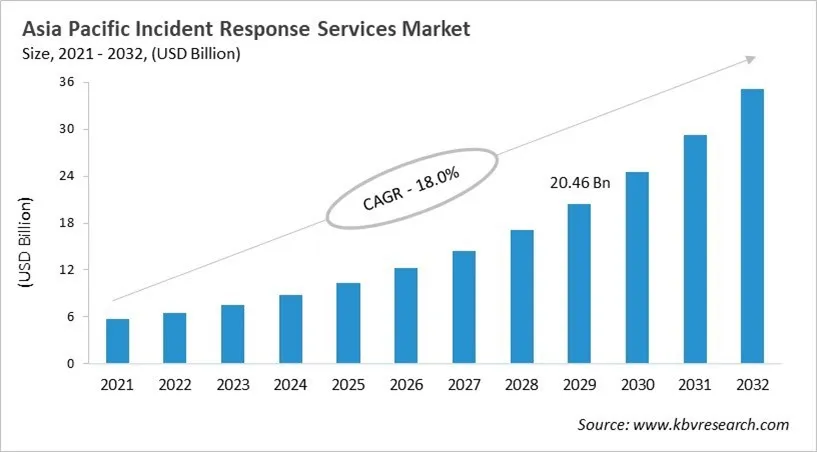
The Asia Pacific Incident Response Services Market has grown along with the region's quick shift to digital technology, more use of the cloud, and higher cyber risk exposure in both the public and private sectors. At first, most of the work was done by the government, with national cybersecurity agencies and CERTs focusing on reactive containment and recovery. Over time, more digital activity across borders, more complicated cloud services, and stricter rules led to the development of structured, collaborative, and resilient incident response frameworks. OEMs and specialized service providers expanded their formal response offerings to follow public guidance. This included dealing with ransomware, data breaches, and supply chain incidents. Incident response became a strategic necessity for business continuity and regulatory compliance.
Some important trends in the market are stronger national cybersecurity frameworks, a growing need for experts in cloud and ransomware response, and more cooperation between the public and private sectors. Service providers work closely with government agencies, hire skilled forensic and cloud security experts, and use automation and threat intelligence to make their responses more effective. The market is still competitive and fragmented, with global OEM-backed companies and regional specialists. Companies stand out from each other based on their technical depth, regulatory alignment, and presence in different regions. During large-scale incidents, providers and authorities working together show that incident response is a shared responsibility that builds trust and resilience in the Asia Pacific's digital economies.
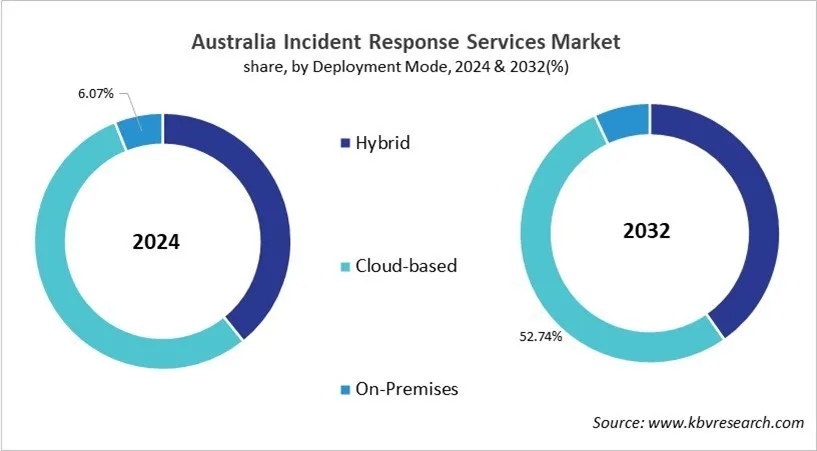
Based on Deployment Mode, the market is segmented into Hybrid, Cloud-based and On-Premises. The Hybrid market segment dominated the Australia Incident Response Services Market by Deployment Mode is expected to grow at a CAGR of 20.9 % during the forecast period thereby continuing its dominance until 2032. Also, The On-Premises market is anticipated to grow as a CAGR of 22.7 % during the forecast period during (2025 - 2032).
Based on End-User Industry, the market is segmented into BFSI, IT & Telecom, Government & Defense, Healthcare & Life Sciences, Industrial Manufacturing, Energy & Utilities, Retail & E-commerce and Other End-User Industry. Among various Japan Incident Response Services Market by End-User Industry; The BFSI market achieved a market size of USD $392.6 Million in 2024 and is expected to grow at a CAGR of 16.2 % during the forecast period. The IT & Telecom market is predicted to experience a CAGR of 17.1% throughout the forecast period from (2025 - 2032).
Free Valuable Insights: The Incident Response Services Market is Predicted to reach USD 137.12 Billion by 2032, at a CAGR of 18.5%
China has one of the most advanced and complicated incident response service environments in the Asia Pacific region. This is because of its huge digital economy, extensive network infrastructure, and strong national cybersecurity governance. National frameworks coordinate incident response from the center. CNCERT plays a key role in monitoring, reporting, and coordinating responses across sectors. At the same time, businesses are starting to see incident response as a core operational function. The need to protect critical information infrastructure and enterprise systems has grown because of fast digital transformation, widespread cloud adoption, and the growth of the industrial internet and smart infrastructure. Market trends point to centralized monitoring, automation, and real-time threat intelligence. Security operations centers are also adding more and more incident response capabilities. OEM-led cybersecurity providers that follow national rules are the most competitive, especially Huawei, whose integrated and scalable solutions strongly support China's regulatory and strategic cybersecurity goals.

By Enterprise Size
By Deployment Mode
By Service Type
By End-User Industry
By Country
Our team of dedicated experts can provide you with attractive expansion opportunities for your business.



 Unique Offerings