The Asia Pacific HMI Sensors In Wearables Market is expected to reach $1.92 billion by 2029 and would witness market growth of 14.1% CAGR during the forecast period (2025-2032).
The China market dominated the Asia Pacific HMI Sensors In Wearables Market by Country in 2024, and would continue to be a dominant market till 2032; thereby, achieving a market value of $836.6 million by 2032. The Japan market is registering a CAGR of 13.3% during (2025 - 2032). Additionally, The India market would showcase a CAGR of 14.8% during (2025 - 2032). The China and Japan led the Asia Pacific HMI Sensors In Wearables Market by Country with a market share of 32.4% and 17.4% in 2024. The Singapore market is expected to witness a CAGR of 16.2% during throughout the forecast period.
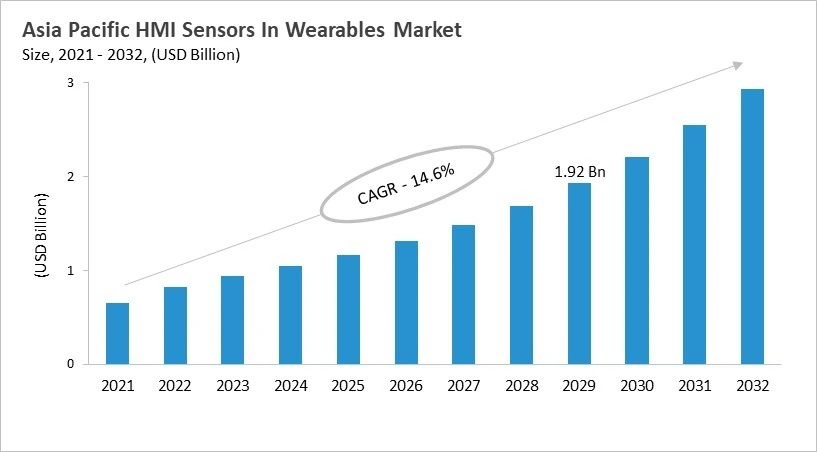
The Asia Pacific HMI sensors in wearables market has advanced rapidly, driven by strong electronics manufacturing, supportive digital health policies, and high smartphone adoption. Early devices focused on basic fitness tracking, but technological progress enabled the integration of advanced sensors such as SpO₂, ECG, temperature, and bio-impedance systems. National initiatives like Japan’s healthcare digitalization and China’s “Healthy China 2030” accelerated innovation and adoption. Taiwan’s semiconductor leadership further strengthened the market through low-power, miniaturized chip solutions. Post-COVID, governments emphasized remote monitoring and digital healthcare, positioning wearables as tools for continuous and preventive care. The market now reflects a convergence of semiconductor innovation, AI analytics, and connected healthcare ecosystems.
Key trends shaping the region include sensor miniaturization, AI-enabled analytics, and expansion of digital health applications. OEMs focus on integrating multiple sensing functions into compact modules while improving battery life and comfort. AI is increasingly used to convert sensor data into personalized and predictive health insights, supported by national smart technology programs. Leading companies pursue strategies such as ecosystem integration, partnerships with government health initiatives, and heavy semiconductor R&D investment. Competition is innovation-driven, emphasizing sensor accuracy, interoperability, and regulatory alignment. Overall, Asia Pacific is evolving toward highly integrated, intelligent, and healthcare-oriented wearable HMI sensor ecosystems.
Based on Sensor Type, the market is segmented into Touch Sensors, Motion Sensors, Biometric Sensors, Voice & Audio Sensors, and Other Sensor Type. The Touch Sensors market segment dominated the China HMI Sensors In Wearables Market by Sensor Type is expected to grow at a CAGR of 11.1 % during the forecast period thereby continuing its dominance until 2032. Also, The Voice & Audio Sensors market is anticipated to grow as a CAGR of 13.4 % during the forecast period during (2025 - 2032).
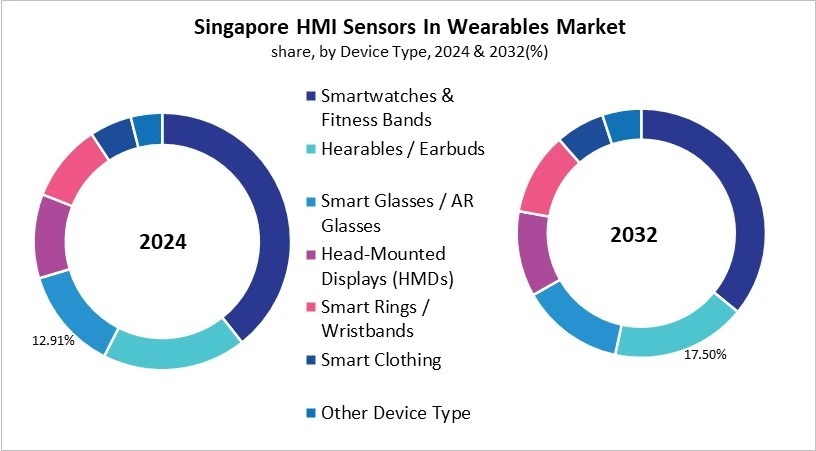
Based on Device Type, the market is segmented into Smartwatches & Fitness Bands, Hearables / Earbuds, Smart Glasses / AR Glasses, Head-Mounted Displays (HMDs), Smart Rings / Wristbands, Smart Clothing, and Other Device Type. Among various Singapore HMI Sensors In Wearables Market by Device Type; The Smartwatches & Fitness Bands market achieved a market size of USD $21.3 Million in 2024 and is expected to grow at a CAGR of 14.8 % during the forecast period. The Smart Clothing market is predicted to experience a CAGR of 19% throughout the forecast period from (2025 - 2032).
Free Valuable Insights: HMI Sensors In Wearables Market is Predicted to reach USD 9.16 billion by 2032, at a CAGR of 13.6%
China has one of the biggest and most connected markets for HMI sensors in wearables in Asia Pacific. This is because it has a strong electronics manufacturing base and a huge number of consumers. Optical heart-rate sensors, motion sensors, SpO₂ sensors, and touch interfaces are common in wearables. The NMPA regulates medical-grade devices. The Healthy China 2030 Plan and other national programs that promote digital health and preventive care also indirectly help sensor-based wearables. The need for health and fitness tracking is growing because more people are getting chronic diseases and the population is getting older. Advanced semiconductor and MEMS manufacturing, along with widespread 5G infrastructure, makes it easier to connect to real-time data. Market trends indicate the convergence of consumer electronics and healthcare via multi-sensor integration and AI-driven analytics. Vertical integration by domestic OEMs makes it possible for quick innovation and low prices. Huawei and Xiaomi are the leaders in the competition. They stand out from each other based on how accurate their sensors are, how long their batteries last, and how well their products work with other devices.

By Sensor Type
By Application
By End Use
By Device Type
By Country
Our team of dedicated experts can provide you with attractive expansion opportunities for your business.



 Unique Offerings