The Asia Pacific High Performance Computing Market is expected to reach $24.88 billion by 2032 and would witness market growth of 7.4% CAGR during the forecast period (2025-2032).
The China market dominated the Asia Pacific High Performance Computing Market by Country in 2024, and would continue to be a dominant market till 2032; thereby, achieving a market value of $7,596.9 million by 2032. The Japan market is registering a CAGR of 6.7% during (2025 - 2032). Additionally, The India market is expected to witness a CAGR of 8.1% during (2025 - 2032). The China and Japan led the Asia Pacific High Performance Computing Market by Country with a market share of 34.5% and 17.9% in 2024.The Singapore market is expected to witness a CAGR of 9.1% during throughout the forecast period.
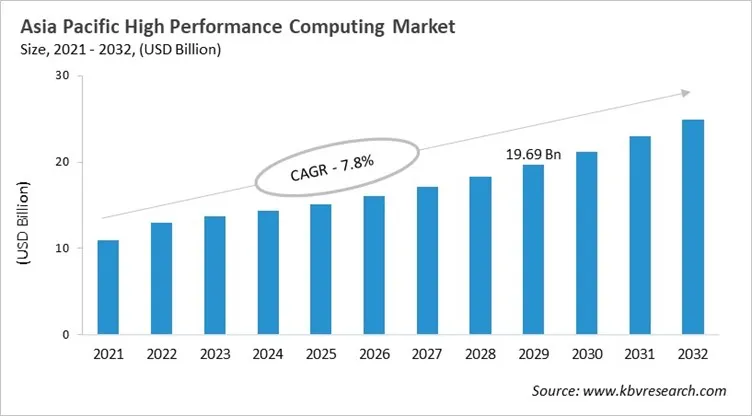
High Performance Computing (HPC) is now a key digital skill across the Asia Pacific region that helps with scientific research, industrial innovation, and national development goals. Government-led programs in countries like Japan, China, Australia, and South Korea helped the early growth. National laboratories and universities were quick to adopt them. The switch to clustered, commercially based systems made HPC more widely used in both business and academia. As digital economies grew, industries like manufacturing, energy, electronics, and pharmaceuticals were adopted faster. Today, the area has a wide range of national supercomputers, enterprise systems, and cloud-based HPC platforms.
Recent changes in the Asia Pacific HPC market include strong government leadership, more use of AI, and quick adoption of hybrid and cloud-based models. Both simulation and AI workloads can run on GPU-accelerated and heterogeneous architectures. Co-design strategies make sure that systems meet the needs of research and industry in each area. Standardized programming models and open software ecosystems make it easier for different systems to work together. Energy efficiency and sustainability are very important. Performance, integration with accelerators, and alignment with national supercomputing initiatives drive competition.
Based on Component, the market is segmented into Servers, Storage, Software, Services, Cloud, Networking Devices and Other Component. The Servers market segment dominated the Japan High Performance Computing Market by Component is expected to grow at a CAGR of 5.9 % during the forecast period thereby continuing its dominance until 2032. Also, The Cloud market is anticipated to grow as a CAGR of 7.7 % during the forecast period during (2025 - 2032).
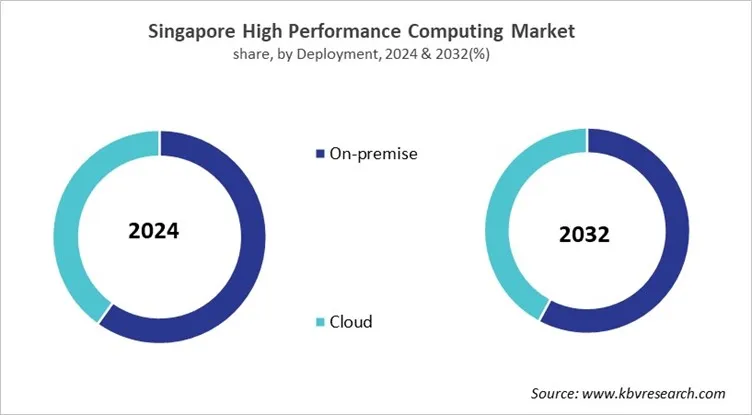
Based on Deployment, the market is segmented into On-premise and Cloud. With a compound annual growth rate (CAGR) of 8.6% over the projection period, the On-premise Market, dominate the Singapore High Performance Computing Market by Deployment in 2024 and would be a prominent market until 2032. The Cloud market is expected to witness a CAGR of 9.7% during (2025 - 2032).
Free Valuable Insights: The High Performance Computing Market is Predicted to reach USD 94.91 Billion by 2032, at a CAGR of 6.9%
China has built a strategically driven HPC ecosystem that makes supercomputing a national infrastructure that supports priorities like advanced manufacturing, artificial intelligence, aerospace, climate modeling, and defense research. Strong government support and coordination make it possible for universities, national laboratories, and state-backed industrial clusters to use the technology widely. One of the main goals is to become more self-sufficient in technology by using indigenous processors, interconnects, and software instead of relying on foreign ones. HPC is being used more in AI training, data analysis, and digitalization of industry. Heterogeneous architectures that mix CPUs, GPUs, and special accelerators are becoming the norm. Energy efficiency, scalability, and the convergence of cloud and high-performance computing are important design trends. Most of the competition in the market is between companies in the same country, thanks to close cooperation between local OEMs and government research institutions.

By Component
By Deployment
By End Use
By Country
Our team of dedicated experts can provide you with attractive expansion opportunities for your business.






 Unique Offerings