The Asia Pacific Generative AI in Software Development Lifecycle Market would witness market growth of 35.1% CAGR during the forecast period (2025-2032).
The China market dominated the Asia Pacific Generative AI in Software Development Lifecycle Market by Country in 2024, thereby, achieving a market value of USD 358.8 million by 2032. The Japan market is registering a CAGR of 34% during (2025 - 2032). Additionally, The India market would showcase a CAGR of 35.8% during (2025 - 2032). The China and Japan led the Asia Pacific Generative AI in Software Development Lifecycle Market by Country with a market share of 27.4% and 15.2% in 2024.
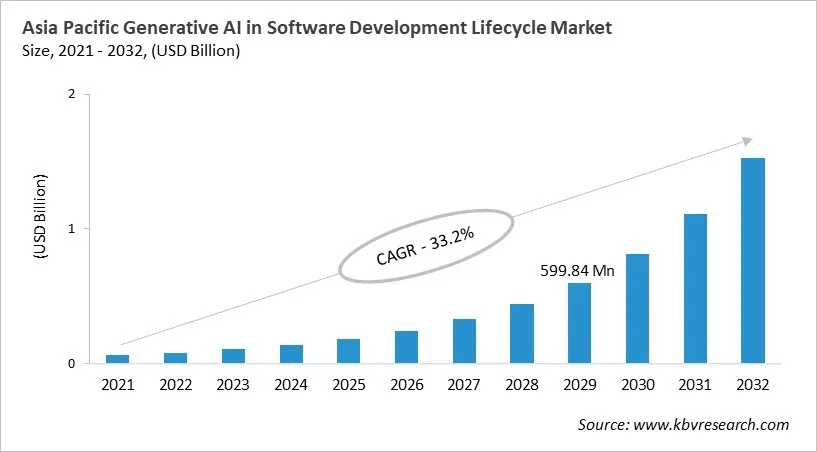
Since 2023, the Asia Pacific (APAC) Generative AI in the Software Development Lifecycle (SDLC) market has moved from exploratory pilots to regulated, scalable adoption. This is because of government policies and national programs. India's IndiaAI Mission, Japan's AI Guidelines for Businesses, Singapore's National AI Strategy 2.0, South Korea's AI Basic Act, and China's Interim Measures have all made it clear how AI-assisted development should work, with a focus on data residency, auditability, and operational compliance. These rules help businesses use coding copilots, automated testing, and AI-driven code review in safe and responsible ways. Microsoft/GitHub, Google, AWS, and Chinese companies have all changed their services to meet residency, latency, and governance needs.
Some important trends in the market are "sovereign-by-design" SDLC, the move from autocomplete to agentic workflows, and national-scale programmatic initiatives. Vendors offer multi-file editing, automated pull requests, and built-in testing, all while making sure that everything is logged, traceable, and follows local rules. Outside of China, Microsoft, Google, and AWS are the leaders with platforms that allow residency and governance tools. Inside China, Alibaba, Tencent, Baidu, and Huawei are the leaders with offerings that comply with sovereignty. End users, like software engineers, DevOps, and SecOps teams, get more done, have better workflows, and can keep an eye on security. Competition is based on operational fit, compliance readiness, and agentic throughput.
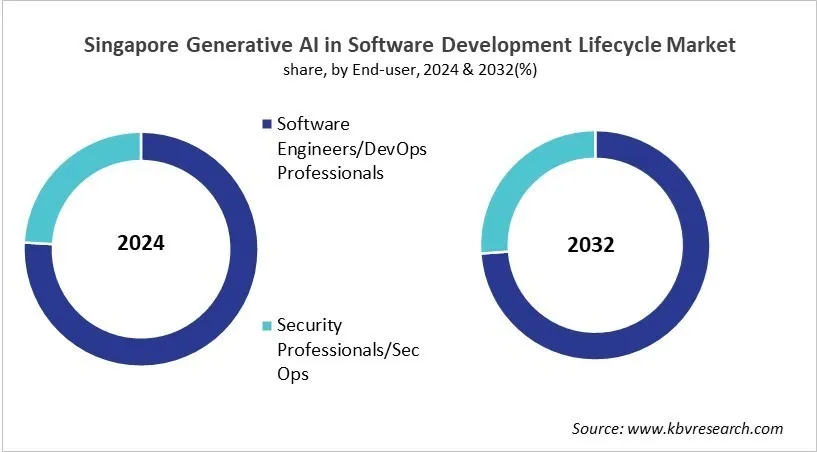
Based on End-user, the market is segmented into Software Engineers/DevOps Professionals, and Security Professionals/SecOps. With a compound annual growth rate (CAGR) of 36.7% over the projection period, the Software Engineers/DevOps Professionals Market, dominate the Singapore Generative AI in Software Development Lifecycle Market by End-user in 2024 and would be a prominent market until 2032. The Security Professionals/SecOps market is expected to witness a CAGR of 38.6% during (2025 - 2032).
Free Valuable Insights: The Global Generative AI in Software Development Lifecycle Market is Predict to reach USD 5.26 Billion by 2032, at a CAGR of 34.2%
Strong domestic OEMs and strict rules, like the 2023 Interim Measures for Generative AI, which require compliance, content safety, and provider filings, are what drive China's generative AI in the SDLC. Enterprise adoption focuses on private cloud or VPC deployments that can be audited. Local code assistants like Alibaba Cloud Lingma, Tencent CodeBuddy, Baidu Comate, and Huawei CodeArts make it possible to do agentic workflows, edit multiple files, generate unit tests, and securely integrate CI. Some important factors are sovereign deployment, the ability to control content, and compliance with Chinese-language standards. These tools help big state-linked companies use SDLC practices that are efficient and can be checked.

By End-user
By Application
By Country
Our team of dedicated experts can provide you with attractive expansion opportunities for your business.



 Unique Offerings