The Asia Pacific Emission Monitoring Systems Market would witness market growth of 10.7% CAGR during the forecast period (2025-2032).
The China market dominated the Asia Pacific Emission Monitoring Systems Market by Country in 2024, and would continue to be a dominant market till 2032; thereby, achieving a market value of $670.4 million by 2032. The Japan market is registering a CAGR of 9.9% during (2025 - 2032). Additionally, The India market would showcase a CAGR of 11.4% during (2025 - 2032). The China and Japan led the Asia Pacific Emission Monitoring Systems Market by Country with a market share of 31.5% and 16.7% in 2024. The Malaysia market is expected to witness a CAGR of 13.1% during throughout the forecast period.
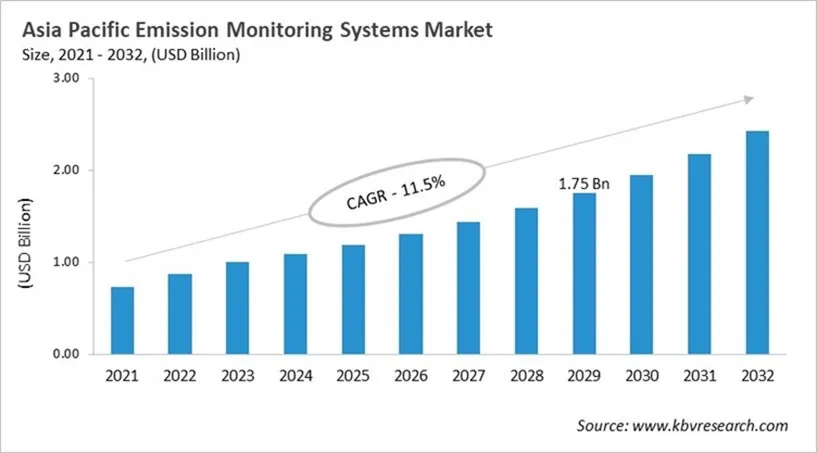
Due to faster industrialization, urban growth, and stricter environmental rules in major economies like China, India, Japan, and South Korea, the Asia Pacific Emission Monitoring Systems (EMS) market has grown quickly. Authorities like China's Ministry of Ecology and Environment, India's CPCB, and Japan's Ministry of the Environment have made it easier for CEMS and PEMS to be used in power generation, cement, metals, petrochemicals, and waste management. These frameworks stress the importance of real-time emissions reporting, high measurement accuracy, and strict compliance. This makes EMS an important part of managing air quality, keeping an eye on greenhouse gases, and following the rules.
Digital transformation and sustainability-driven strategies are changing the market at the same time. OEMs like Siemens Energy and ABB are working on predictive monitoring, IoT-enabled analyzers, and cloud-based reporting platforms to make things more accurate, lower costs over time, and help with automated compliance. More and more, EMS data is being used in ESG reporting, planning for decarbonization, and corporate governance systems, especially in Japan and South Korea. As industries look for reliable, future-ready solutions to meet environmental, operational, and climate goals, the competitive landscape favors providers with strong regulatory alignment, digital innovation, strong service networks, and regional partnerships.
Based on Type, the market is segmented into Continuous Emission Monitoring System (CEMS), and Predictive Emission Monitoring System (PEMS). The Continuous Emission Monitoring System (CEMS) market segment dominated the South Korea Emission Monitoring Systems Market by Type is expected to grow at a CAGR of 12.3 % during the forecast period thereby continuing its dominance until 2032. Also, The Predictive Emission Monitoring System (PEMS) market is anticipated to grow as a CAGR of 14.9 % during the forecast period during (2025 - 2032).
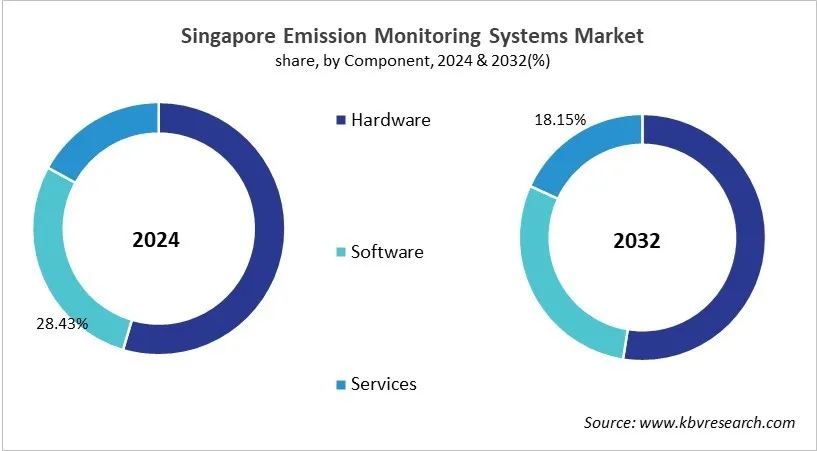
Based on Component, the market is segmented into Hardware, Software, and Services. With a compound annual growth rate (CAGR) of 12.2% over the projection period, the Hardware Market, dominate the Singapore Emission Monitoring Systems Market by Component in 2024 and would be a prominent market until 2032. The Services market is expected to witness a CAGR of 13.7% during (2025 - 2032).
Free Valuable Insights: The Emission Monitoring Systems Market is Predicted to reach USD 7.87 Billion by 2032, at a CAGR of 10.0%
China had the largest share of the Asia Pacific emission monitoring systems market. This was due to the country's rapid industrialization, large urban populations, and strict air quality rules enforced by the Ministry of Ecology and Environment. Strong and lasting demand came from the requirement that all power, metals, chemicals, and manufacturing sectors use continuous emission monitoring systems. The Blue Sky Protection Campaign and Five-Year Pollution Control Plans are two examples of national efforts that made stricter emission limits, real-time reporting, and clearer rules. The market moved toward monitoring solutions that were digital, cloud-based, and AI-enabled, which fit with smart manufacturing and a wider range of energy sources. There was a lot of competition between domestic and global providers over how accurate their technology was, how well their systems worked together, and how well they followed the rules.

By Type
By Component
By End Use
By Country
Our team of dedicated experts can provide you with attractive expansion opportunities for your business.



 Unique Offerings