The Asia Pacific Electric Rice Cooker Market would witness market growth of 9.8% CAGR during the forecast period (2025-2032). In the year 2023, the Asia Pacific market's volume surged to 11,536.4 Thousand Units, showcasing a growth of 13.5% (2021-2024).
Induction rice cookers employ induction-heating technology, enabling more precise temperature control, faster heat-up time and generally more consistent cooking results compared to simpler heating methods. They cater to users for whom rice cooking is less of a basic daily chore and more of a refined culinary activity—a desire for better texture, better flavour and premium finish. Thus, the Induction segment in China market consumed 396.3 Thousand Units in 2024.
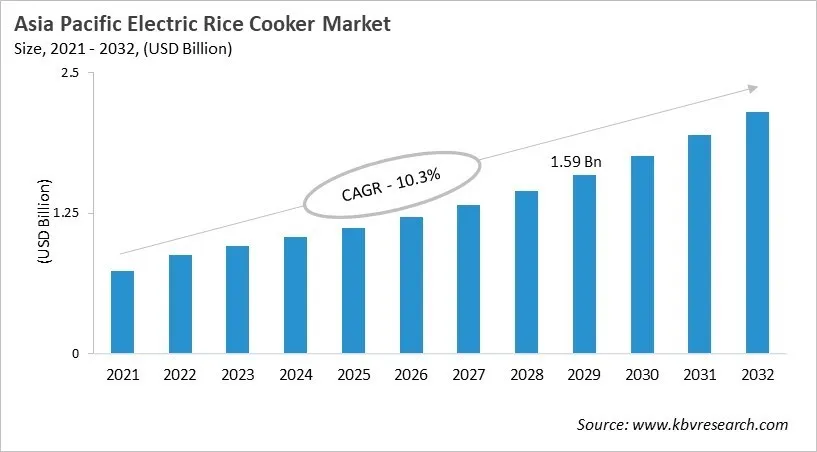
The China market dominated the Asia Pacific Electric Rice Cooker Market by Country in 2024, and would continue to be a dominant market till 2032; thereby, achieving a market value of $654.6 Million by 2032. The Japan market is registering a CAGR of 9.2% during (2025 - 2032). Additionally, The India market would showcase a CAGR of 10.7% during (2025 - 2032). The China and Japan led the Asia Pacific Electric Rice Cooker Market by Country with a market share of 34.3% and 21.1% in 2024. The Singapore market is expected to witness a CAGR of 11.7% during throughout the forecast period.
The evolution of the electric rice cooker in the Asia-Pacific region reflects a convergence of cultural significance, technological innovation, and socio-economic transformation. Originating with Toshiba’s 1955 automatic rice cooker, the appliance transitioned from a novelty to an essential household item as urbanisation, rising incomes, and changing lifestyles reshaped daily cooking practices. Manufacturers such as Panasonic, Tiger, and Zojirushi advanced the technology through features like induction heating, non-stick pots, and smart controls, while regional production expanded to meet diverse preferences across Japan, China, India, and Southeast Asia.
Today, the Asia-Pacific rice cooker market is highly competitive and segmented, driven by trends such as multifunctionality, localisation, and digital integration. Premium brands focus on technology-led differentiation and design aesthetics, while local manufacturers cater to mass markets through cost-efficient, high-capacity models. Companies increasingly emphasise e-commerce channels, brand storytelling, and user experience to align with evolving consumer expectations for convenience, versatility, and modern living. Thus, the market stands as a blend of cultural heritage and technological sophistication, mirroring the region’s broader economic and social progression.
Based on Application, the market is segmented into Household and Commercial. The Household market segment dominated the China Electric Rice Cooker Market by Application is expected to grow at a CAGR of 7.9 % during the forecast period thereby continuing its dominance until 2032. Also, The Commercial market is anticipated to grow as a CAGR of 8.9 % during the forecast period during (2025 - 2032).
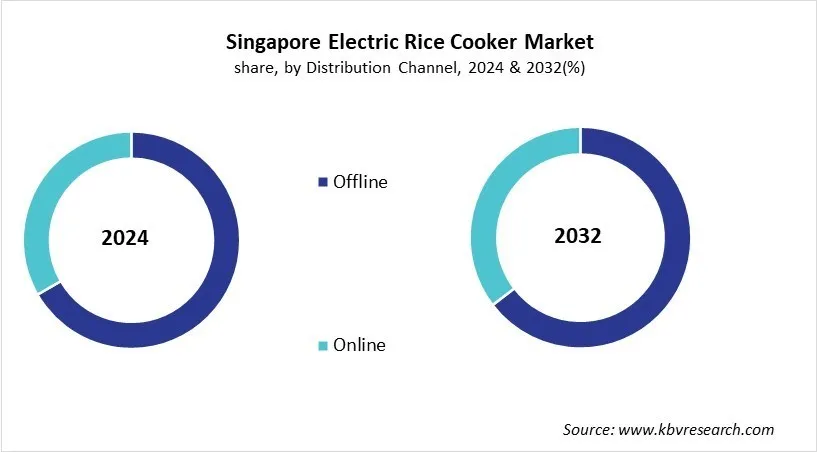
Based on Distribution Channel, the market is segmented into Offline and Online. With a compound annual growth rate (CAGR) of 11.3% over the projection period, the Offline Market, dominate the Singapore Electric Rice Cooker Market by Distribution Channel in 2024 and would be a prominent market until 2032. The Online market is expected to witness a CAGR of 12.6% during (2025 - 2032).
Free Valuable Insights: The Electric Rice Cooker Market is Predicted to reach USD 4.07 Billion by 2032, at a CAGR of 9.7%
In China, the electric rice cooker market is deeply rooted in the cultural and dietary centrality of rice, making it a staple appliance across urban and rural households. Market growth is driven by urbanization, smaller households, dual-income families seeking convenience, rising disposable incomes, and expanding e-commerce and modern retail channels. Consumers are increasingly shifting from basic to multifunctional and smart rice cookers, featuring steaming, multi-grain settings, timers, and connectivity, with a focus on energy efficiency and premium designs for urban homes. The competitive landscape is shaped by both local brands that know what customers want and how much they can afford, and international brands that offer high-end models. Differentiation is based on features, looks, and service networks. While traditional cooking practices and long replacement cycles remain constraints in some regions, innovation and rapid adaptation are key to capturing growth in this mature yet evolving market.

By Application (Volume, Thousand Units, USD Billion, 2021-2032)
By Distribution Channel (Volume, Thousand Units, USD Billion, 2021-2032)
By Product (Volume, Thousand Units, USD Billion, 2021-2032)
By Country (Volume, Thousand Units, USD Billion, 2021-2032)
Our team of dedicated experts can provide you with attractive expansion opportunities for your business.





 Unique Offerings