The Asia Pacific Digital Thread Market would witness market growth of 20.7% CAGR during the forecast period (2025-2032).
The China market dominated the Asia Pacific Digital Thread Market by Country in 2024, and would continue to be a dominant market till 2032; thereby, achieving a market value of $4,106.6 million by 2032. The Japan market is showcasing a CAGR of 19.9% during (2025 - 2032). Additionally, The India market would register a CAGR of 21.7% during (2025 - 2032). The China and Japan led the Asia Pacific Digital Thread Market by Country with a market share of 32.9% and 18.2% in 2024.The Singapore market is expected to witness a CAGR of 23% during throughout the forecast period.
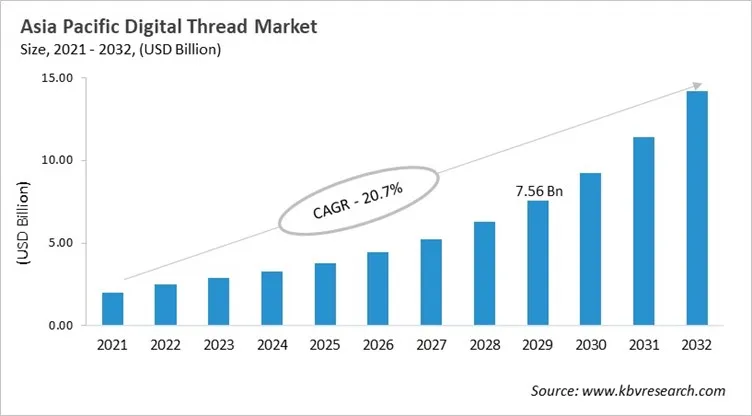
The Asia Pacific Digital Thread Market has grown quickly as the region speeds up the modernization of its industries and the connection of all stages of the manufacturing process. Japan, South Korea, Singapore, and Australia were the first to adopt it, thanks to strong government support, smart factory programs, and an industry that was ready. The market has changed over time from separate digital systems to integrated platforms that connect CAD, PLM, MES, IoT, and analytics. The growth of digital twins, multi-tier traceability, and large-scale automation has made adoption even stronger, especially in the automotive, aerospace, electronics, and heavy machinery industries. Digital thread systems are the basis for new ideas, efficient operations, and strong supply chain management in the area today.
A mix of global technology companies, regional OEMs, and industrial automation companies that offer lifecycle-connected platforms and services shapes competition in Asia Pacific. Investing in model-based engineering, digital-twin integration, open architecture, and frameworks that help suppliers work together are some of the most important strategies. Partnerships between governments and businesses still have an impact on standards, training, and the growth of digital infrastructure, which speeds up the adoption of technology by businesses. As AI-powered analytics, cloud manufacturing, and smart factory systems get better, companies that are good at interoperability, localization, cybersecurity, and working together in an ecosystem will have an edge over their competitors. The market is moving toward widespread use, making Asia Pacific a major center for digital-thread innovation.
Based on Deployment, the market is segmented into On-Premises and Cloud-Based. The On-Premises market segment dominated the China Digital Thread Market by Deployment is expected to grow at a CAGR of 18.2 % during the forecast period thereby continuing its dominance until 2032. Also, The Cloud-Based market is anticipated to grow as a CAGR of 19.4 % during the forecast period during (2025 - 2032).
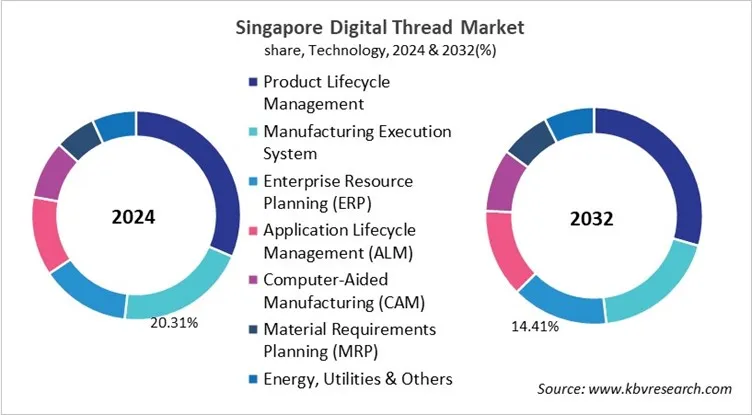
Based on Technology, the market is segmented into Product Lifecycle Management, Manufacturing Execution System, Enterprise Resource Planning (ERP), Application Lifecycle Management (ALM), Computer-Aided Manufacturing (CAM), Material Requirements Planning (MRP) and Energy, Utilities & Others. With a compound annual growth rate (CAGR) of 22% over the projection period, the Product Lifecycle Management Market, dominate the Singapore Digital Thread Market by Technology in 2024 and would be a prominent market until 2032. The Material Requirements Planning (MRP) market is expected to witness a CAGR of 25.6% during (2025 - 2032).
Free Valuable Insights: The Digital Thread Market is Predicted to reach USD 49.68 Billion by 2032, at a CAGR of 20.1%
China’s digital thread market is expanding rapidly as part of the country’s broader intelligent manufacturing and digital economy initiatives led by MIIT. Adoption is driven by the need to integrate lifecycle data across sectors such as automotive, electronics, aerospace and semiconductors, supporting innovation, global compliance and engineering efficiency. Key trends include the rise of digital twins, unified CAD-PLM-MES-IoT platforms, AI-enabled simulation and smart-factory deployment, reflecting increasing automation maturity. Competition exists between global vendors, domestic industrial-software providers and cloud platforms, with differentiation based on scalability, security, interoperability and data sovereignty. As China deepens smart-factory adoption and strengthens high-tech manufacturing, the digital thread is becoming a core enabler of operational excellence and global competitiveness.

By Deployment
By Module
By Technology
By End User
By Country
Our team of dedicated experts can provide you with attractive expansion opportunities for your business.



 Unique Offerings