The Asia Pacific Digital Map Market is expected to reach $13.50 billion by 2029 and would witness market growth of 13.9% CAGR during the forecast period (2025-2032).
The China market dominated the Asia Pacific Digital Map Market by Country in 2024, and would continue to be a dominant market till 2032; thereby, achieving a market value of $5,303.4 million by 2032. The Japan market is registering a CAGR of 13% during (2025 - 2032). Additionally, The India market would showcase a CAGR of 14.6% during (2025 - 2032). The China and Japan led the Asia Pacific Digital Map Market by Country with a market share of 29.9% and 17.1% in 2024.The Singapore market is expected to witness a CAGR of 15.4% during throughout the forecast period.
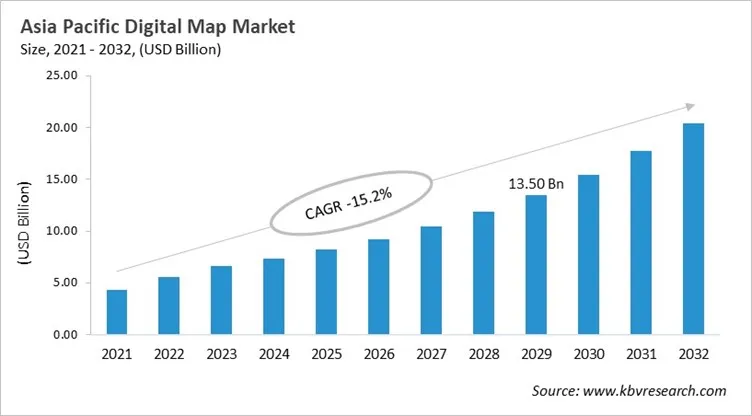
The Asia Pacific Digital Map Market has become a key part of the region's digital infrastructure thanks to long-running government cartographic programs and quick improvements in satellite imaging, GIS, and cloud-based mapping platforms. National mapping agencies moved from paper maps to digital geospatial databases. They did this with the help of regional coordination frameworks that encourage standardization, data sharing, and building capacity. Open data initiatives and national spatial data infrastructures have sped up the use of authoritative geospatial datasets for urban planning, disaster management, environmental monitoring, and economic development by governments, businesses, and developers.
The growth of businesses and new technologies have turned digital maps into real-time, dynamic location intelligence platforms. Global OEM mapping services offer scalable, API-driven solutions that enable mobility, logistics, smart cities, and e-commerce in areas with a lot of people. Digital maps are very important for building smart cities and making them more resilient to disasters. In the competition, public agencies, global platforms, standards bodies, and regional developers all work together. This cooperative ecosystem across Asia Pacific focuses on interoperability, customization, and innovation while protecting data sovereignty and public trust.
Based on End-use Industry, the market is segmented into Automotive, Public Sector & Defense, Engineering & Construction, Retail & Geomarketing, Telecommunications, and Other End-use Industry. Among various China Digital Map Market by End-use Industry; The Public Sector & Defense market achieved a market size of USD $379.4 Million in 2024 and is expected to grow at a CAGR of 10.5 % during the forecast period. The Retail & Geomarketing market is predicted to experience a CAGR of 13% throughout the forecast period from (2025 - 2032).
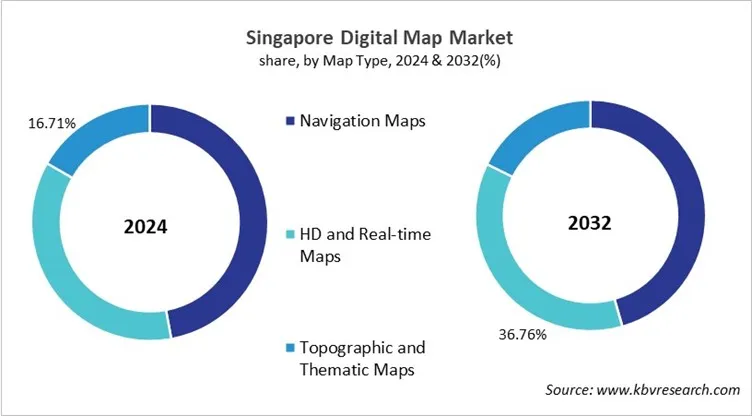
Based on Map Type, the market is segmented into Navigation Maps, HD and Real-time Maps, Topographic and Thematic Maps. The Navigation Maps market segment dominated the Singapore Digital Map Market by Map Type is expected to grow at a CAGR of 14.9 % during the forecast period thereby continuing its dominance until 2032. Also, The Topographic and Thematic Maps market is anticipated to grow as a CAGR of 16.3 % during the forecast period during (2025 - 2032).
Free Valuable Insights: The Digital Map Market is Predicted to reach USD 66.82 Billion by 2032, at a CAGR of 13.1%
China's digital map ecosystem includes both strong government-led platforms and advanced commercial mapping services. This shows that the country sees spatial data as important digital infrastructure. The national Tianditu platform offers official base maps, satellite images, and terrain data that help with governance, planning, and public services. Regulatory oversight makes geographic information a key part of digital governance and national development. Commercial mapping services built into big digital ecosystems are what make them so popular with both businesses and consumers. Market trends point to mobile integration, cloud GIS, and smart transport systems as important areas of growth. Competition works like a public-private partnership, where official base data is combined with value-added business services. China's digital map market strikes a balance between regulatory control and innovation to help smart cities and the digital transformation.

By Solution
By Map Type
By Deployment
By End-use Industry
By Country
Our team of dedicated experts can provide you with attractive expansion opportunities for your business.



 Unique Offerings