The Asia Pacific Computer Aided Manufacturing Software Market is expected to reach $1.20 billion by 2029 and would witness market growth of 10.1% CAGR during the forecast period (2025-2032).
The China market dominated the Asia Pacific Computer Aided Manufacturing Software Market by Country in 2024, and would continue to be a dominant market till 2032; thereby, achieving a market value of $472.3 million by 2032. The Japan market is registering a CAGR of 9.4% during (2025 - 2032). Additionally, The India market would showcase a CAGR of 10.8% during (2025 - 2032). The China and Japan led the Asia Pacific Computer Aided Manufacturing Software Market by Country with a market share of 32.5% and 20.2% in 2024. The Malaysia market is expected to witness a CAGR of 13.2% during throughout the forecast period.
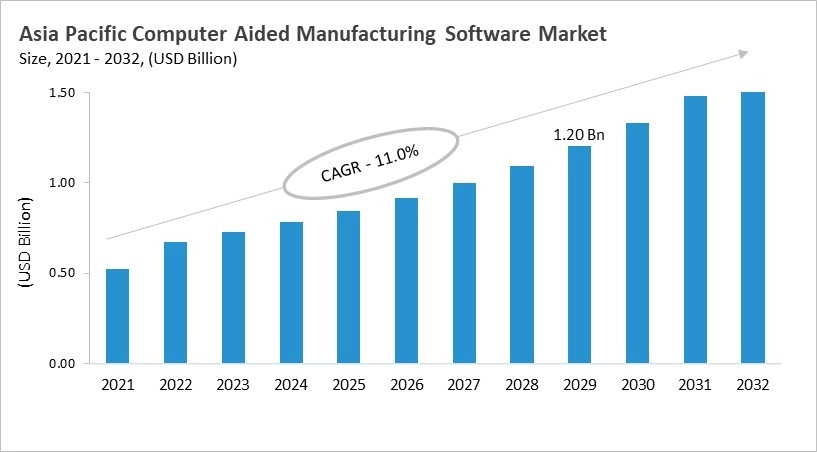
The Asia Pacific (APAC) region is a major growth driver for CAM software. This is because it is a major manufacturing hub, and smart manufacturing and Industry 4.0 initiatives are becoming more popular there. Countries like India, Malaysia, the Philippines, Vietnam, China, Korea, and Japan are putting national plans into action that focus on robotics, industrial IoT, and AI-enabled manufacturing. CAD/CAM tools are very important for digitizing the shop floor. Japan is still a leader in high-precision applications. For example, domestic companies like CAMTUS and CGS are leaders in mold, die, and multi-axis machining. In contrast, China and other emerging markets are quickly improving their industrial capabilities, often combining domestic CAM solutions with imported high-end hardware. Workforce development is also very important. Technical institutes and government programs teach CAM to make sure there are enough skilled workers for advanced manufacturing.
Vendors in APAC use strategies that combine global technology leadership with local customization. For example, Japan focuses on high-quality, precision-focused solutions, and multinational companies like Siemens, Dassault Systèmes, and HCL's CAMWorks offer localized support and training. The competitive landscape is very dynamic. Global providers compete on advanced features and integration with PLM systems, while domestic players use their cost advantages, language support, and knowledge of local machine tools to their advantage. Collaborative smart-manufacturing projects that bring together software, automation, and robotics across the electronics, automotive, and high-volume consumer-goods sectors are making the CAM market in the region even stronger. These projects are creating a strong and quickly growing ecosystem.
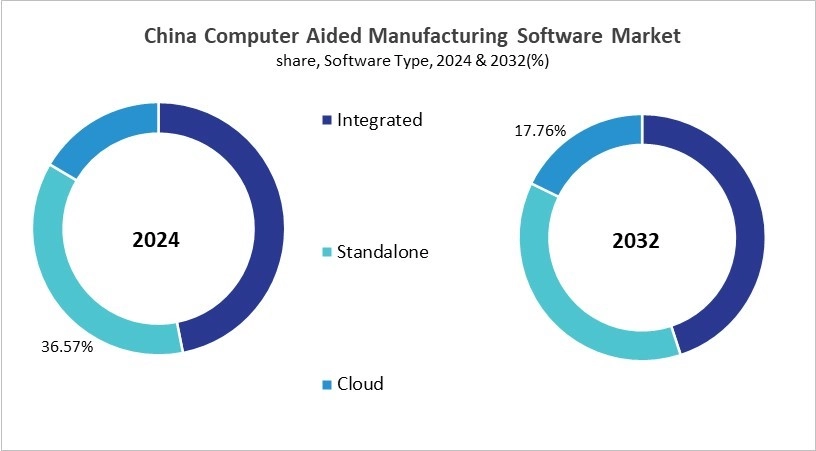
Based on Software Type, the market is segmented into Integrated, Standalone and Cloud. With a compound annual growth rate (CAGR) of 7.7% over the projection period, the Integrated Market, dominate the China Computer Aided Manufacturing Software Market by Software Type in 2024 and would be a prominent market until 2032. The Cloud market is expected to witness a CAGR of 9.3% during (2025 - 2032).
Based on End-User Industry, the market is segmented into Automotive, Aerospace & Defence, Industrial Machinery, Electronics & Semiconductor, Medical Devices and Energy and Utilities. Among various Japan Computer Aided Manufacturing Software Market by End-User Industry; The Automotive market achieved a market size of USD $42.9 Million in 2024 and is expected to grow at a CAGR of 8.4 % during the forecast period. The Energy and Utilities market is predicted to experience a CAGR of 9.9% throughout the forecast period from (2025 - 2032).
Free Valuable Insights: Computer Aided Manufacturing Software Market is Predicted to reach USD 5.49 billion by 2032, at a CAGR of 9.3%
China's CAM software market is driven by its large and varied manufacturing base in industries like automotive, electronics, aerospace, machine tools, heavy industry, and consumer goods. This creates a strong need for solutions that can make things with high precision and in large quantities. The "Made in China 2025" and "smart-manufacturing roadmaps" from the government focus on AI-enabled automation, digital twins, and precision machining. These strategies depend on CAM to work. Key factors include big investments in modern machine-tool fleets, the growth of domestic OEMs, and government incentives for factories that use digital technology. Market trends show that 3-axis and 5-axis CAM, integrated CAD/CAM/PLM platforms, AI-assisted toolpath optimization, and real-time machine data feedback are all becoming more popular. There is a lot of competition between global vendors and new local software companies that offer low-cost, CNC-integrated solutions. Cloud-based platforms and subscription models are becoming more popular. In the next few years, CAM is likely to change into smart, fully integrated digital-twin ecosystems that can support flexible, automated, and mass-customized production lines.

By Deployment Mode
By Software Type
By Manufacturing Process
By End-User Industry
By Country
Our team of dedicated experts can provide you with attractive expansion opportunities for your business.



 Unique Offerings