The Asia Pacific Computer Aided Engineering Market would witness market growth of 10.4% CAGR during the forecast period (2025-2032).
The China market dominated the Asia Pacific Computer Aided Engineering (CAE) Market by Country in 2024, and would continue to be a dominant market till 2032; thereby, achieving a market value of $2,208.8 million by 2032. The Japan market is showcasing a CAGR of 9.8% during (2025 - 2032). Additionally, The India market would exhibit a CAGR of 11.3% during (2025 - 2032). The China and Japan led the Asia Pacific Computer Aided Engineering (CAE) Market by Country with a market share of 35.9% and 21.2% in 2024.The Singapore market is expected to witness a CAGR of 12.6% during throughout the forecast period.
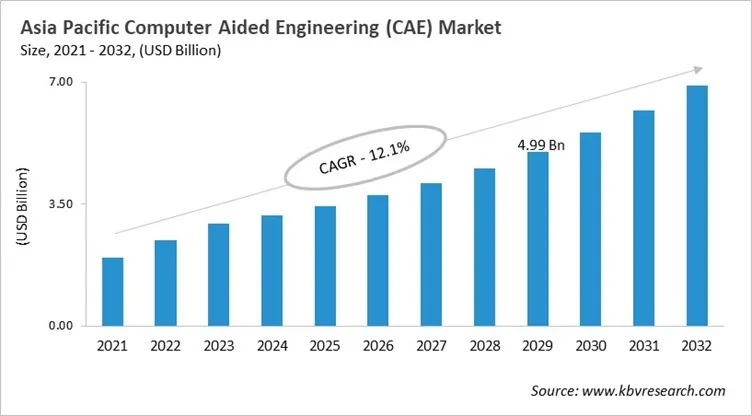
The Asia Pacific CAE market is growing quickly because of strong industrialization, more manufacturing ecosystems, and government-backed efforts to make the digital world better. Many industries, including automotive, aerospace, electronics, energy, and machinery, use CAE tools like FEA, CFD, and multiphysics simulation to make products better, lower costs, and speed up development. As part of their national competitiveness strategies, the governments of China, Japan, South Korea, Singapore, and India all support simulation, high-performance computing (HPC) infrastructure, and digital engineering. Global CAE vendors have made their presence stronger by opening regional R&D centers, localizing their solutions, and working with businesses and universities. This has sped up the adoption of CAE across the region.
The use of digital twins, cloud-based simulation platforms, and AI-integrated CAE workflows is growing quickly in the market. Digital twins are being used more to improve manufacturing, infrastructure, and energy systems. Cloud CAE makes it easier for small and medium-sized businesses to use by lowering the cost of hardware. AI helps with automation, optimization, and design exploration, which helps industries solve tough engineering problems in EVs, semiconductors, and advanced materials. Asia Pacific is one of the most dynamic growth hubs for CAE in the world because of the intense competition between global and regional vendors, as well as the strong engineering talent and innovation ecosystems in the region.
Based on Component, the market is segmented into Software, and Services. The Software market segment dominated the Singapore Computer Aided Engineering (CAE) Market by Component is expected to grow at a CAGR of 12.2 % during the forecast period thereby continuing its dominance until 2032. Also, The Services market is anticipated to grow as a CAGR of 13.6 % during the forecast period during (2025 - 2032).

Based on Deployment Model, the market is segmented into On-premise, and Cloud-based. With a compound annual growth rate (CAGR) of 10.9% over the projection period, the On-premise Market, dominate the India Computer Aided Engineering (CAE) Market by Deployment Model in 2024 and would be a prominent market until 2032. From 2025 to 2032 The Cloud-based market is expected to witness a CAGR of 11.8% during (2025 - 2032).
Free Valuable Insights: The Computer Aided Engineering (CAE) Market is Predicted to reach USD 22.64 Billion by 2032, at a CAGR of 9.9%
China has one of the fastest-growing CAE markets in the Asia Pacific region. This is because it has a lot of factories and is very focused on making its industries more digital. Many fields, like automotive, electric vehicles, aerospace, electronics, heavy machinery, and renewable energy, use CAE tools to improve products, speed up development cycles, and increase performance. Simulation is needed for things like crash analysis, battery and thermal modeling, aerodynamics, and multiphysics system optimization because China's manufacturing ecosystem is so big and complicated. Market trends show that more people are using cloud-based CAE platforms, AI-powered simulation workflows, and digital twin technologies that work with PLM and industrial IoT systems. Some of the biggest companies in the world that sell these things are Siemens, Ansys, Dassault Systèmes, and Hexagon. They use localized platforms and partnerships to compete with domestic providers in applications that are sensitive to cost and are not very popular. Fierce competition, strategies for localization, and following national digital standards are all things that affect China's changing CAE landscape.

By Deployment Model
By Component
By End-use Industry
By Country
Our team of dedicated experts can provide you with attractive expansion opportunities for your business.







 Unique Offerings