The Asia Pacific Computational Fluid Dynamics Market would witness market growth of 8.0% CAGR during the forecast period (2025-2032).
The China market dominated the Asia Pacific Computational Fluid Dynamics Market by Country in 2024, and would continue to be a dominant market till 2032; thereby, achieving a market value of USD 483.5 million by 2032. Japan market is registering a CAGR of 7.4% during (2025 - 2032). Additionally, The India market is showcasing a CAGR of 8.8% during (2025 - 2032).
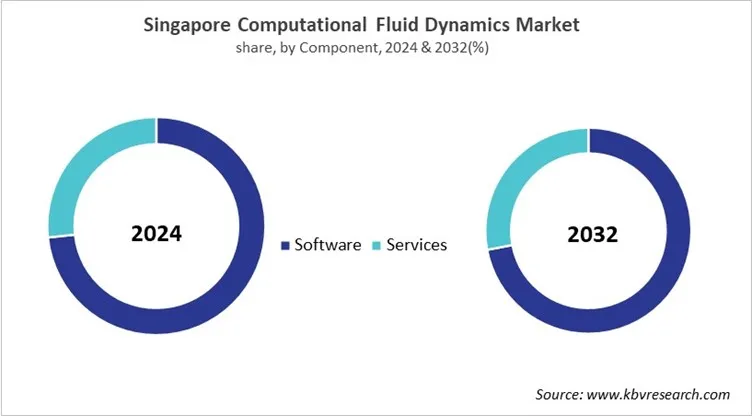
The Asia Pacific region is quickly adopting Computational Fluid Dynamics (CFD) because of the rise of industries, government efforts to go digital, and the necessity for efficient product design. CFD was once only used in schools, but now it is widely employed in the automotive, aerospace, energy, and electronics industries in nations like China, Japan, India, and South Korea. High-speed computing and cloud-based platforms have made CFD tools easier to get, especially for small and medium-sized businesses. This has led to faster simulations and cheaper ways to improve design and performance.
New technologies like AI and machine learning are changing CFD by making simulations more accurate, taking less time to run, and allowing for predictive modeling. Companies have invested money into research and development (R&D) and working with universities to make better, easier-to-use solutions that meet the demands of specific areas. ANSYS and Siemens are global leaders that compete with nimble regional firms that offer specialized services. As environmental standards are stricter, CFD's role in developing systems that use less energy becomes more important. At the same time, cloud adoption and skill development programs make sure that more people can use these systems and that the region stays competitive.
Free Valuable Insights: The Global Computational Fluid Dynamics Market is Predict to reach USD 5.12 Billion by 2032, at a CAGR of 7.5%
Japan's Computational Fluid Dynamics (CFD) market is growing rapidly as it is renowned for its precise engineering and new ideas in important fields such as automotive, aerospace, electronics, and energy. Automakers like Toyota and Honda use CFD a lot to improve electric vehicles, regulate heat, and develop aerodynamics. In aerospace, JAXA and other top companies use high-fidelity simulations to cut down on physical testing and improve aviation and space technologies. At the same time, new urban mobility platforms like drones and eVTOLs are opening up new CFD uses.
The electronics industry uses CFD to manage heat in compact equipment, while the energy industry uses it for hydrogen systems, wind turbines, and clean power initiatives that support Japan's sustainability goals. Combining AI and machine learning to make CFD faster and more accurate at predicting things is a big topic, especially in robotics and automation. Even while legacy systems can be hard to work with, programs like Society 5.0 are speeding up the use of cloud-based CFD. The market is competitive, with both multinational companies like Ansys and Siemens and local innovators like Software Cradle offering custom CFD solutions that meet Japan's specific industrial needs.
Based on Deployment Mode, the market is segmented into On-premises and Cloud. Based on Component, the market is segmented into Software and Services. Based on End User, the market is segmented into Aerospace, Automotive, Energy, Manufacturing, Material & Chemical Processing, and Other End User. Based on countries, the market is segmented into China, Japan, India, South Korea, Singapore, Malaysia, and Rest of Asia Pacific.

By Deployment Mode
By Component
By End User
By Country
Our team of dedicated experts can provide you with attractive expansion opportunities for your business.







 Unique Offerings