The Asia Pacific Climate Tech Market is expected to reach $26.26 billion by 2029 and would witness market growth of 21.1% CAGR during the forecast period (2025-2032).
The China market dominated the Asia Pacific Climate Tech Market by Country in 2024, and would continue to be a dominant market till 2032; thereby, achieving a market value of $16,980.5 million by 2032. The Japan market is registering a CAGR of 20.1% during (2025 - 2032). Additionally, The India market would showcase a CAGR of 22.1% during (2025 - 2032). The China and Japan led the Asia Pacific Climate Tech Market by Country with a market share of 39.5% and 13.2% in 2024. The Singapore market is expected to witness a CAGR of 23.4% during throughout the forecast period.
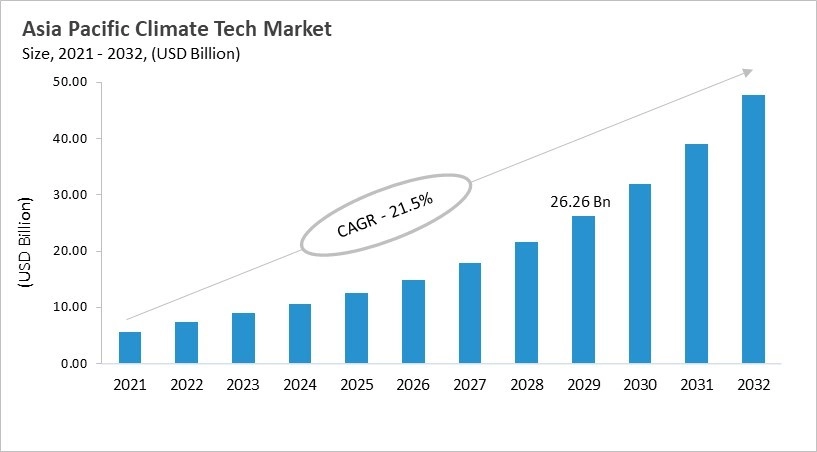
The Asia Pacific region has become a world leader in climate technology by moving from projects that were funded by donors to a policy-led, market-enabling ecosystem that combines climate action with economic and digital growth. Governments, multilateral organizations, and tech companies are working on a wide range of solutions, such as clean energy, strong infrastructure, and digital climate tools like AI, IoT, and geospatial systems. Regional collaboration platforms and policy frameworks are more and more including climate technologies in national development plans and NDCs. This is made possible by carbon pricing, climate finance mechanisms, and regulatory changes. This change shows a strategic shift from pilot-based interventions to deployment that can be scaled up and is focused on the market in both the mitigation and adaptation sectors.
Digital-climate integration, stronger regional cooperation, and more climate finance tools that lower the risk of investments and draw in private capital are all important factors in market momentum. Institutions like the ADB and regional technology networks are very important for making it easier for technology to spread across borders, building capacity, and creating partnerships between the public and private sectors. Strong manufacturing and innovation hubs in Northeast Asia and rapidly growing startup ecosystems in Southeast Asia, especially in renewable energy and digital climate solutions, are what shape competitive dynamics. The climate tech scene in the Asia Pacific region is getting more mature, competitive, and in line with goals for long-term sustainability and economic resilience.
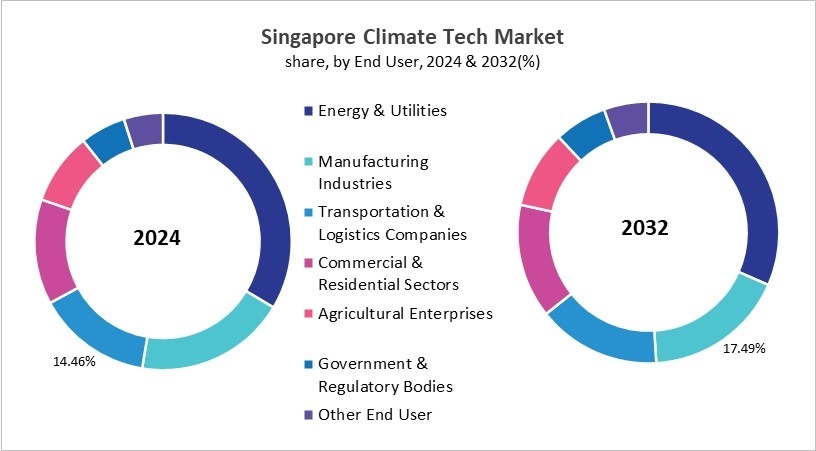
Based on End User, the market is segmented into Energy & Utilities, Manufacturing Industries, Transportation & Logistics Companies, Commercial & Residential Sectors, Agricultural Enterprises, Government & Regulatory Bodies and Other End User. Among various Singapore Climate Tech Market by End User; The Energy & Utilities market achieved a market size of USD $174.9 Million in 2024 and is expected to grow at a CAGR of 22.4 % during the forecast period. The Agricultural Enterprises market is predicted to experience a CAGR of 24.2% throughout the forecast period from (2025 - 2032).
Based on Technology, the market is segmented into Renewable Energy Technologies, Energy Storage Technologies, Climate Risk Monitoring & Data Analytics, Carbon Capture, Utilization & Storage (CCUS), Sustainable Agriculture Technologies and Other Technology. With a compound annual growth rate (CAGR) of 23.3% over the projection period, the Renewable Energy Technologies Market, dominate the Malaysia Climate Tech Market by Technology in 2024 and would be a prominent market until 2032. The Climate Risk Monitoring & Data Analytics market is expected to witness a CAGR of 25.4% during (2025 - 2032).
Free Valuable Insights: Climate Tech Market is Predicted to reach USD 166.96 billion by 2032, at a CAGR of 20.5%
China's climate technology market is quickly becoming a major player in the Asia Pacific region. This is thanks to strong central government policy, coordinated climate governance, and the widespread use of clean technologies. The Ministry of Ecology and Environment and the National Development and Reform Commission are two examples of institutions that have put out official frameworks that describe full strategies for reducing, adapting, and decarbonizing energy, industry, transportation, and urban systems. China's top-down policy structure makes it easy for the whole country to quickly adopt technologies that help with long-term carbon neutrality goals, such as renewable energy, emissions monitoring, electric mobility, energy storage, and efficiency. The country's huge manufacturing base makes it possible to use solar, wind, batteries, and electric vehicles on a large scale, which strengthens its position as the leader in installed clean energy capacity. Dominant domestic companies and selective participation from international technology providers shape competitive dynamics. These companies focus on cost efficiency, localization, and infrastructure integration. China's climate tech ecosystem is a strategic balance between economic growth, industrial competitiveness, and speeding up climate action. This makes China a global leader in the development and use of climate technology.

By End User
By Technology
By Country
Our team of dedicated experts can provide you with attractive expansion opportunities for your business.



 Unique Offerings