The Asia Pacific Cleaning Robot Market would witness market growth of 23.9% CAGR during the forecast period (2025-2032).
The China market dominated the Asia Pacific Cleaning Robot Market by Country in 2024, and would continue to be a dominant market till 2032; thereby, achieving a market value of $2,588 million by 2032. The Japan market is registering a CAGR of 23% during (2025 - 2032). Additionally, The India market would showcase a CAGR of 24.8% during (2025 - 2032). The China and Japan led the Asia Pacific Cleaning Robot Market by Country with a market share of 32.4% and 17.2% in 2024. The Malaysia market is expected to witness a CAGR of 27.7% during throughout the forecast period.
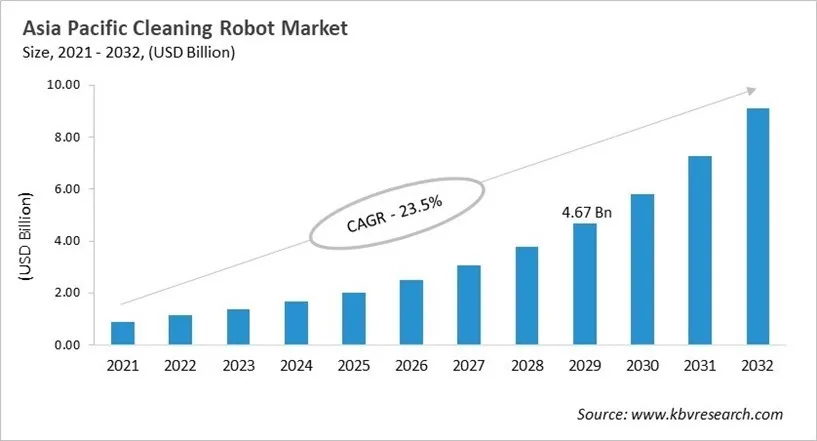
The Asia-Pacific cleaning robot market has grown from global advances in robotics to adoption in specific regions. This is due to urbanization, changes in lifestyle, and more people being aware of smart homes. Automated cleaning solutions are becoming more popular in homes because cities are growing quickly, living spaces are getting smaller, people are working two jobs, and people are busy. Technological advances in sensors, navigation, batteries, and cost-effective production—especially in East Asia—have made cleaning robots more reliable and affordable. This has helped them move from being niche innovations to more common appliances. There isn't a lot of detailed public adoption data, but the fact that smart devices, robotics manufacturing, and consumer demand for convenience are all growing quickly suggests that the market is growing.
Smart-home integration, diversification beyond residential use, and growing competition between regions are also changing the market. Manufacturers are using localization strategies, multipurpose functionality, and omnichannel distribution to meet the needs of different types of housing and income levels in APAC countries. At the same time, interest from businesses and services, like property management and shared facilities, shows that the technology could be used in more places. There are still many players in the competitive landscape, with both high-end and low-cost options available. No one company is the clear leader in all areas. Overall, innovation, low prices, and localized strategies are setting up the Asia-Pacific cleaning robot market for long-term, varied growth.
Based on Product, the market is segmented into In-House and Outdoor. Among various China Cleaning Robot Market by Product; The In-House market achieved a market size of USD $390 Million in 2024 and is expected to grow at a CAGR of 21.5 % during the forecast period. The Outdoor market is predicted to experience a CAGR of 23% throughout the forecast period from (2025 - 2032).
Based on Charging, the market is segmented into Automatic Charging and Manual Charging. The Automatic Charging market segment dominated the Japan Cleaning Robot Market by Charging is expected to grow at a CAGR of 22.7 % during the forecast period thereby continuing its dominance until 2032. Also, The Manual Charging market is anticipated to grow as a CAGR of 23.7 % during the forecast period during (2025 - 2032).
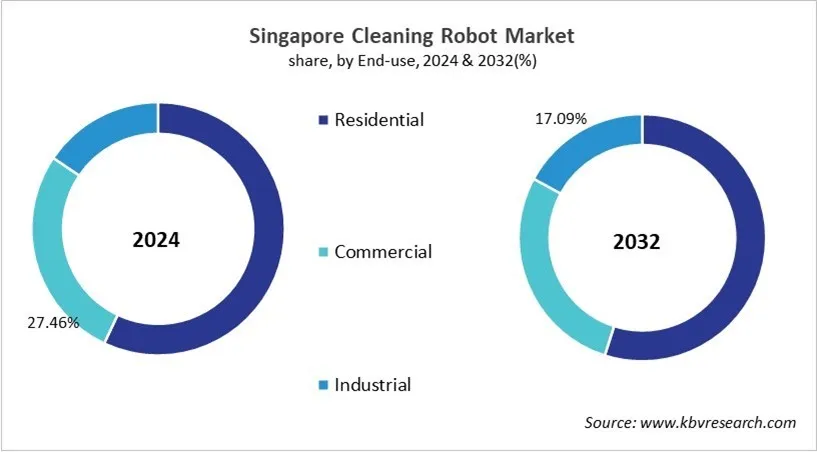
Based on End-use, the market is segmented into Residential, Commercial and Industrial. With a compound annual growth rate (CAGR) of 25.8% over the projection period, the Residential Market, dominate the Singapore Cleaning Robot Market by End-use in 2024 and would be a prominent market until 2032. From 2025 to 2032 The Industrial market is expected to witness a CAGR of 27.8% during (2025 - 2032).
Free Valuable Insights: The Cleaning Robot Market is Predicted to reach USD 31.82 Billion by 2032, at a CAGR of 23.0%
China has the biggest and most advanced cleaning robot market in the Asia Pacific. This is because the country has a lot of factories, cities are growing quickly, and people in major cities are tech-savvy. More disposable income, busy city lives, more women in the workforce, and smaller living spaces have all made younger households and professionals more likely to use automated cleaning solutions. Government support for smart manufacturing and AI, along with worries about pollution and dust making indoor spaces dirty, make demand even stronger. Market trends show that smart home systems are becoming more popular, with features like AI-enabled navigation, vacuum-and-mop combinations, self-emptying systems, and deep-cleaning capabilities. Innovative domestic brands that use large-scale production, low prices, and strong e-commerce channels to stay ahead of the competition are helping the market grow, and the company become a global leader.

By Product
By Charging
By Operation Mode
By End-use
By Distribution Channel
By Type
By Country
Our team of dedicated experts can provide you with attractive expansion opportunities for your business.





 Unique Offerings