The Asia Pacific Building Information Modeling Market would witness market growth of 11.9% CAGR during the forecast period (2025-2032).
The China market dominated the Asia Pacific Building Information Modeling Market by Country in 2024, and would continue to be a dominant market till 2032; thereby, achieving a market value of $1,186.8 million by 2032. The Japan market is showcasing a CAGR of 11.2% during (2025 - 2032). Additionally, The India market would register a CAGR of 12.7% during (2025 - 2032). The China and Japan led the Asia Pacific Building Information Modeling Market by Country with a market share of 28.5% and 18.7% in 2024.The Malaysia market is expected to witness a CAGR of 14.1% during throughout the forecast period.
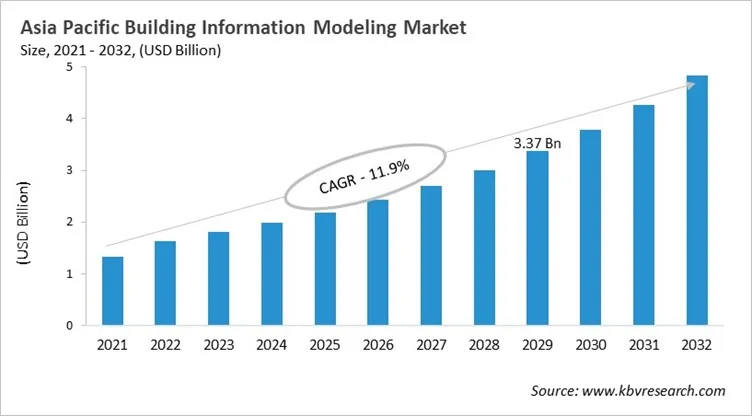
The BIM market in the Asia-Pacific region has grown from early adopters in Singapore, Hong Kong, and China to a digital construction ecosystem that spans the entire region and is driven by mandates. Government rules, big infrastructure projects, and fast urbanization have all pushed BIM from simple modeling to workflows that include design, construction, and operations. Some important trends are the growth of cloud-based collaboration, common data environments, digital twins, and BIM that focuses on sustainability and outcomes that are in line with smart city and performance goals.
Global BIM platform providers and strong regional specialists that offer localized workflows, compliance support, and implementation services both shape the competition in the area. Vendors are concentrating on localization, the expansion of regional data centers, and collaborations with governments and significant contractors to comply with mandated adoption. As BIM grows to include lifecycle management, analytics, and digital twins, it becomes more important to have partnerships with other companies, be able to work with other systems, have cloud capabilities, and be able to handle big, complicated infrastructure projects in a wide range of Asia-Pacific markets.
Based on Project Lifecycle, the market is segmented into Pre-Construction, Construction and Operation. Among various China Building Information Modeling Market by Project Lifecycle; The Pre-Construction market achieved a market size of USD $261 Million in 2024 and is expected to grow at a CAGR of 9.2 % during the forecast period. The Construction market is predicted to experience a CAGR of 10.2% throughout the forecast period from (2025 - 2032).
Based on Application, the market is segmented into Designing, Planning & Modeling, Asset Management and Other Application. With a compound annual growth rate (CAGR) of 10.4% over the projection period, the Designing Market, dominate the Japan Building Information Modeling Market by Application in 2024 and would be a prominent market until 2032. The Asset Management market is expected to witness a CAGR of 11.9% during (2025 - 2032).
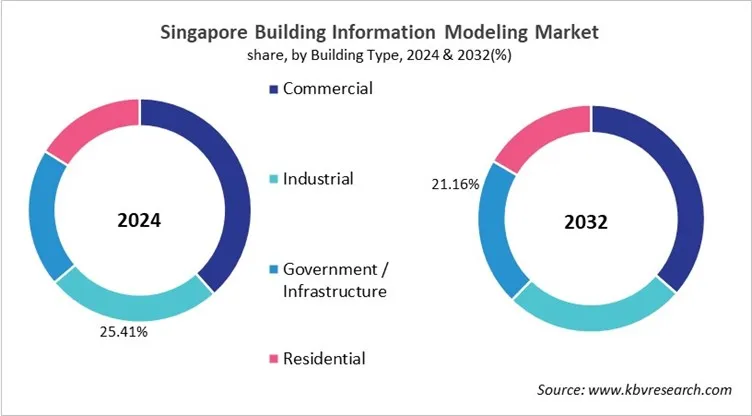
Based on Building Type, the market is segmented into Commercial, Industrial, Government / Infrastructure and Residential. The Commercial market segment dominated the Singapore Building Information Modeling Market by Building Type is expected to grow at a CAGR of 12.5 % during the forecast period thereby continuing its dominance until 2032. Also, The Residential market is anticipated to grow as a CAGR of 13.6 % during the forecast period during (2025 - 2032).
Free Valuable Insights: The Building Information Modeling Market is Predicted to reach USD 18.94 Billion by 2032, at a CAGR of 11.3%
China's BIM market is growing quickly because of big infrastructure projects, government-led digitization policies, and the need for construction that is coordinated, efficient, and long-lasting. BIM is now being used more widely in design, construction, and operations, thanks to requirements in major public works and smart city projects. Some important trends are that more mid-sized businesses are using it, it is being used more in modular and off-site construction, and it is being integrated with cloud platforms, IoT, and digital twins. But there are still problems like a lack of standardization, interoperability gaps, and high training costs. There are both international and domestic software vendors, consulting firms, and AEC companies that are developing their own capabilities. Companies that offer lifecycle services and have strong local compliance are becoming the most competitive.

By Component
By Deployment
By Project Lifecycle
By Building Type
By Application
By Country
Our team of dedicated experts can provide you with attractive expansion opportunities for your business.






 Unique Offerings