The Asia Pacific Biohacking Market would witness market growth of 19.0% CAGR during the forecast period (2025-2032).
The China market dominated the Asia Pacific Biohacking Market by Country in 2024, and would continue to be a dominant market till 2032; thereby, achieving a market value of $5,263.5 million by 2032. The Japan market is registering a CAGR of 18.3% during (2025 - 2032). Additionally, The India market would showcase a CAGR of 19.7% during (2025 - 2032). The China and Japan led the Asia Pacific Biohacking Market by Country with a market share of 26.4% and 21.4% in 2024. The Singapore market is expected to witness a CAGR of 20.7% during throughout the forecast period.
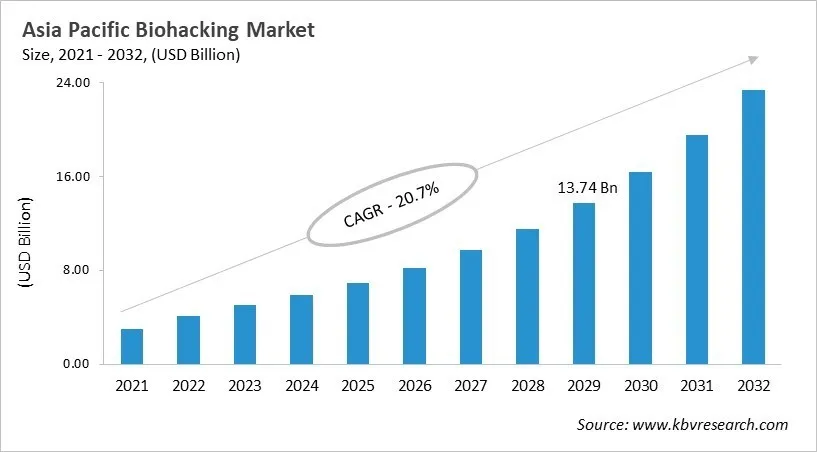
The biohacking market in the Asia Pacific region has quickly turned into a single ecosystem where biotechnology, digital health, and consumer wellness all come together. At first, the market was only for basic fitness trackers and wellness devices. Now, it also includes advanced wearables, genetic testing tools, biomarker-based assessments, cognitive enhancers, and AI-powered health platforms. Growth has sped up because more people are aware of their health, more people are using preventive healthcare, mobile phones are becoming more popular, and governments are supporting these efforts, especially in Japan, South Korea, Australia, India, and Singapore. Cultural factors like an aging population and tech-savvy youth also affect demand. At the same time, ethical, regulatory, and safety issues are still changing in the region.
Key trends that are driving market growth include personalized health monitoring, the rise of cognitive enhancement and longevity-focused solutions, and the deeper integration of AI, genomics, and biotechnology. To get more people to use their products and trust them, companies are using a mix of devices, analytics platforms, subscription services, and personalized interventions. To stay ahead of the competition, companies need to focus on localization, regional manufacturing, and working with healthcare providers and wellness platforms. The landscape is still somewhat fragmented, with global leaders and regional players competing through new ideas, following the rules, data-driven products, and products that fit in with the culture.
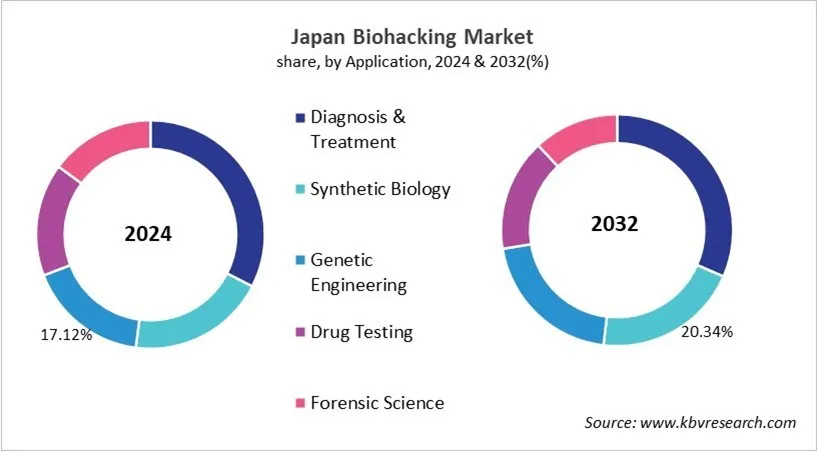
Based on Application, the market is segmented into Diagnosis & Treatment, Synthetic Biology, Genetic Engineering, Drug Testing, and Forensic Science. The Diagnosis & Treatment market segment dominated the Japan Biohacking Market by Application is expected to grow at a CAGR of 16.6 % during the forecast period thereby continuing its dominance until 2032. Also, The Drug Testing market is anticipated to grow as a CAGR of 18.8 % during the forecast period during (2025 - 2032).
Free Valuable Insights: The Biohacking Market is Predicted to reach USD 93.34 Billion by 2032, at a CAGR of 18.3%
Based on Product, the market is segmented into Wearables, Implants, Smart Drugs, Supplements, Mobile Apps, Gene Modification Kits, and Other Product. Among various Singapore Biohacking Market by Product; The Wearables market achieved a market size of USD $115.9 Million in 2024 and is expected to grow at a CAGR of 18.8 % during the forecast period. The Mobile Apps market is predicted to experience a CAGR of 21.3% throughout the forecast period from (2025 - 2032).
China's biohacking scene is growing quickly thanks to a tech-savvy population, a strong biotech infrastructure, and a digital health ecosystem that combines consumer technology with life sciences. More and more people are interested in personal optimization and preventive health. This is because smartphones are widely used, biosensor manufacturing is strong, and there is a lot of new research going on in synthetic biology, genomics, and mobile health. The government's focus on building up the life sciences sector, making supply chains more efficient, and investing more in health tech all help the market grow even faster. Trends point to more integrated platforms that bring together hardware, analytics, coaching, and telehealth. There is also a growing interest in biomarkers, metabolic monitoring, and AI-driven insights. Competitive dynamics include global tech companies, local manufacturers, biotech start-ups, and hospital networks. Success depends on things like localization, clinical partnerships, data security, and following the rules.

By Application
By End Use
By Product
By Country
Our team of dedicated experts can provide you with attractive expansion opportunities for your business.



 Unique Offerings