The Asia Pacific Automated Test Equipment Market is expected to reach $4.69 billion by 2029 and would witness market growth of 5.1% CAGR during the forecast period (2025-2032).
The China market dominated the Asia Pacific Automated Test Equipment Market by Country in 2024, and would continue to be a dominant market till 2032; thereby, achieving a market value of $1,467.2 million by 2032. The Japan market is registering a CAGR of 4.3% during (2025 - 2032). Additionally, The India market would showcase a CAGR of 6.5% during (2025 - 2032). The China and South Korea led the Asia Pacific Automated Test Equipment Market by Country with a market share of 30.5% and 17.4% in 2024. The Malaysia market is expected to witness a CAGR of 6.6% during throughout the forecast period.
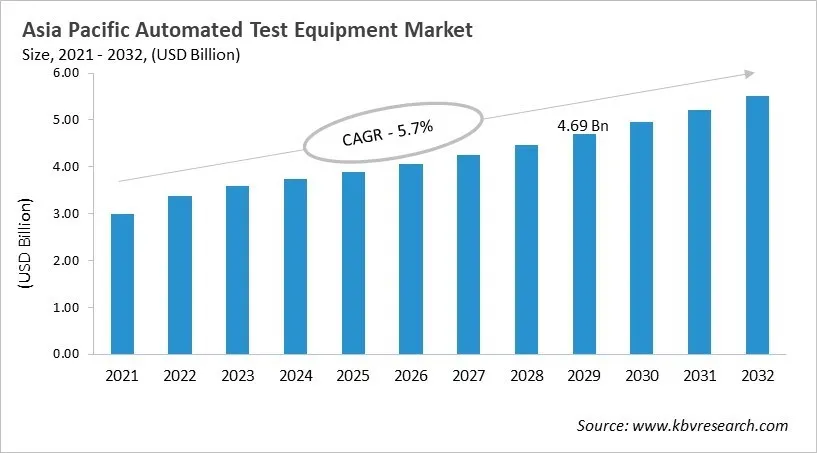
Automated Test Equipment (ATE) is very important for making sure that semiconductors and electronic parts are of high quality, reliable, and work well. This is especially true in the Asia Pacific, which is the world's main hub for making electronics and semiconductors. Large-scale fabrication, OSAT expansion, and high-volume consumer electronics production in China, Japan, South Korea, Taiwan, and Southeast Asia have made ATE adoption necessary for keeping yield, throughput, and global quality standards. As AI processors, 5G ICs, automotive electronics, and advanced memory make semiconductor designs more complicated, ATE systems are changing to support high-speed, mixed-signal, RF, and system-level testing. Government-backed semiconductor ecosystem initiatives also increase demand by indirectly increasing the region's ability to make and put together chips.
Global OEMs like Advantest and Teradyne are at the top of the competitive landscape. They stay on top in Asia Pacific by doing a lot of research and development, making AI-enabled test platforms, and working with foundries and other ecosystem players. Some important trends in the market are the use of AI and machine learning in testing workflows, the growth of advanced-node and heterogeneous integration testing, and the localization of service and support infrastructure to make it easier for customers to get help. By being involved in major industry events and working closely with semiconductor manufacturers, ATE suppliers can make sure that their products are in line with regional technology roadmaps. In Asia Pacific's fast-growing ATE market, success is defined by innovation leadership, ecosystem partnerships, and regional engagement.
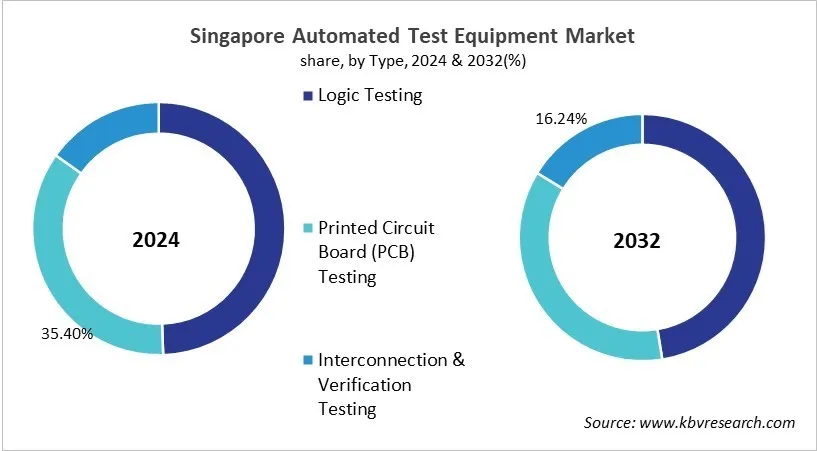
Based on Type, the market is segmented into Logic Testing, Printed Circuit Board (PCB) Testing, and Interconnection & Verification Testing. The Logic Testing market segment dominated the Singapore Automated Test Equipment Market by Type is expected to grow at a CAGR of 6.1 % during the forecast period thereby continuing its dominance until 2032. Also, The Interconnection & Verification Testing market is anticipated to grow as a CAGR of 7.7 % during the forecast period during (2025 - 2032).
Based on Product, the market is segmented into Non-Memory ATE, Memory ATE, Discrete ATE Product, and Other Product. With a compound annual growth rate (CAGR) of 2.9% over the projection period, the Non-Memory ATE Market, dominate the China Automated Test Equipment Market by Product in 2024 and would be a prominent market until 2032. The Discrete ATE Product market is expected to witness a CAGR of 4.6% during (2025 - 2032).
Free Valuable Insights: The Automated Test Equipment Market is Predicted to reach USD 10.63 Billion by 2032, at a CAGR of 5.0%
China is a key player in the electronics manufacturing ecosystem in the Asia Pacific region. Its large-scale production of electronics and semiconductors creates a lot of demand for high-precision Automated Test Equipment (ATE). Automated testing is very important for the country's growing electronics and IC manufacturing base because it makes sure that products are of high quality, work reliably, and meet global standards. The Ministry of Industry and Information Technology is leading government efforts to improve the capabilities of domestic intelligent testing equipment and encourage industrial self-sufficiency. The need for advanced ATE solutions is even stronger now that technology is moving so quickly and products are getting more complicated in high-value electronics. The market is still competitive because of major global ATE suppliers and new domestic players, as well as localized services and policies that encourage innovation. Industrial growth, policy support, and advanced technology all work together to make ATE a key part of China's manufacturing competitiveness.

By Type
By Product
By Vertical
By Country
Our team of dedicated experts can provide you with attractive expansion opportunities for your business.



 Unique Offerings