The Asia Pacific Automated Feeding Systems Market is expected to reach $2.72 billion by 2029 and would witness market growth of 17.6% CAGR during the forecast period (2025-2032).
The China market dominated the Asia Pacific Automated Feeding Systems Market by Country in 2024, and would continue to be a dominant market till 2032; thereby, achieving a market value of $1,402.4 million by 2032. The Japan market is showcasing a CAGR of 16.6% during (2025 - 2032). Additionally, The India market would register a CAGR of 18.4% during (2025 - 2032). The China and Japan led the Asia Pacific Automated Feeding Systems Market by Country with a market share of 34.8% and 15.2% in 2024. The South Korea market is expected to witness a CAGR of 19.9% during throughout the forecast period.
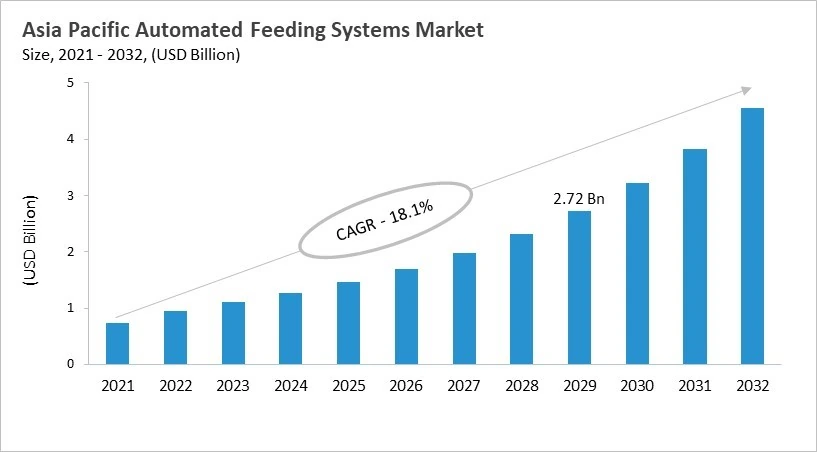
The Asia Pacific Automated Feeding Systems Market has grown along with the quick modernization of farming and government support for mechanization and digital farming. Countries like Australia, China, India, and Southeast Asia are using automated feeding to boost productivity, food security, and the efficiency of managing feed. OEMs like Lely, GEA, and DeLaval have grown in the region by offering robotic and programmable feeding systems that work for both large and medium-sized farms. Automation helps livestock industries that export goods and cuts down on feed waste while making things more consistent and long-lasting.
Some important trends are that more people are using smart farming technologies, that there is more demand for animal protein, and that there are fewer people working in rural areas. Increasingly, automated feeding systems are being linked to herd monitoring and farm management platforms so that ration control and performance tracking can happen in real time. Competitive strategies stress new technologies, expanding services in different areas, and designing systems that can be put together in different ways. In advanced markets, integration and digital skills are what drive competition. In emerging economies, on the other hand, affordability and scalability are what matter most. Digital transformation, the need for efficiency, and modernization efforts across a wide range of livestock systems are all influencing the market.
Based on components, the automated feeding systems market is characterized into hardware, services, and software. The Hardware market segment dominated the China Automated Feeding Systems Market by Component is expected to grow at a CAGR of 15.4 % during the forecast period thereby continuing its dominance until 2032. Also, The Services market is anticipated to grow as a CAGR of 16.5 % during the forecast period during (2025 - 2032).
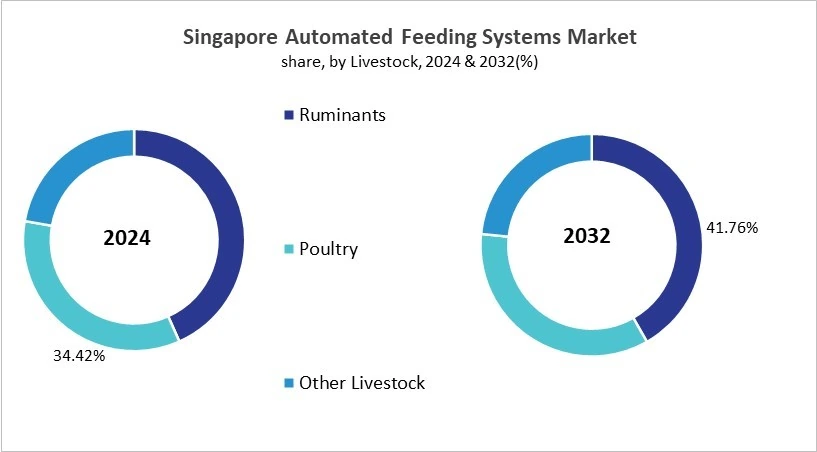
Based on Livestock, the market is segmented into Ruminants, Poultry, and Other Livestock. With a market value of $21.9 Million by 2032, and a compound annual growth rate (CAGR) of 19.7% over the projection period, the Ruminants Market, dominate the Singapore Automated Feeding Systems Market by Livestock in 2024 and would be a prominent market until 2032. The Other Livestock market is expected to witness a CAGR of 21.1% during (2025 - 2032).
Free Valuable Insights: Automated Feeding Systems Market is Predicted to reach USD 16.85 billion by 2032, at a CAGR of 16.9%
As the demand for meat and dairy rises, China's automated feeding systems market is growing quickly as livestock production becomes more modern. More big commercial farms are using automated feeders, sensors, and robots to make sure that feeding is more consistent and efficient. This change is strongly supported by the government's focus on food security and productivity, especially in the pork and poultry industries. Companies like Big Dutchman offer advanced feeding solutions through their local operations, while global OEMs like GEA and Lely offer high-end automated platforms. Integration with IoT and data analytics for real-time feed and livestock monitoring is a trend in the market. Competition brings together global technology with systems that are tailored to different farm sizes. But there are still problems with high upfront costs, skill requirements, and gaps in regional infrastructure. Overall, the modernization of agriculture is likely to lead to more widespread use of automated feeding systems in China.

By Component
By System Type
By Livestock
By Country
Our team of dedicated experts can provide you with attractive expansion opportunities for your business.



 Unique Offerings