The Asia Pacific AI Workload Management Market would witness market growth of 34.0% CAGR during the forecast period (2025-2032).
The China market dominated the Asia Pacific AI Workload Management Market by Country in 2024, and would continue to be a dominant market till 2032; thereby, achieving a market value of $25,694.2 million by 2032. The Japan market is registering a CAGR of 33.3% during (2025 - 2032). Additionally, The India market would showcase a CAGR of 34.8% during (2025 - 2032). The China and Japan led the Asia Pacific AI Workload Management Market by Country with a market share of 32% and 20% in 2024. The Singapore market is expected to witness a CAGR of 36.4% during throughout the forecast period.
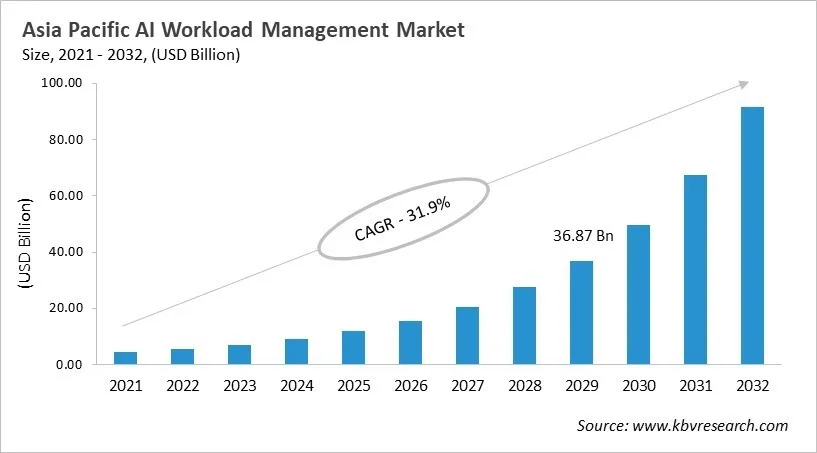
The Asia Pacific region has quickly become a key player in the global AI scene, and managing AI workloads has become a key part of its technological infrastructure. The rapid growth of AI in fields like healthcare, finance, manufacturing, telecommunications, and automotive has led to the need for this area, which includes managing, scheduling, and optimizing AI tasks in both on-premises and multi-cloud environments. Government programs in China, Japan, South Korea, India, and Malaysia have played a big role in this growth. These programs have encouraged innovation, research, and regulatory oversight through strategic policies, partnerships between the public and private sectors, and investments in AI infrastructure. AI workload management has come a long way since it started using GPUs and TPUs to scale AI models. Now it uses cloud computing, containerization, and hybrid architectures that combine edge computing for real-time, low-latency processing.
Recently, the focus has been on automation, predictive resource allocation, and cost optimization. This has helped businesses improve their operational efficiency, lower their computing costs, and quickly deploy AI-driven applications. Machine learning algorithms are now used by advanced workload management solutions to intelligently schedule tasks, make the best use of resources, and ensure that new data privacy and ethical standards are followed. Top companies in the area are putting a lot of money into research and development, making strategic partnerships, and providing scalable, customizable solutions that come with built-in security and compliance features. There are both well-known technology leaders and new startups in the competitive landscape. To be successful in the market, companies must keep coming up with new ideas, be able to adapt to changes in the law, and be able to provide secure, efficient, and industry-specific AI workload management solutions.
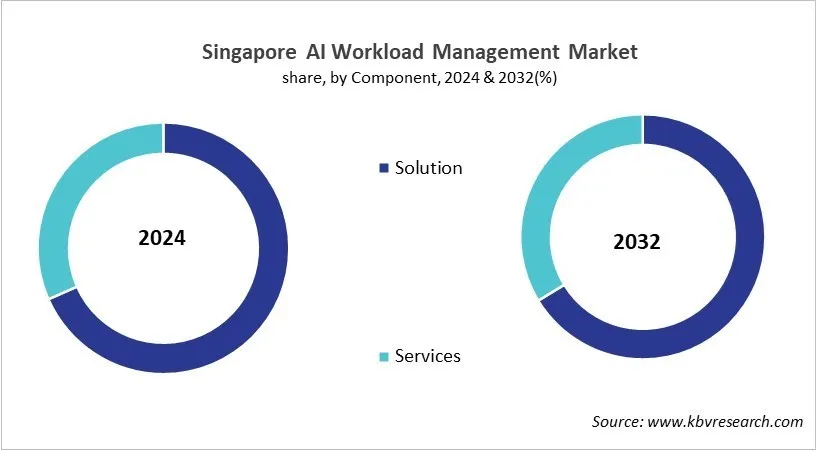
Based on Component, the market is segmented into Solution, and Services. The Solution market segment dominated the Singapore AI Workload Management Market by Component is expected to grow at a CAGR of 35.8 % during the forecast period thereby continuing its dominance until 2032. Also, The Services market is anticipated to grow as a CAGR of 37.4 % during the forecast period during (2025 - 2032).
Free Valuable Insights: The Global AI Workload Management Market is Predict to reach USD 320.48 Billion by 2032, at a CAGR of 33.3%
Based on Vertical, the market is segmented into IT & Telecommunication, BFSI, Healthcare & Life Sciences, Retail & E-commerce, Manufacturing, Government & Public Sector, and Other Vertical. Among various Japan AI Workload Management Market by Vertical; The IT & Telecommunication market achieved a market size of USD $426.1 Million in 2024 and is expected to grow at a CAGR of 31.8 % during the forecast period. The Manufacturing market is predicted to experience a CAGR of 34.8% throughout the forecast period from (2025 - 2032).
China has become a major player in the Asia Pacific AI Workload Management Market, thanks to the rapid growth of AI in fields like manufacturing, finance, healthcare, telecommunications, and smart cities. Government-backed projects and national plans that stress self-reliance in AI and computing infrastructure have sped up investment in domestic chips, data centers, and cloud platforms. Companies are using both cloud-based and on-premise solutions more and more to improve their operations, handle large amounts of data, and stay in line with regulations. Market trends show a move toward hybrid cloud environments, AI-driven automation, predictive scheduling, and edge computing for real-time analytics. At the same time, industry-specific, customizable solutions are becoming more popular. In the competitive landscape, domestic tech giants like Huawei, Alibaba Cloud, and Baidu are at the top, along with specialized startups. Differentiation is based on scalability, integration, automation, and following local laws.

By Deployment
By Enterprise Size
By Component
By Vertical
By Country
Our team of dedicated experts can provide you with attractive expansion opportunities for your business.


![AI Workload Management Market Size, Share & Growth [2032]](https://www.kbvresearch.com/upload/cover/ai-workload-management-market.webp "AI Workload Management Market Size, Share & Growth [2032]")

 Unique Offerings