The Asia Pacific AI-Based Personalization Engines Market is expected to reach $146.66 billion by 2028 and would witness market growth of 5.8% CAGR during the forecast period (2025-2032).
The China market dominated the Asia Pacific AI-Based Personalization Engines Market by Country in 2024, and would continue to be a dominant market till 2032; thereby, achieving a market value of $53,184.7 million by 2032. The Japan market is showcasing a CAGR of 5.2% during (2025 - 2032). Additionally, The India market would register a CAGR of 6.5% during (2025 - 2032). The China and Japan led the Asia Pacific AI-Based Personalization Engines Market by Country with a market share of 32.4% and 19.2% in 2024. The Singapore market is expected to witness a CAGR of 7.9% during throughout the forecast period.
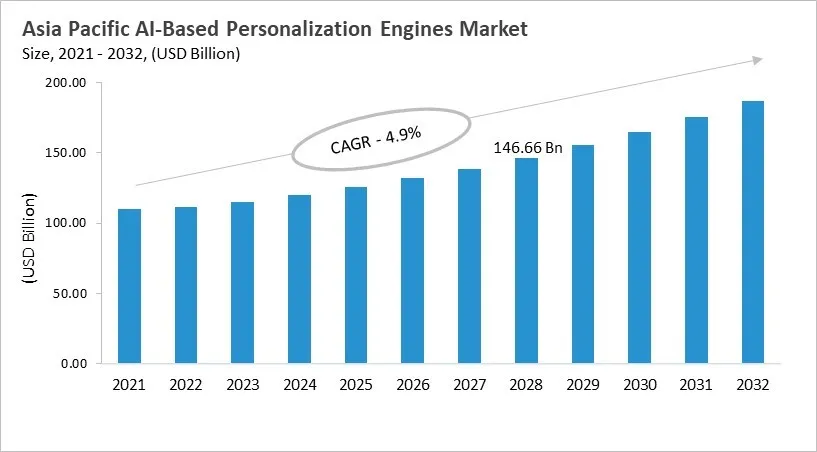
Asia Pacific has quickly moved from testing AI to using personalization engines in the core business strategies of retail, banking, media, and public services. Real-time, culturally adaptive personalization is in high demand because so many people use mobile devices, there are so many digital populations, and the government supports AI projects. Cloud and OEM platforms like Microsoft, Google, AWS, and Alibaba Cloud have made access more equal by providing scalable AI and personalization APIs. Instead of pilot projects, businesses are now focusing on full-scale deployment, measurable ROI, and improving customer experience. National AI strategies and regional frameworks like APEC encourage the responsible, open, and inclusive use of AI. Localization is still very important because systems need to work with different languages, cultures, and rules. In general, personalization has become a key part of digital transformation in Asia Pacific.
Global cloud providers, strong local innovators, and collaborative ecosystems all play a role in shaping competition in the region. Multinational OEMs control basic AI platforms, while local companies offer tailored solutions that meet cultural and compliance needs. Public-private partnerships, industry consortia, and skills development programs speed up the use and integration of new technologies into business IT systems. Increasingly, vendors offer complete AI suites that include personalization throughout customer journeys and operational workflows. Along with performance, ethical AI, data privacy, and explainability are now important factors that set products apart. To be successful, a business needs to be able to do more than just technical things. It also needs to be able to adapt to the market and follow the rules. Asia Pacific is a major growth hub for AI-based personalization engines because of its size, diversity, and support for policies.
Based on Deployment, the market is segmented into Cloud, and On-premises. The Cloud market segment dominated the China AI-Based Personalization Engines Market by Deployment is expected to grow at a CAGR of 4.2 % during the forecast period thereby continuing its dominance until 2032. Also, The On-premises market is anticipated to grow as a CAGR of 4 % during the forecast period during (2025 - 2032).
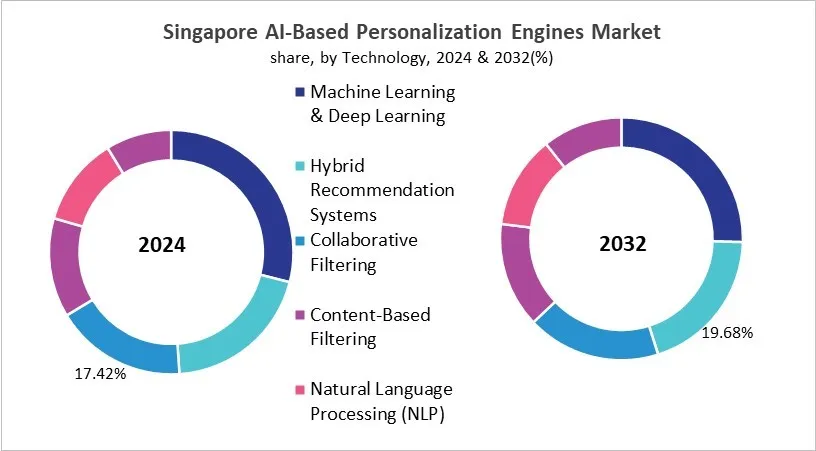
Based on Technology, the market is segmented into Machine Learning & Deep Learning, Hybrid Recommendation Systems, Collaborative Filtering, Content-Based Filtering, Natural Language Processing (NLP), and Other Technology. Among various Singapore AI-Based Personalization Engines Market by Technology; The Machine Learning & Deep Learning market achieved a market size of USD $1688.7 Million in 2024 and is expected to grow at a CAGR of 6.1 % during the forecast period. The Natural Language Processing (NLP) market is predicted to experience a CAGR of 8.4% throughout the forecast period from (2025 - 2032).
China is one of the most advanced and biggest markets for AI-based personalization engines in Asia Pacific. This is because its digital ecosystems are so well-connected. Personalization is a big part of e-commerce, digital payments, social media, and streaming platforms, which serve millions of users in real time. The biggest tech companies in the US create huge amounts of data that are used to make smart AI-driven recommendations. Strong government support for AI and digital infrastructure makes businesses adopt them even faster. Market trends show that deep learning and predictive, real-time personalization are changing quickly. Domestic OEMs and cloud providers that offer end-to-end, ecosystem-based solutions are the main competitors. International vendors don't do much, so local platforms are the main drivers of innovation. Personalization is still a key part of China's digital economy.

By Component
By Deployment
By Application
By Technology
By End Use
By Country
Our team of dedicated experts can provide you with attractive expansion opportunities for your business.





 Unique Offerings