The Asia Pacific AI Annotation Market would witness market growth of 26.3% CAGR during the forecast period (2025-2032).
The China market dominated the Asia Pacific AI Annotation Market by Country in 2024, and would continue to be a dominant market till 2032; thereby, achieving a market value of $893.6 million by 2032. The Japan market is registering a CAGR of 25.4% during (2025 - 2032). Additionally, The India market would showcase a CAGR of 27.2% during (2025 - 2032). The China and Japan led the Asia Pacific AI Annotation Market by Country with a market share of 38.4% and 17.4% in 2024. The Malaysia market is expected to witness a CAGR of 30.5% during throughout the forecast period.
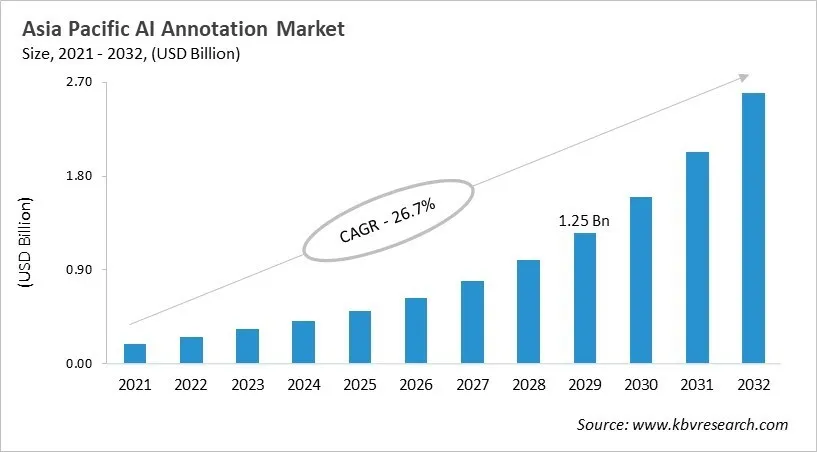
In the Asia-Pacific region, the annotation of training data has changed from a small outsourcing job to a key part of digital transformation, thanks to strong government support, good policies, and national AI initiatives. Annotation services are now the backbone of the region's AI growth in vision, language, sensor, and multimodal applications. They have moved from manual, crowd-based methods to platform-enabled, scalable workflows. Some important trends in the market are multilingual and culturally contextual annotation to deal with the region's linguistic diversity, a greater focus on regulatory compliance and data governance, and hybrid automation workflows that use machine pre-labeling and human-in-the-loop verification to improve efficiency and accuracy. These changes are in line with the growing use of AI in businesses and investments in computing infrastructure, talent, and digital policy frameworks in the region.
Annotation providers in the Asia-Pacific region are setting themselves apart by focusing on regional localization, language-diverse annotator pools, and cultural-context expertise. They are also investing in platform automation, hybrid workflows, and value-added services like dataset curation and domain-specific annotation. Companies also focus on secure delivery, compliance, and audit-ready frameworks to keep up with changing AI rules and data-sovereignty needs. There are local, regional, and global competitors in the market. Companies are now competing on quality, domain expertise, regulatory compliance, and workflow complexity instead of price. More and more businesses are setting up their own annotation capabilities, which makes clients more loyal and makes it necessary for service providers to offer platform maturity, regional depth, and strategic AI-data partnerships to stay competitive.
Based on Data Modality, the market is segmented into Image & Video Computer Vision, Text & Natural Language Processing (NLP), LiDAR & Sensor fusion, Tabular, Structured, & Synthetic Data Tagging and Audio & Speech. The Image & Video Computer Vision market segment dominated the China AI Annotation Market by Data Modality is expected to grow at a CAGR of 23.2 % during the forecast period thereby continuing its dominance until 2032. Also, The Audio & Speech market is anticipated to grow as a CAGR of 27.7 % during the forecast period during (2025 - 2032).
Free Valuable Insights: The AI Annotation Market is Predicted to reach USD 8.68 Billion by 2032, at a CAGR of 25.7%
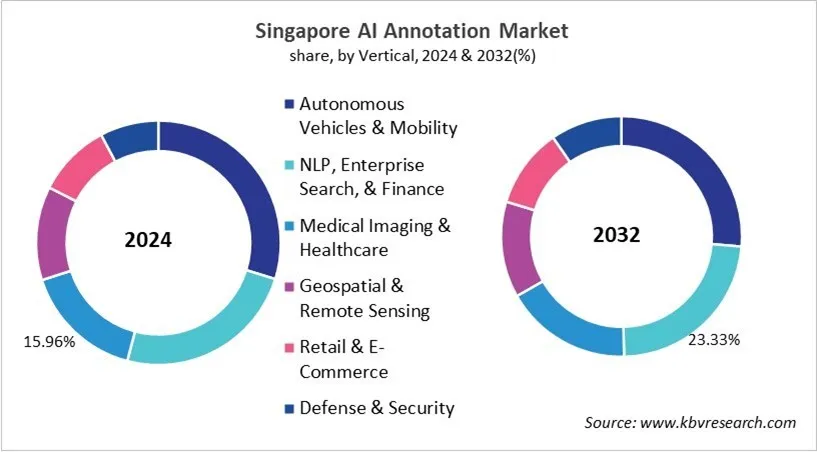
Based on Vertical, the market is segmented into Autonomous Vehicles & Mobility, NLP, Enterprise Search, & Finance, Medical Imaging & Healthcare, Geospatial & Remote Sensing, Retail & E-Commerce and Defense & Security. Among various Singapore AI Annotation Market by Vertical; The NLP, Enterprise Search, & Finance market achieved a market size of USD $5.1 Million in 2024 and is expected to grow at a CAGR of 27.9 % during the forecast period. The Retail & E-Commerce market is predicted to experience a CAGR of 30% throughout the forecast period from (2025 - 2032).
The Chinese AI annotation market is becoming a key part of the country's AI goals. This is because the government sees data labeling as an "emerging industry" and gives it financial, tax, and other incentives. Some of the main things that are driving growth are the availability of a lot of public and business data, requirements for collaborative data annotation for large language models, and the creation of national standards for high-quality annotation. Regulatory oversight now connects AI algorithm filings to compliance with data processing and annotation rules. This puts more emphasis on quality, traceability, and following national policies. The market is moving away from simple image and mapping annotation and toward more complex text, audio, and multimodal data annotation. There is also a trend toward specialist platforms that combine human-in-the-loop and hybrid AI workflows. Competitive advantage favors domestic providers who can handle Chinese language and dialect data within the rules, while international companies have to deal with barriers and think about partnerships or following the rules in their own operations. Overall, annotation is becoming more formalized as an important part of China's AI value chain.

By Data Modality
By Buyer Type
By Vertical
By Country
Our team of dedicated experts can provide you with attractive expansion opportunities for your business.



 Unique Offerings