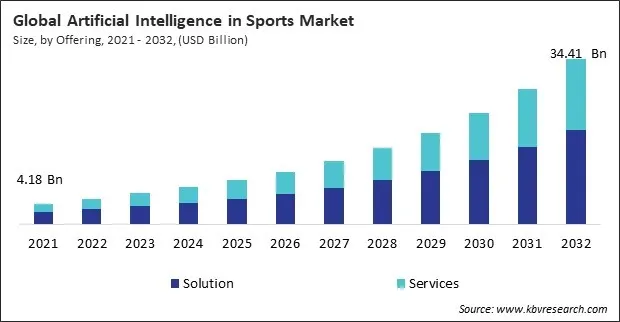
“Global Artificial Intelligence in Sports Market to reach a market value of USD 34.41 Billion by 2032 growing at a CAGR of 20.8%”
The Global Artificial Intelligence in Sports Market size is expected to reach $34.41 billion by 2032, rising at a market growth of 20.8% CAGR during the forecast period.
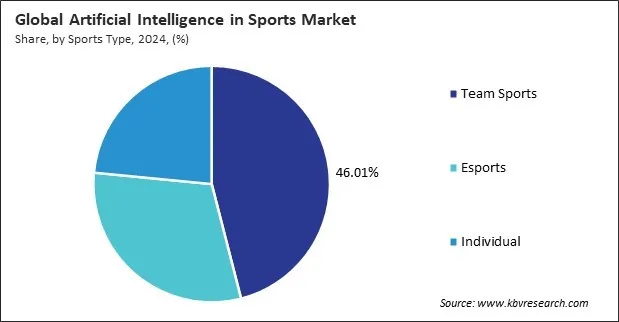
The adoption of AI-powered video analytics, wearables, and predictive modeling tools has significantly improved team coordination and tactical decision-making, making team sports a primary area of investment and innovation in the AI sports market. Thus, the team sports segment acquired the 46% revenue share in the artificial intelligence in sports market in 2024. This dominance reflects the widespread application of AI technologies across various team-based sports such as football, basketball, baseball, and cricket. AI is being utilized for player performance tracking, game strategy optimization, injury prevention, and fan experience enhancement.
The major strategies followed by the market participants are Partnerships as the key developmental strategy to keep pace with the changing demands of end users. For instance, In November, 2024, IBM Corporation teamed up with Ferrari S.p.A., becoming the official Fan Engagement and Data Analytics Partner of Scuderia Ferrari HP. The collaboration focuses on enhancing global fan experiences through advanced data insights, a new mobile app, and innovative digital solutions aimed at improving engagement and overall team performance. Additionally, In December, 2021, Sportradar Group AG teamed up with Bundesliga International, a DFL Deutsche Football League subsidiary, to enhance fan engagement. This collaboration aimed to provide streamlined, improved access to top-tier German football content, leveraging Sportradar’s expertise in data delivery and digital solutions to enrich the overall viewing experience.
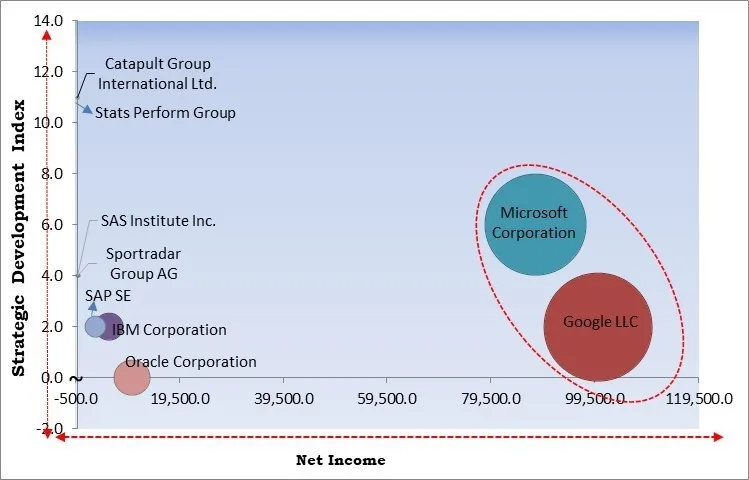
Based on the Analysis presented in the KBV Cardinal matrix; Google LLC and Microsoft Corporation are the forerunners in the Artificial Intelligence in Sports Market. Companies such as Oracle Corporation, IBM Corporation, and SAP SE are some of the key innovators in Artificial Intelligence in Sports Market. In August, 2023, Google LLC announced the partnership with FOX Sports to leverage generative AI via Vertex AI Vision. This partnership enhances video search, automates content tagging, and streamlines media workflows, allowing FOX Sports to create new content faster and improve live sports coverage, collaboration, and viewer engagement across platforms.
During the COVID-19 pandemic, the sports industry experienced a significant decline in revenue due to the cancellation or postponement of major events, tournaments, and league matches worldwide. As a consequence, clubs, organizations, and broadcasters faced financial strain, leading to a temporary reduction in investments in advanced technologies, including artificial intelligence. Budgets earmarked for innovation, performance analytics, and fan engagement tools were reallocated to critical operations and pandemic response efforts. This reallocation caused delays or cancellations in AI-related initiatives across various sports domains. Thus, the COVID-19 pandemic had a negative impact on the market.

Artificial Intelligence has revolutionized performance analytics in the sports industry, enabling teams, coaches, and athletes to achieve unprecedented levels of precision and efficiency in training and game-day decision-making. One of the most powerful applications of AI lies in real-time data tracking—gathered from wearables, motion sensors, and computer vision systems—used to monitor biomechanics, fatigue levels, heart rate variability, and movement efficiency. Therefore, by transforming performance tracking and tailoring injury-preventive strategies through intelligent, predictive systems, AI has become an indispensable ally in maximizing athlete longevity and effectiveness.
Additionally, AI is at the heart of a dramatic shift in how fans engage with sports, personalizing experiences and making interactions more immersive, dynamic, and satisfying. One of the key enablers here is recommendation engines powered by AI, like those used in entertainment platforms. These systems analyze fans' behavior across apps, social media, ticketing portals, and e-commerce platforms to recommend content, merchandise, and match experiences uniquely suited to each user’s preferences. Whether it’s highlighting a favorite player’s stats, replaying iconic moments, or sending notifications about upcoming matches, AI personalizes every touchpoint in the fan journey. Thus, by turning passive viewers into interactive participants through personalized content and immersive technologies, AI is redefining fan engagement in sports as a deeply connected, dynamic experience.
However, one of the most critical restraints hampering the widespread adoption of AI in sports is the issue of data privacy and ethical use of athlete and consumer data. In modern sports ecosystems, AI applications heavily depend on real-time data collection — from biometric data during training, to behavioral data collected through fan engagement platforms. Wearable sensors, smart stadiums, and tracking cameras generate volumes of highly sensitive information, much of which pertains to individuals' health, location, and private routines. When such data is analyzed by AI systems for performance enhancement or audience targeting, it raises important questions about consent, ownership, and risk of misuse. In conclusion, unless data governance frameworks and ethical standards are significantly strengthened, the risks associated with data privacy and ethical misuse will continue to restrict the pace and scope of AI adoption in the sports industry.
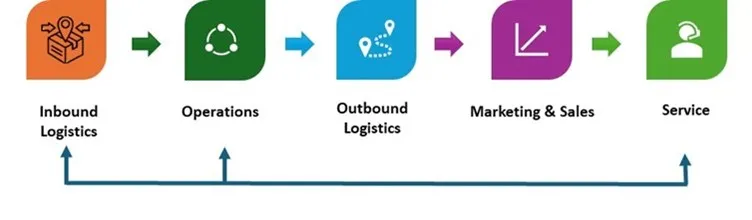
The value chain of the Artificial Intelligence in Sports Market starts with Inbound Logistics, where data from sensors, cameras, and wearables is collected and sourced for processing. In Operations, AI models analyze player performance, game strategies, and injury risks using machine learning and computer vision. Outbound Logistics involves delivering these insights through dashboards, apps, or live broadcasts. Marketing & Sales promote AI-powered solutions to teams, leagues, and broadcasters. Finally, Service includes continuous model training, tech support, and performance updates for optimal user experience.
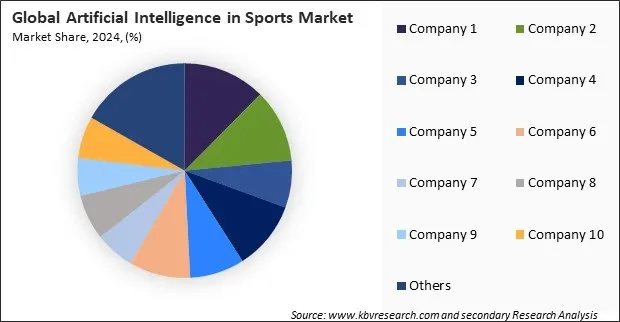
The leading players in the market are competing with diverse innovative offerings to remain competitive in the market. The above illustration shows the percentage of revenue shared by some of the leading companies in the market. The leading players of the market are adopting various strategies in order to cater demand coming from the different industries. The key developmental strategies in the market are Partnerships & Collaborations.
Free Valuable Insights: Global Artificial Intelligence in Sports Market size to reach USD 34.41 Billion by 2032
Based on offering, the artificial intelligence in sports market is characterized into solution and services. The solution segment garnered 59% revenue share in the artificial intelligence in sports market in 2024. This segment includes AI-driven tools and platforms that assist in decision-making, performance analysis, player tracking, strategy development, and predictive modeling. The growing adoption of AI technologies by teams, leagues, and broadcasting partners to enhance on-field strategies and fan engagement contributed heavily to the prominence of this segment.
On the basis of sports type, the artificial intelligence in sports market is classified into team sports, esports, and individual. The individual segment held 23% revenue share in the artificial intelligence in sports market in 2024. This segment encompasses sports such as tennis, golf, athletics, boxing, and others where athletes compete individually rather than as part of a team. AI technologies in this space are primarily focused on personalized training programs, performance monitoring, biomechanics analysis, and real-time feedback systems.
By technology, the market is divided into gen AI and other AI. The other AI segment garnered 47% revenue share in the artificial intelligence in the sports market in 2024. These solutions form the foundation of most AI applications in sports today ranging from real-time game analysis, player tracking, and scouting to fan sentiment analysis and operational optimization. These tools are well-established and continue to evolve with advancements in algorithmic accuracy, processing speed, and data availability.
| Category | Details |
|---|---|
| Use Case Title | Confidential |
| Date | 2025 |
| Entities Involved | Confidential |
| Objective | To optimize player performance, team strategy, and officiating using traditional AI technologies such as machine learning, computer vision, and predictive modeling. |
| Context and Background | Before GenAI, sports teams relied on traditional AI for analytics, injury prevention, and officiating. In 2025, these remain core, using supervised learning, reinforcement learning for simulations, and AI-enhanced video/sensor analytics. |
| Description |
|
| Key Capabilities Deployed |
|
| Benefits |
|
| Source | Confidential |
Region-wise, the artificial intelligence in the sports market is analyzed across North America, Europe, Asia Pacific, and LAMEA. The North America segment recorded 38% revenue share in the artificial intelligence in the sports market in 2024. The region’s leadership can be attributed to early adoption of advanced technologies, high investments in sports analytics, and the presence of major leagues such as the NFL, NBA, MLB, and NHL. Professional teams across the U.S. and Canada are increasingly utilizing AI for player performance optimization, fan engagement, injury prevention, and tactical decision-making.
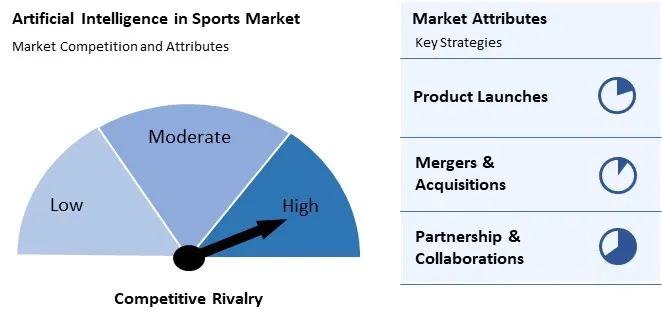
The Artificial Intelligence in Sports Market is highly competitive, driven by rapid technological advancements and increasing demand for performance analytics, injury prevention, and fan engagement solutions. Key players like IBM, SAS, and Microsoft compete with specialized startups offering niche AI applications. The market sees continuous innovation in computer vision, predictive analytics, and wearable tech integration. Strategic collaborations with sports franchises and broadcasters intensify competition, while barriers to entry remain moderate due to high data requirements and domain-specific algorithm development.
| Report Attribute | Details |
|---|---|
| Market size value in 2024 | USD 7.72 Billion |
| Market size forecast in 2032 | USD 34.41 Billion |
| Base Year | 2024 |
| Historical Period | 2021 to 2023 |
| Forecast Period | 2025 to 2032 |
| Revenue Growth Rate | CAGR of 20.8% from 2025 to 2032 |
| Number of Pages | 314 |
| Number of Tables | 342 |
| Report coverage | Market Trends, Revenue Estimation and Forecast, Segmentation Analysis, Regional and Country Breakdown, Competitive Landscape, Market Share Analysis, Porter’s 5 Forces Analysis, Company Profiling, Companies Strategic Developments, SWOT Analysis, Winning Imperatives |
| Segments covered | Offering, Sports Type, Technology, Region |
| Country scope |
|
| Companies Included | IBM Corporation, Microsoft Corporation, Trumedia Networks, Inc., Google LLC (Alphabet Inc.), SAP SE, Stats Perform Group, SAS Institute Inc., Oracle Corporation, Sportradar Group AG and Catapult Group International Ltd. |
By Offering
By Sports Type
By Technology
By Geography
This Market size is expected to reach $34.41 billion by 2032.
Performance Optimization and Injury Prevention are driving the Market in coming years, however, Data Privacy and Ethical Concerns restraints the growth of the Market.
IBM Corporation, Microsoft Corporation, Trumedia Networks, Inc., Google LLC (Alphabet Inc.), SAP SE, Stats Perform Group, SAS Institute Inc., Oracle Corporation, Sportradar Group AG and Catapult Group International Ltd.
The expected CAGR of this Market is 20.8% from 2023 to 2032.
The Gen AI segment is leading the Market by Technology in 2024; thereby, achieving a market value of $17.42 billion by 2032.
The North America region dominated the Market by Region in 2024, and would continue to be a dominant market till 2032; thereby, achieving a market value of $12.32 billion by 2032.
Our team of dedicated experts can provide you with attractive expansion opportunities for your business.












 Unique Offerings