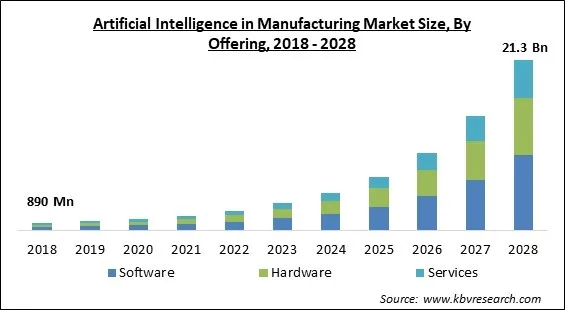
The Global Artificial Intelligence in Manufacturing Market size is expected to reach $21.3 billion by 2028, rising at a market growth of 43.4% CAGR during the forecast period.
In recent years, artificial intelligence has become one of the fastest-growing technology. AI is linked to human intellect and shares similar traits like language comprehension, thinking, learning, problem solving, and so on. In the development and revision of such a technology, manufacturers in the market face huge underlying intellectual obstacles. AI is at the heart of the market's next-generation software technologies.
The implementation of artificial intelligence in the manufacturing sector is growing due to increased automation in the manufacturing industry and increased demand for big data integration. Moreover, the artificial intelligence in manufacturing market is being driven by the increased use of machine vision cameras in industrial applications such as machinery inspection, material movement, field service, and quality control. Furthermore, leading market players are employing a variety of methods, such as product launch and product innovation, to increase their current product portfolio and maintain competition in the quickly expanding AI industry. Oracle, for example, released new artificial intelligence-based apps for supply chain, manufacturing, and other professionals in October 2017. IBM released Watson Assistant, an AI-powered business assistant, in 2018. This product is an artificial intelligence-enabled smart enterprise assistant.
Artificial intelligence (AI) in manufacturing supply chains can forecast demand trends for items across time, socioeconomic segments, and geographical marketplaces. Prominent corporations are incorporating AI into their systems in order to boost client happiness. For example, GE launched the Brilliant Manufacturing Suite to enable customers to create their Brilliant Factory concept. Moreover, the use of automation and big data in the manufacturing business reduces risks throughout manufacturing processes and allows customers to receive rapid responses, improving the customer experience. However, some human vocations are projected to be replaced by AI-based technological systems in the near future.
To stop the spread of the COVID-19 pandemic, unprecedented lockdowns were enacted around the world, and many manufacturing units were shut down. The pandemic wreaked havoc on the global population and the virus killed millions of people around the world. It also had a drastically negative impact on the manufacturing sector. The disposable income of many people dropped. This resulted in lower demand for industrial items and, as a result, slowed global economic activity. Many countries are in the process of recovering from the ill effects of the pandemic. Improvements in manufacturing plant operating efficiency, rising application of AI in intelligent business operations, and increasing deployment of automation technologies to mitigate the consequences of COVID-19 are all prospects for AI in the manufacturing industry.
The Industrial Internet of Things (IIoT) enables an architecture that offers real-time information about operational and business systems, making industrial operations more efficient, productive, and inventive. The data collected by IoT devices must be transformed into instructions that tell machines how to execute specific tasks. These instructions were created by an AI system that used deep learning, context awareness, and natural language processing to learn human behavior (NLP). AI-based systems function faster and are less likely to make mistakes. As a result, manufacturing efficiency improves, assisting in business expansion.
Companies in the manufacturing industry have access to a wealth of data collection and tracking resources. Big data, also known as sensor data, production data, IoT-driven systems, and manufacturing software, is exceedingly massive and difficult for humans to understand. Since vast volumes of structured and unstructured data from a variety of sources can be examined rapidly, AI and big data analytics have emerged as viable solutions for important manufacturing concerns. Organizations can interpret data and detect anomalies using AI and machine learning algorithms, minimize maintenance costs, improve customer service, increase predictive and preventative maintenance, and use raw data to support decision-making.
Artificial intelligence (AI) provides firms with tools to improve their predictive maintenance and machinery inspection processes. But, manufacturers, on the other hand, are hesitant to incorporate new technologies, particularly AI-based solutions, into their expensive machines and equipment. Any errors in management could increase the costs. Furthermore, many manufacturers are skeptical of AI-based systems' ability to accurately perform maintenance and inspection tasks. Given these considerations, persuading manufacturers and persuading them that AI-based solutions are cost-effective, effective, and safe is a little more difficult. However, some manufacturers are increasingly accepting of the potential benefits of AI-based solutions and the range of applications they can support.
Based on Offering, the market is segmented into Software, Hardware, and Services. The hardware segment procured a substantial revenue share in the artificial intelligence in manufacturing market in 2021. The AI program is executed on hardware that includes processors and logic circuits, among other things. AI requires its processing units, which is anticipated to increase hardware demand. In addition, according to PWC, AI hardware vendors are expanding and consolidating their market share.
Based on Application, the market is segmented into Predictive maintenance & Machinery Inspection, Inventory Optimization, Quality Control, Cybersecurity, Industrial robots, Field Services, Production Planning, and Others. The predictive maintenance and machinery inspection segment acquired the largest revenue share in the artificial intelligence in manufacturing market. This is due to these technologies (vibration analysis, infrared thermography, motor circuit analysis, and so on) detecting faults that were missed by prior inspection methods while the machine is in use. Condition monitoring, also known as predictive maintenance (PdM), is the early detection and eradication of equipment faults that could result in unplanned downtime or wasteful expenditures using condition-based monitoring technologies, statistical process control, or equipment performance.
Based on Technology, the market is segmented into Machine Learning, Computer Vision, Natural Language Processing, and Context-aware Computing. The computer vision segment procured a substantial revenue share in the artificial intelligence in manufacturing market in 2021. This is due to artificial intelligence, along with computer vision techniques, aiding in the faster completion of jobs. The robots can better understand and navigate in the factory environment and around humans with the use of computer vision. The use of AI-based computer vision in smart factories aids in the detection of flaws and problems in the final product. The technology improves the factory's workflow even further. Micron Technology Inc., for example, manufactures memory technology on silicon wafers. This is a highly precise and sophisticated process with a significant likelihood of flaws that are not visible to the naked eye.
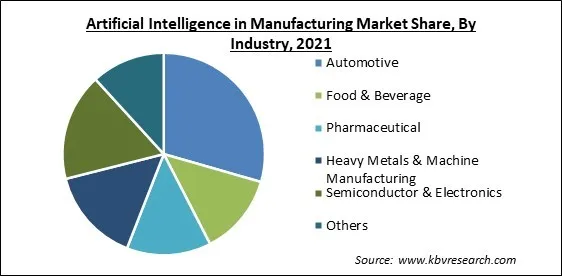
Based on Industry, the market is segmented into Automotive, Food & Beverage, Pharmaceutical, Heavy Metals & Machine Manufacturing, Semiconductor & Electronics, and Others. The semiconductor and electronics segment procured a substantial revenue share in the artificial intelligence in manufacturing market in 2021. This is due to artificial intelligence (AI) being employed in the semiconductor and electronics sector for production planning, quality control, and material mobility. AI-based solutions are projected to aid manufacturers in lowering production costs, implementing new technologies, and integrating components. Electronics equipment production is a complicated process that necessitates real-time manufacturing data.
| Report Attribute | Details |
|---|---|
| Market size value in 2021 | USD 1.8 Billion |
| Market size forecast in 2028 | USD 21.3 Billion |
| Base Year | 2021 |
| Historical Period | 2018 to 2020 |
| Forecast Period | 2022 to 2028 |
| Revenue Growth Rate | CAGR of 43.4% from 2022 to 2028 |
| Number of Pages | 359 |
| Number of Tables | 533 |
| Report coverage | Market Trends, Revenue Estimation and Forecast, Segmentation Analysis, Regional and Country Breakdown, Competitive Landscape, Companies Strategic Developments, Company Profiling |
| Segments covered | Offering, Application, Technology, Industry, Region |
| Country scope | US, Canada, Mexico, Germany, UK, France, Russia, Spain, Italy, China, Japan, India, South Korea, Singapore, Malaysia, Brazil, Argentina, UAE, Saudi Arabia, South Africa, Nigeria |
| Growth Drivers |
|
| Restraints |
|
Based on Regions, the market is segmented into North America, Europe, Asia Pacific, and Latin America, Middle East & Africa. The Asia Pacific region acquired the largest revenue share in the artificial intelligence in manufacturing market in 2021. To study innovative technologies, Japan has developed the Industrial Value Chain Initiative. Among the leading corporations that cater to big industries in the electric, IT, machinery, and automobile fields are Mitsubishi Electric, Fujitsu, Nissan Motor, and Panasonic. For a long time, connected machines and transport robots have been employed on the shop floor of corporations like Toyota. Furthermore, the government has promoted IT initiatives around the country. Information and communication technology, manufacturing processes, the automotive and industrial sectors, automation and robot technologies, and electronic parts are all strong areas for Japan.
Free Valuable Insights: Global Artificial Intelligence in Manufacturing Market size to reach USD 21.3 Billion by 2028
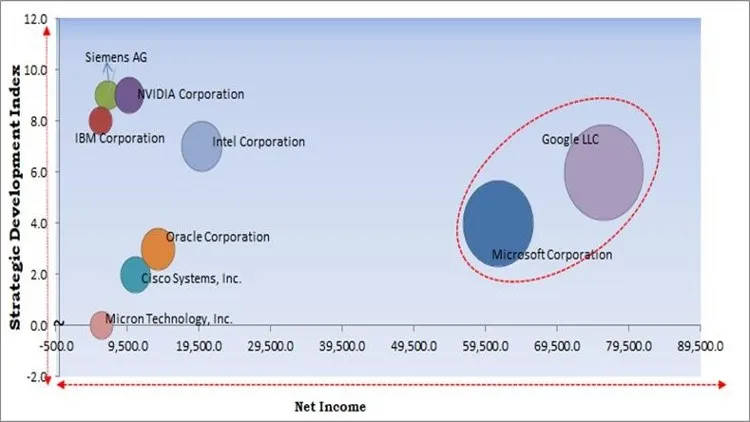
The major strategies followed by the market participants are Product Launches. Based on the Analysis presented in the Cardinal matrix; Apple, Inc. and Google, Inc. are the forerunners in the Artificial Intelligence in Manufacturing Market. Companies such as IBM Corporation, Intel Corporation, and NVIDIA are some of the key innovators in the Market.
The market research report covers the analysis of key stake holders of the market. Key companies profiled in the report include NVIDIA Corporation, Cisco Systems, Inc., Microsoft Corporation, IBM Corporation, Intel Corporation, Oracle Corporation, Google LLC, Micron Technology, Inc., Siemens AG, and General Electric (GE) Co.
By Offering
By Application
By Technology
By Industry
By Geography

The artificial intelligence in manufacturing market size is projected to reach USD 21.3 billion by 2028.
Developing industrial IoT and automation technologies are driving the market in coming years, however, hesitancy among manufacturers to adopt AI-based technologies growth of the market.
NVIDIA Corporation, Cisco Systems, Inc., Microsoft Corporation, IBM Corporation, Intel Corporation, Oracle Corporation, Google LLC, Micron Technology, Inc., Siemens AG, and General Electric (GE) Co.
The Software segment acquired maximum revenue share in the Global artificial intelligence in manufacturing Market by Offering in 2021, thereby, achieving a market value of $9,452.3 million by 2028.
The Machine Learning segment is leading the Global artificial intelligence in manufacturing Market by Technology in 2021; thereby, achieving a market value of $8,773.5 million by 2028.
The Asia Pacific is the fastest growing region in the Global artificial intelligence in manufacturing Market by Region in 2021, and would continue to be a dominant market till 2028.
Our team of dedicated experts can provide you with attractive expansion opportunities for your business.



 Unique Offerings