“Global Application Modernization Services Market to reach a market value of USD 62.61 Billion by 2032 growing at a CAGR of 16.3%”
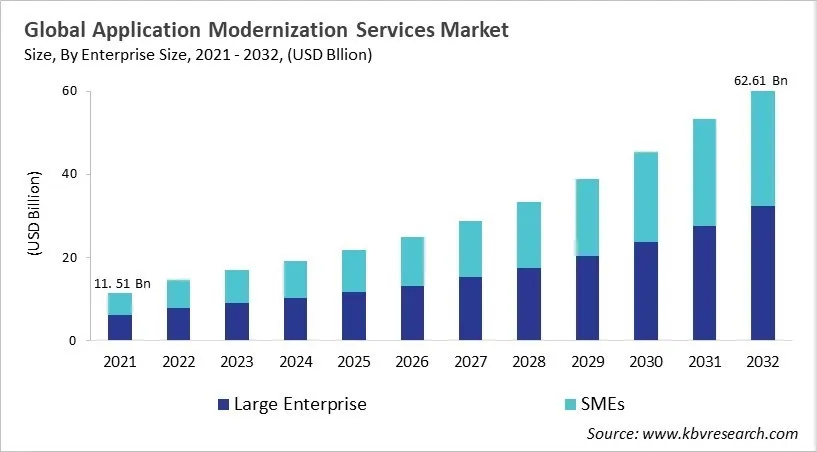
The Global Application Modernization Services Market size is estimated at $21.78 billion in 2025 and is expected to reach $62.61 billion by 2032, rising at a market growth of 16.3% CAGR during the forecast period. The market is growing rapidly due to increasing enterprise demand for cloud migration, legacy system upgrades, and digital transformation. Rising adoption of AI, DevOps, and microservices, coupled with the need for enhanced operational efficiency and scalability, drives the market.
Application modernization services include professional offerings that help enterprises in transforming into modern, scalable, cloud-ready systems aligned with developing business and digital strategies. Modernization gained significant traction with the growth of microservices, containers, architectures, and DevOps. Key technology giants like IBM, AWS, and Microsoft frame modernization as a portfolio-driven process involving rationalization, assessment, and selective rearchitecting, rehosting, refactoring, or replacing applications. Application services are crucial to organization digital transformation initiatives across public and private sectors, allowing enhanced scalability, compliance, resilience, and cost-efficiency, especially as enterprises and governments modernize aging IT systems to support AI-enabled and data-driven operations.
The application modernization market is shaped by key trends, including AI and automation-driven modernization, cloud-native adoption, API-first design, microservices, and embedded DevSecOps practices. Enterprises largely move toward re-architecting and re-platforming applications to fully leverage PaaS, IaaS, Kubernetes, containers, and serverless technologies, often in multicloud and hybrid environments. The competitive landscape include system integrators, IT service firms, global cloud providers, and IT service firms like Accenture, TCS, Microsoft, IBM, and AWS, positioning themselves ahead through cloud partnerships, industry expertise, modernization frameworks, and AI tooling. Application modernization service has developed into a continued, strategic capability that bridges the gap between legacy systems and digital architectures.
The major strategies followed by the market participants are Partnerships as the key developmental strategy to keep pace with the changing demands of end users. For instance, In September, 2024, Oracle Corporation teamed up with Amazon Web Services (AWS) and enabled customers to run Oracle database services directly on AWS infrastructure. This collaboration aims to provide greater flexibility, performance, and scalability, helping businesses modernize IT environments and streamline cloud operations across both Oracle Cloud and AWS platforms. Moreover, In April, 2025, Tata Consultancy Services Ltd. teamed up with Google Cloud to drive AI-led transformation in the retail sector. The collaboration will help retailers enhance customer experiences, optimize operations, and accelerate growth using generative AI solutions. This strategic alliance combines TCS’ industry expertise with Google Cloud’s advanced AI capabilities for impactful business innovation.
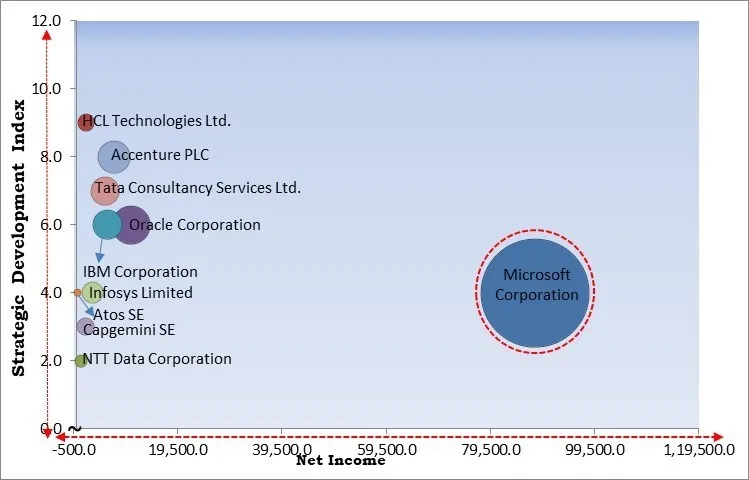
Based on the Analysis presented in the KBV Cardinal matrix; Microsoft Corporation is the forerunner in the Application Modernization Services Market. In November, 2024, Microsoft Corporation teamed up with Kyndryl and introduced new application modernization services and generative AI tools to help mainframe customers transition to Microsoft Cloud. These innovations aim to simplify legacy application transformation, improve operational efficiency, and accelerate cloud adoption, empowering enterprises to modernize their IT infrastructure with advanced AI-driven capabilities. Companies such as Oracle Corporation, Accenture PLC, and IBM Corporation are some of the key innovators in Application Modernization Services Market.
The COVID-19 pandemic made it much harder for businesses to modernize their applications because they put business continuity, emergency operations, and enabling remote work ahead of long-term digital transformation projects. Key sectors like retail, manufacturing, travel, and hospitality saw budget cuts and lower revenues, which led to modernization efforts being put on hold or canceled. This lowered demand for services like application refactoring, re-platforming, and cloud migration. Lockdowns, limited on-site access, and problems with remote collaboration made it harder for service providers to do their jobs. This led to longer project timelines and higher implementation risks. Workforce issues like not having enough skilled workers, burnout, and hiring freezes made it even harder to finish projects. Moving quickly to remote work environments also created problems with security, infrastructure, and compliance. As a result, the pandemic had a big negative impact on the market for modernizing applications. Thus, the COVID-19 pandemic had a Negative impact on the market.

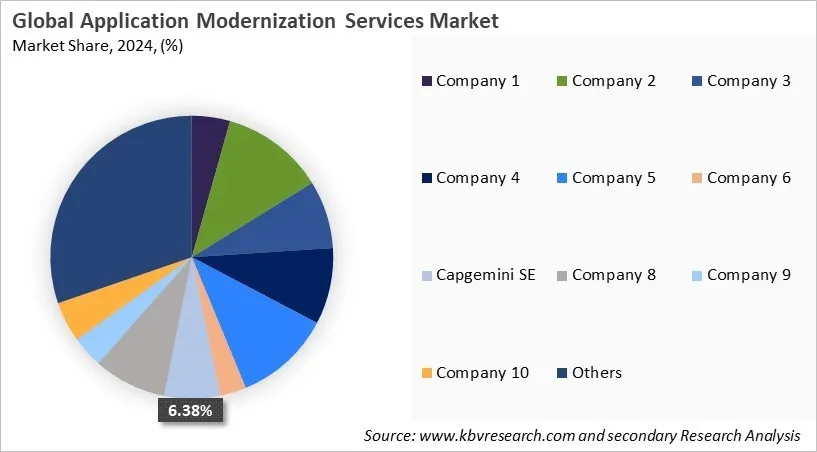
The leading players in the market are competing with diverse innovative offerings to remain competitive in the market. The above illustration shows the percentage of revenue shared by some of the leading companies in the market. The leading players of the market are adopting various strategies in order to cater demand coming from the different industries. The key developmental strategies in the market are Acquisitions, and Partnerships & Collaborations.
Free Valuable Insights: Application Modernization Services Market size to reach USD 62.61 Billion by 2032
Based on Enterprise Size, the market is segmented into Large Enterprise and SMEs. The SMEs segment acquired 46% revenue share in the market in 2024. Small and medium-sized enterprises form an important segment of the Application Modernization Services Market, driven by the need to enhance agility, reduce operational complexity, and improve customer engagement through modern digital applications. SMEs often focus on modernizing select business-critical applications rather than entire portfolios, favoring cloud-based deployment, modular upgrades, and platform-as-a-service models.
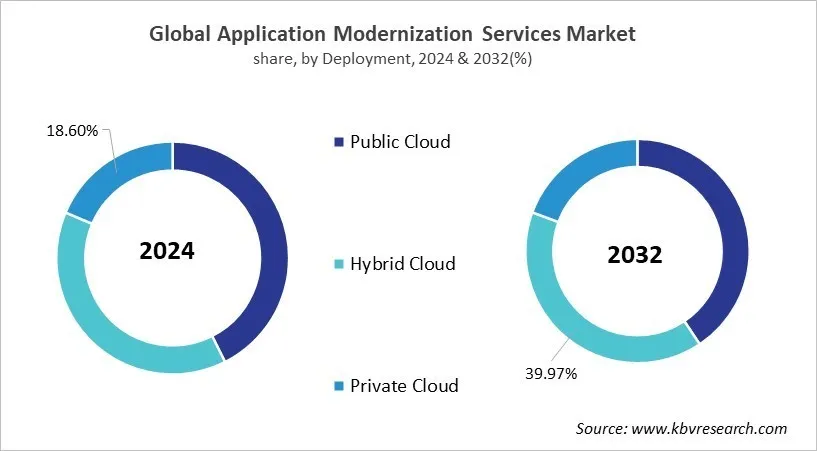
Based on Deployment, the market is segmented into Public Cloud, Hybrid Cloud and Private Cloud. The Hybrid Cloud segment attained 39% revenue share in the market in 2024. The Hybrid Cloud segment reflects organizations modernizing applications while maintaining a balance between on-premise systems and cloud environments. Application modernization in hybrid deployments prioritizes interoperability, data consistency, and seamless workload orchestration across multiple platforms. Enterprises in this segment focus on integrating modernized applications with existing legacy systems while enabling gradual cloud adoption.
Region-wise, the Application Modernization Services Market is analyzed across North America, Europe, Asia Pacific, and LAMEA. The North America segment recorded 39% revenue share in the market in 2024. The application modernization services market is anticipated to grow at a substantial rate in North America and Europe regions. This is because of widespread digital transformation initiatives, advanced cloud adoption, and the presence of major technology service vendors and enterprise IT budgets. The US region witness a high rate of modernization projects across industry like healthcare, government, and finance, and strong adoption of cloud-native and hybrid architectures driven by leading hyperscale cloud vendors. Also, Canada is experiencing expansion owing to public sector modernization and mid-market cloud migration efforts. The regional market further benefits significantly from innovation ecosystems, robust regulatory frameworks, and a dense service-provider landscape that raises demand for refactoring, rehosting, and AI-augmented modernization services. Moreover, Europe region application modernization services market is expected to expand at a steady pace. The growth in supported by regulatory pressure like GDPR, digital transformation mandates, and industry-specific modernization needs in financial services, public institutions, and manufacturing. Organizations in key European markets prioritize hybrid cloud modernization and compliance-led transformation.
In the Asia Pacific and LAMEA regions, the application modernization services market is projected to grow at a rapid rate. This is due to strong government-backed technology initiatives and rapid digitalization across Japan, India, China, and South Korea. Regional enterprises modernize traditional systems to support Industry 4.0 adoption, cloud-native architectures, and digital transformation in e-commerce, banking, and government industry. The region’s expanding IT services ecosystem is predicted to continue to experience robust demand for modernization solutions. Additionally, the LAMEA application modernization services market is witnessing rapid growth. The market is propelled by rising cloud adoption, modernization of traditional infrastructure in industries such as public services and telecom, and digital government initiatives.
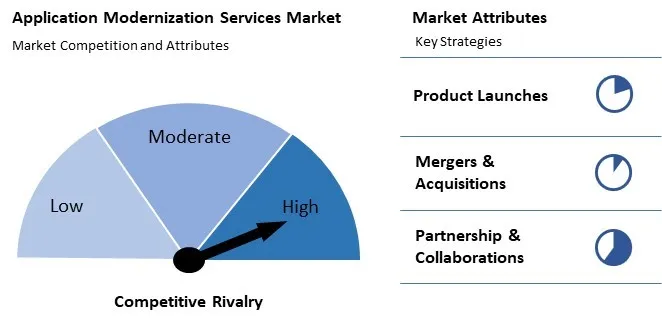
The Application Modernization Services market is very competitive because more and more businesses want to go digital. To get clients, providers focus on standing out by offering new solutions, high-quality service, and specialized knowledge. Key competitive levers are strategic partnerships, flexible engagement models, and services that add value. Technological progress never stops, and customer expectations are always changing. This makes competition even tougher, forcing companies to constantly improve their skills and use new technologies to stay relevant and keep their place in the market in this fast-changing and dynamic environment.
| Report Attribute | Details |
|---|---|
| Market size value in 2025 | USD 21.78 Billion |
| Market size forecast in 2032 | USD 62.61 Billion |
| Base Year | 2024 |
| Historical Period | 2021 to 2023 |
| Forecast Period | 2025 to 2032 |
| Revenue Growth Rate | CAGR of 16.3% from 2025 to 2032 |
| Number of Pages | 648 |
| Number of Tables | 508 |
| Report coverage | Market Trends, Revenue Estimation and Forecast, Segmentation Analysis, Regional and Country Breakdown, Competitive Landscape, Market Share Analysis, Porter’s 5 Forces Analysis, Company Profiling, Companies Strategic Developments, SWOT Analysis, Winning Imperatives |
| Segments covered | Enterprise Size, Deployment, Industry Vertical, Service Type, Region |
| Country scope |
|
| Companies Included | Oracle Corporation, IBM Corporation, Microsoft Corporation, HCL Technologies Ltd. (HCL Enterprises), Accenture PLC, Atos SE, Capgemini SE, Tata Consultancy Services Ltd., NTT Data Corporation, and Infosys Limited |
By Enterprise Size
By Deployment
By Industry Vertical
By Service Type
By Geography
This Market size is expected to reach USD 62.61 Billion by 2032.
The application modernization services market is projected to grow at a CAGR of 16.3% between 2025 and 2032.
Digital transformation initiatives to enhance business agility, combined with rising security, compliance, and risk mitigation needs, are driving market growth.
Oracle Corporation, IBM Corporation, Microsoft Corporation, HCL Technologies Ltd. (HCL Enterprises), Accenture PLC, Atos SE, Capgemini SE, Tata Consultancy Services Ltd., NTT Data Corporation, and Infosys Limited.
The Large Enterprise segment captured the maximum revenue in the Global Application Modernization Services Market by Enterprise Size in 2024, thereby, achieving a market value of $32.3 billion by 2032.
The North America region dominated the Global Application Modernization Services Market by Region in 2024, and would continue to be a dominant market till 2032; thereby, achieving a market value of $23.4 billion by 2032.
Our team of dedicated experts can provide you with attractive expansion opportunities for your business.







 Unique Offerings