“Global Animal Feed Micronutrients Market to reach a market value of USD 2.39 Billion by 2032 growing at a CAGR of 9.2%”
The Global Animal Feed Micronutrients Market size is expected to reach USD 2.39 billion by 2032, rising at a market growth of 9.2% CAGR during the forecast period.
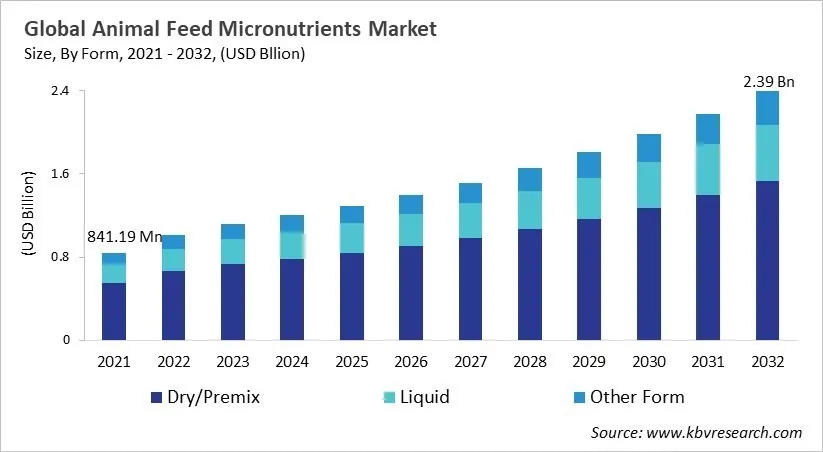
The animal feed micronutrients market has recently become a highly specialized genre focusing on the important role of minerals and vitamins in health, growth, productivity, and livestock. The market is witnessing a significant shift toward chelated and organic forms with the advancements in environmental safety and bioavailability. This transition is also supported by the regulatory bodies ensuring feed safety and quality. Also, the demand for balanced feed formulations and precision nutrition is rapidly increasing owing to the changing consumer preferences for high-quality animal protein. With the growing livestock production across the globe, micronutrients have also become important in enhancing fertility, disease resistance, and immunity, thereby making them crucial for sustainable animal production.
The animal feed micronutrients market is expanding, supported by elements including the rapid growth in developing nations and the increase in sustainability-focused solutions and precision nutrition. Personalized micronutrient blends are allowing the providers to enhance productivity, feed efficiency, and animal health while reducing waste. Further, the environmental concerns are encouraging the adoption of eco-friendly delivery and formulation systems. The surging demand for animal protein from regions such as Latin America and Asia is resulting in strong growth opportunities. The market is intensively competitive among multinational corporations with global networks and robust R&D, and startups are thriving by cost-effective solutions.

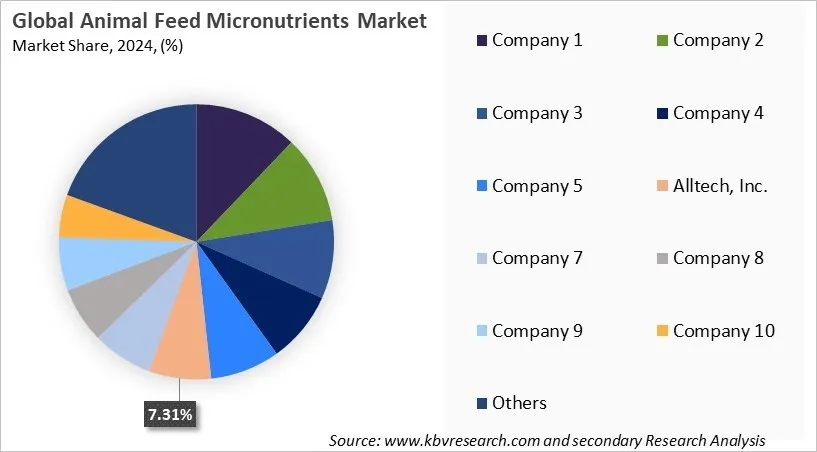
The leading players in the market are competing with diverse innovative offerings to remain competitive in the market. The above illustration shows the percentage of revenue shared by some of the leading companies in the market. The leading players of the market are adopting various strategies in order to cater demand coming from the different industries. The key developmental strategies in the market are Acquisitions, and Partnerships & Collaborations.
The COVID-19 pandemic hurt the animal feed micronutrients market because it caused big problems with the supply chain, such as a lack of raw materials, limits on transportation, and higher production costs. Labor shortages and restrictions on movement made it harder for livestock operations to work, which lowered the demand for feed. Market needs went down even more because people ate less meat when restaurants and food services closed. Export restrictions and import delays created price volatility and supply instability. Overall, the pandemic caused fewer sales, problems with running the business, and slower growth in the feed micronutrients sector. Thus, the COVID-19 pandemic had negative impact on the market.
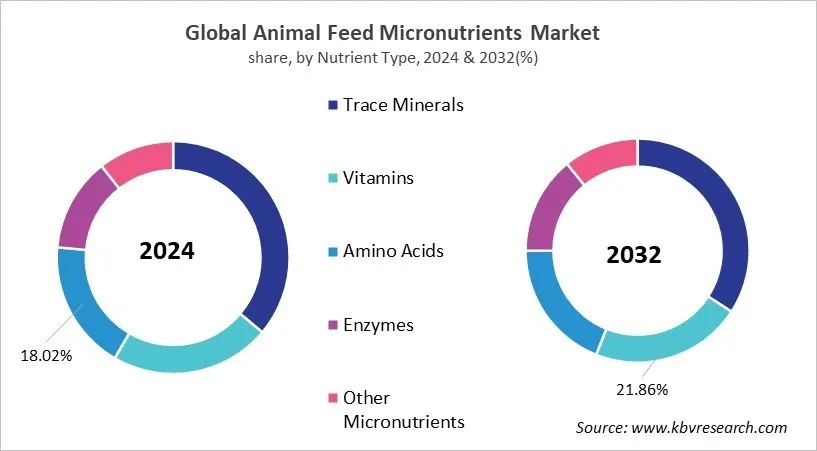
Based on Nutrient Type, the market is segmented into Trace Minerals, Vitamins, Amino Acids, Enzymes, and Other Micronutrients. The vitamins segment recorded 22% revenue share in the animal feed micronutrients market in 2024. The vitamins segment is another critical component of the market. Vitamins are essential for regulating metabolic processes, enhancing immune function, and improving overall animal vitality. They contribute to better growth rates, feed efficiency, and disease resistance in livestock.
Free Valuable Insights: Global Animal Feed Micronutrients Market size to reach USD 2.39 Billion by 2032
Based on Form, the market is segmented into Dry/Premix, Liquid, and Other Form. The liquid segment attained 22% revenue share in the animal feed micronutrients market in 2024. The liquid form of animal feed micronutrients is gaining traction as it offers flexibility in application and can be directly added to water or mixed into feed. This form is particularly useful for improving nutrient absorption and providing quick supplementation, especially in intensive livestock farming practices.
Region-wise, the animal feed micronutrients market is analyzed across North America, Europe, Asia Pacific, and LAMEA. The Asia Pacific segment gained 42% revenue share in the animal feed micronutrients market in 2024. The animal feed micronutrients market is expected to experience growth in the North America and Europe regions. This is due to the factors, including stringent regulatory frameworks, high consumer demand, and advanced livestock farming practices. Market players in these regions are prioritizing sustainability, precision nutrition, and compliance with stringent feed safety regulations. The emphasize on the utilization of eco-friendly and bioavailable micronutrient formulations to improve productivity, welfare, and animal health while reducing environmental impacts like soil mineral accumulation. Both Europe and North America regions are showcasing wide acceptance of innovative feed technologies, led by developed feed companies and research partnerships.
In the Asia Pacific and LAMEA regions, the animal feed micronutrients market is predicted to grow at a steady rate. This is driven by the increasing urbanization, rising consumption of animal protein, and growing disposable income. The Asia Pacific region is experiencing rapid growth in the livestock industry, which results in significant demand for micronutrient-rich feed to improve productivity. The LAMEA region is also showcasing profitable market opportunities supported by the rising dairy & meat production, especially in the Middle East and Brazil. The animal feed micronutrients market is growing rapidly, with global as well as regional players investing in localized solutions to cater to regional nutritional requirements.
| Report Attribute | Details |
|---|---|
| Market size value in 2025 | USD 1.29 Billion |
| Market size forecast in 2032 | USD 2.39 Billion |
| Base Year | 2024 |
| Historical Period | 2021 to 2023 |
| Forecast Period | 2025 to 2032 |
| Revenue Growth Rate | CAGR of 9.2% from 2025 to 2032 |
| Number of Pages | 482 |
| Number of Tables | 390 |
| Report coverage | Market Trends, Revenue Estimation and Forecast, Segmentation Analysis, Regional and Country Breakdown, Market Share Analysis, Porter’s 5 Forces Analysis, Company Profiling, Companies Strategic Developments, SWOT Analysis, Winning Imperatives |
| Segments covered | Form, Nutrient Type, Livestock, Region |
| Country scope |
|
| Companies Included | Cargill, Incorporated, Archer Daniels Midland Company, DSM-Firmenich, BASF SE, Nutreco N.V. (SHV Holdings N.V.), Alltech, Inc., Evonik Industries AG (RAG-Stiftung), Kemin Industries, Inc., Balchem Corporation, and Zinpro Corporation |
By Form
By Nutrient Type
By Livestock
By Geography
This Market size is expected to reach USD 2.39 Billion billion by 2032.
The animal feed micronutrients market is projected to grow at a CAGR of 9.2% between 2025 and 2032.
Rising demand for high-quality animal protein coupled with growing awareness of animal health and immunity.
Cargill, Incorporated, Archer Daniels Midland Company, DSM-Firmenich, BASF SE, Nutreco N.V. (SHV Holdings N.V.), Alltech, Inc., Evonik Industries AG (RAG-Stiftung), Kemin Industries, Inc., Balchem Corporation, and Zinpro Corporation
The Trace Minerals segment led the maximum revenue in the Global Animal Feed Micronutrients Market by Nutrient Type in 2024, thereby, achieving a market value of USD 819.5 million by 2032.
The Asia Pacific region dominated the Global Animal Feed Micronutrients Market by Region in 2024, thereby, achieving a market value of USD 1,034.3 million by 2032.
Our team of dedicated experts can provide you with attractive expansion opportunities for your business.







 Unique Offerings