“Global Alternative Legal Services Providers (ALSP) Market to reach a market value of USD 44.69 Billion by 2032 growing at a CAGR of 8.2%”
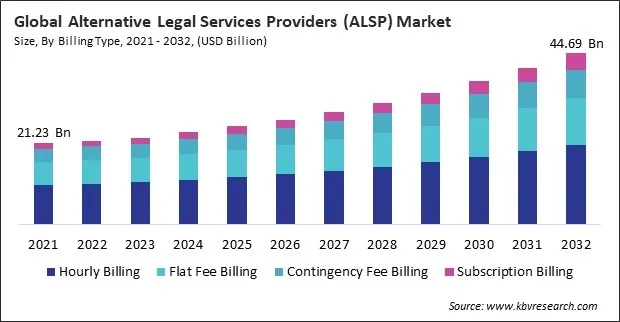
The Global Alternative Legal Services Providers (ALSP) Market size is expected to reach $44.69 billion by 2032, rising at a market growth of 8.2% CAGR during the forecast period.
Due to the high demand from companies looking for help with governance, mergers and acquisitions, regulatory compliance, intellectual property management, and contract lifecycle management, corporate legal services make up the largest segment of the ALSP market. In this field, ALSPs provide scalable and affordable solutions, frequently utilizing legal technology to expedite corporate filings, document automation, and due diligence. Businesses are increasingly looking to ALSPs for flexible, specialized support that enhances or supplements internal legal departments as they place a higher priority on efficiency and legal risk management. The corporate segment's growth is still driven by the allure of consistent pricing and faster turnaround times. Thus, the corporate segment acquired 31% revenue share in the alternative legal services providers (ALSP) market in 2024.

There is growing pressure on law firms and corporate legal departments to cut expenses without sacrificing the quality of their legal work. This pressure comes from a larger business need for financial restraint, particularly considering volatile economies, cutthroat international markets, and growing customer demands for value-based billing and cost transparency. Therefore, increasing reliance on ALSPs as effective, cost-effective solutions for both routine and specialized legal tasks is being significantly accelerated by the mounting cost pressures that law firms and legal departments are facing.
ALSPs can now provide services with previously unheard-of speed, accuracy, and scalability thanks to technological advances that have also drastically changed the environment in which they operate. In the legal function, technologies like blockchain, robotic process automation (RPA), natural language processing (NLP), machine learning (ML), and artificial intelligence (AI) are being used more. Therefore, automation and legal technology developments have been crucial in enabling ALSPs to provide high-accuracy, scalable, and reasonably priced services that are changing client expectations in the legal services sector. The adoption of ALSP in fundamental legal functions is thus still severely constrained by client perception, which is fueled by concerns about quality, credibility, and institutional legitimacy.
Client trust, however, continues to be a fundamental barrier impeding the expansion of ALSPs, even despite their increasing use. Particularly among businesses that depend on reputable, long-standing law firms, the traditional legal services model is firmly established. These firms are frequently the go-to option for high-stakes legal matters because of the reputation they have developed over the years.
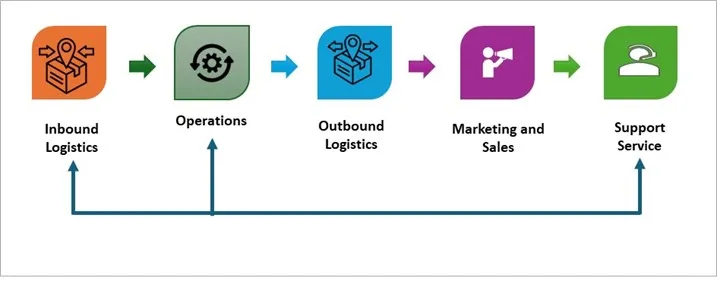
The value chain of Alternative Legal Services Providers (ALSPs) includes several key stages that enhance service delivery and cost efficiency. Inbound Logistics involves sourcing legal talent, technology platforms, and client data. Operations focus on document review, legal research, contract management, and compliance processing using AI and legal tech. Outbound Logistics entails delivering legal outputs—such as completed contracts, risk assessments, or legal memos—to clients via secure digital channels. Marketing and Sales includes showcasing tech-enabled capabilities and industry-specific expertise to attract corporate clients and law firms. Lastly, Support Service ensures ongoing client engagement, legal updates, and system maintenance for long-term value.
Alternative Legal Services Providers (ALSPs) saw a spike in demand during the COVID-19 pandemic as a result of the legal industry's rapid acceleration of digital transformation. Due to operational disruptions and remote work requirements, law firms and corporate legal departments have resorted to ALSPs for technologically advanced solutions. ALSPs had previously made investments in cloud-based contract management, automation, and document review driven by AI. They were therefore in a good position to meet the pressing demand for digital workflows, allowing customers to continue operating even during lockdowns. Consequently, the market benefited from the COVID-19 pandemic.
Based on billing type, the alternative legal services providers (ALSP) market is characterized into hourly billing, flat fee billing, contingency fee billing, and subscription billing segment. The flat fee billing segment procured 28% revenue share in the alternative legal services providers (ALSP) market in 2024. Clients who value budget control and cost predictability are increasingly choosing flat fee billing. In this model, ALSPs charge a set, fixed price for services that are well defined, like drafting contracts, reviewing documents, conducting compliance audits, or handling e-discovery.
| Category | Details |
|---|---|
| Use Case Title | Confidential |
| Date | 2025 |
| Entities Involved | Confidential |
| Objective | Deliver scalable, predictable legal services for routine contracts via flat-fee engagement models supported by automation. |
| Context and Background | Corporate legal teams are moving away from hourly pricing for routine, high-volume work such as NDAs and MSAs. Flat fee models allow for cost predictability, but demand operational maturity from ALSPs to remain profitable. |
| Description | UnitedLex implemented a flat-fee service for Uber’s contract lifecycle support, focused on vendor and partnership agreements. Ironclad’s CLM engine auto-classified contracts by risk tier, enabling UnitedLex’s legal operations team to process them in batches with guaranteed SLAs. Monthly invoices were based on volume bands rather than hourly logs, reducing administrative complexity. By standardizing clause-level review and response templates, UnitedLex cut review time by 40%, while Uber gained a fixed cost structure to forecast legal spend. |
| Key Capabilities Deployed |
|
| Regions Covered |
|
| Benefits |
|
| Source | Confidential |
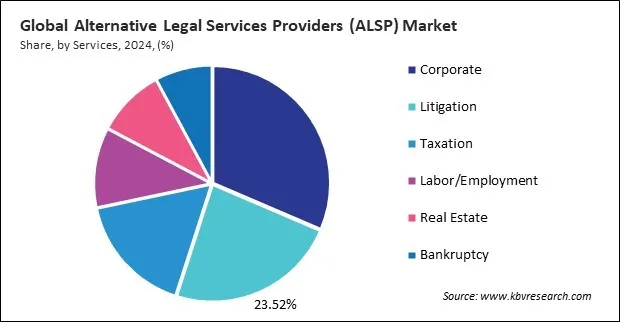
On the basis of services, the alternative legal services providers (ALSP) market is classified into corporate, litigation, taxation, labor/employment, real estate, and bankruptcy. The taxation segment witnessed 17% revenue share in the alternative legal services providers (ALSP) market in 2024. ALSPs provide legal services pertaining to taxes, such as risk mitigation, documentation preparation, compliance with changing regulations, and assistance with corporate tax planning. For multinational firms navigating cross-border tax laws and regulatory frameworks, these services are especially helpful.
Free Valuable Insights: Global Alternative Legal Services Providers (ALSP) Market size to reach USD 44.69 Billion by 2032
Region-wise, the alternative legal services providers (ALSP) market is analyzed across North America, Europe, Asia Pacific, and LAMEA. The North America segment recorded 44% revenue share in the alternative legal services providers (ALSP) market in 2024. North America leads the ALSP market, fueled by a mature legal ecosystem, high demand for cost-efficient legal solutions, and widespread adoption of legal technology.
| Report Attribute | Details |
|---|---|
| Market size value in 2024 | USD 24.19 Billion |
| Market size forecast in 2032 | USD 44.69 Billion |
| Base Year | 2024 |
| Historical Period | 2021 to 2023 |
| Forecast Period | 2025 to 2032 |
| Revenue Growth Rate | CAGR of 8.2% from 2025 to 2032 |
| Number of Pages | 295 |
| Number of Tables | 311 |
| Report coverage | Market Trends, Revenue Estimation and Forecast, Segmentation Analysis, Regional and Country Breakdown, Competitive Landscape, Porter’s 5 Forces Analysis, Company Profiling, Companies Strategic Developments, SWOT Analysis, Winning Imperatives |
| Segments covered | Billing Type, Services, Region |
| Country scope |
|
| Companies Included | Axiom Global Inc., Integreon, Inc., Elevate Services, Inc., Lawyers On Demand Limited, QuisLex, Inc., Morae Global Corporation, KPMG International Limited, Ernst & Young Global Limited, UnitedLex Corporation and Cognia Law (Pty) Ltd |
By Billing Type
By Services
By Geography
This Market size is expected to reach $44.69 billion by 2032.
Rising Cost Pressure on Legal Departments and Law Firms are driving the Market in coming years, however, Client Trust and Perception Issues restraints the growth of the Market.
Axiom Global Inc., Integreon, Inc., Elevate Services, Inc., Lawyers On Demand Limited, QuisLex, Inc., Morae Global Corporation, KPMG International Limited, Ernst & Young Global Limited, UnitedLex Corporation and Cognia Law (Pty) Ltd
The expected CAGR of this Market is 8.2% from 2023 to 2032.
The Hourly Billing segment is leading the Market by Billing Type in 2024; thereby, achieving a market value of $20.84 billion by 2032.
The North America region dominated the Market by Region in 2024, and would continue to be a dominant market till 2032; thereby, achieving a market value of $18.90 billion by 2032.
Our team of dedicated experts can provide you with attractive expansion opportunities for your business.







 Unique Offerings