“Global All-flash Array Market to reach a market value of USD 59.27 Billion by 2032 growing at a CAGR of 15.7%”
The Global All-flash Array Market size is expected to reach $59.27 billion by 2032, rising at a market growth of 15.7% CAGR during the forecast period.
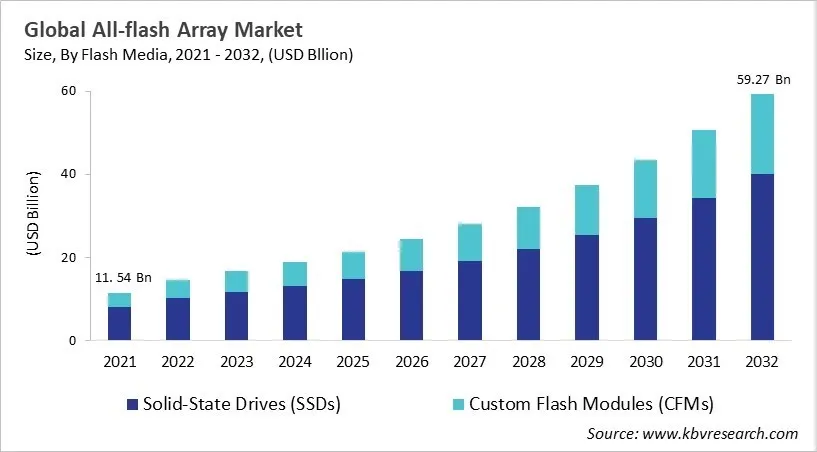
The all-flash array market has developed as a fully flash-based primary storage platform. The developments in NAND flash technology, NVMe/NVMe-oF protocols, and controller design allow AFAs to support databases along with analytics, virtualization, and AI pipelines. Enterprises deployed AFAs for their efficiency, sustainability, and performance benefits, phasing out power-hungry HDD estates. The emphasis has shifted to resilience and cyber-recovery, with rapid restore, and immutable snapshots becoming key safeguards against ransomware. These days, AFAs serve a broad range of workloads, developing into secure, energy-efficient, and resilient data platforms aligned with sustainability goals.
The all-flash array market is witnessing trends on full-stack NVMe adoption, QLC-optimized architectures, platformization around sustainability, AIOps, and security. Providers have refined software defined features such as deduplication, inline compression, policy-driven automation, and intelligent tiering to extend flash life. Enterprises are demanding solutions that deliver deep cyber-resilience against ransomware, operational simplicity through AIOps-based automation, and predictable low latency for mission-critical usage. The market seems to be competitive where platforms that combine QLC economics with strong security, sustainability credentials, and enterprise-grade durability are helping providers in gaining market positions.
The major strategies followed by the market participants are Product Launches as the key developmental strategy to keep pace with the changing demands of end users. For instance, In June, 2025, Pure storage Inc. unveiled next-generation FlashArray and FlashBlade products, including FlashArray//XL R5, FlashArray//ST, and FlashBlade//S R2, delivering higher performance, scalability, and unified block, file, and object storage. These all-flash solutions handle massive, high-performance workloads, enabling enterprises to manage exponential data growth, accelerate AI and analytics, and simplify hybrid cloud data management at any scale. Moreover, In April, 2024, IBM Corporation unveiled the FlashSystem 5300, an entry-level all-flash storage platform offering higher performance, density, and AI-driven ransomware detection in a compact 1U design. It delivers up to 45% more throughput and 50% greater bandwidth than the 5200 model, supporting scalable hybrid-cloud workloads with enhanced resilience, efficiency, and VMware integrations for diverse enterprise needs.
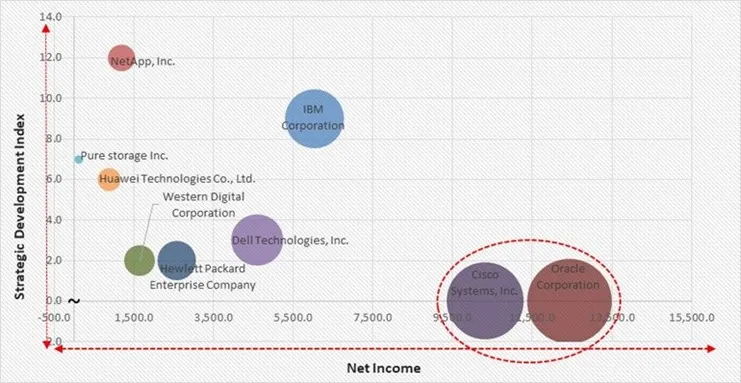
Based on the Analysis presented in the KBV Cardinal matrix; Oracle Corporation, and Cisco Systems, Inc. are the forerunners in the All-flash Array Market. Companies such as IBM Corporation, Dell Technologies, Inc., and Hewlett Packard Enterprise Company are some of the key innovators in All-flash Array Market. In April, 2025, Dell Technologies, Inc. unveiled new server, storage, and data-protection innovations to power AI-ready data centers. Updates include PowerEdge servers with Intel Xeon 6 processors, enhanced PowerStore software, next-gen ObjectScale, advanced PowerScale nodes, and PowerProtect upgrades—delivering higher performance, energy efficiency, stronger security, and simplified management to modernize IT infrastructure and support demanding AI workloads.
The COVID-19 pandemic sped up the use of all-flash arrays (AFAs) a lot. Businesses needed high-performance, low-latency storage solutions to support remote work, digital collaboration, and e-commerce. Organizations used AFAs to handle the growing amount of data coming from telemedicine, remote education, and streaming services. OEMs responded by offering remote deployment services, flexible financing, and positioning AFAs as essential for building strong IT infrastructure. Supply chain problems and delayed capital spending made adoption slower at first, but later, companies made infrastructure modernization a top priority. They replaced old disk arrays to make things more efficient, cut costs, and ensure business continuity. In the end, the pandemic was a catalyst that showed how important it is for enterprise storage to be flexible, efficient, and strong. Thus, the COVID-19 had a negative impact on the market.

Free Valuable Insights: Global All-flash Array Market size to reach USD 59.27 Billion by 2032
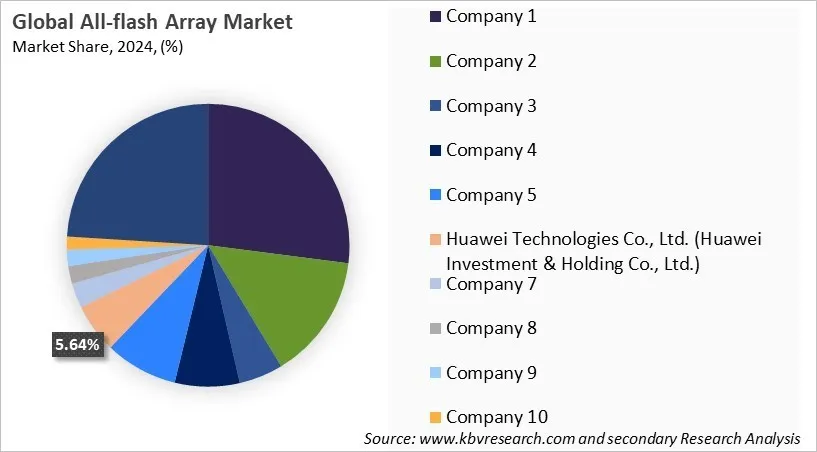
The leading players in the market are competing with diverse innovative offerings to remain competitive in the market. The above illustration shows the percentage of revenue shared by some of the leading companies in the market. The leading players of the market are adopting various strategies in order to cater demand coming from the different industries. The key developmental strategies in the market are Acquisitions, Product Launches and Product Expansions, and Partnerships & Collaborations.
Based on Flash Media, the market is segmented into Solid-State Drives (SSDs) and Custom Flash Modules (CFMs). The Custom Flash Modules (CFMs) segment procured 30.5% revenue share in the market in 2024. CFMs are designed to meet specific application requirements, offering tailored solutions for enterprises that need highly specialized storage configurations. These modules provide greater flexibility and scalability, allowing businesses to optimize their storage systems according to specific workloads and performance needs.
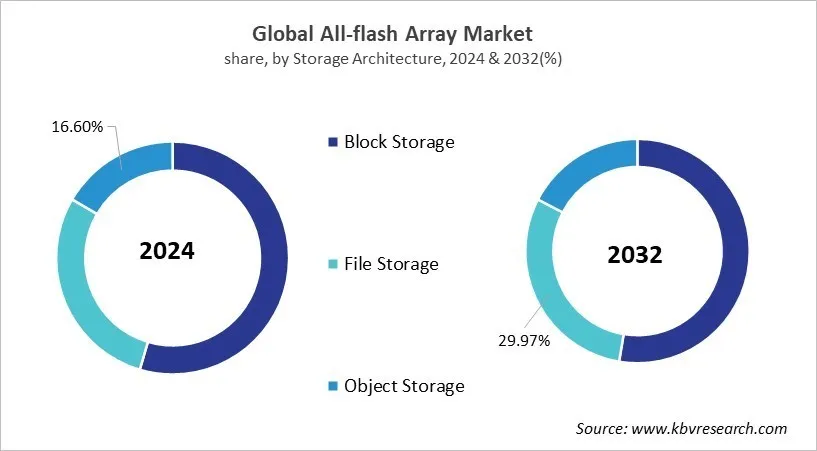
Based on Storage Architecture, the market is segmented into Block Storage, File Storage, and Object Storage. The File Storage segment recorded 28.8% revenue share in the market in 2024. This type of architecture is well-suited for collaboration platforms, shared drives, and content-heavy environments where data is stored and accessed in its native file format. Industries such as healthcare, education, and media production rely heavily on file storage because it simplifies access for multiple users and supports extensive data sharing.
Region-wise, the global All-flash Array market is analyzed across North America, Europe, Asia Pacific, and LAMEA. The North America segment recorded the 37.8% revenue share in the market in 2024. The all-flash array market is witnessing significant growth in the North America and Europe regions. The market expansion is supported by strong enterprise IT budgets, early technological adoption, and strict regulatory frameworks. Enterprises in industries like healthcare, banking, telecom, and government are prioritizing AFAs to reduce power costs, improve cyber-resilience against ransomware, and modernize data centers. Moreover, Europe’s sustainability mandates and energy-efficient targets in the US have spurred the transformation away from HDDs, while the requirement for deterministic latency to support financial trading, advanced analytics, and AI workloads has led to large deployments of NVMe-oF. Also, the presence of hybrid cloud strategies in the regions leads to the adoption of AFAs with software-defined automation.
The Asia Pacific and LAMEA regions are also predicted to capture a noticeable share in the all-flash array market. This is due to the rapid expansion of telecom and cloud infrastructure, digital transformation, and the modernization of enterprise IT in developing nations. Asia Pacific is witnessing surged in the adoption of AFAs to support AI-based applications, hyperscale data centers, and 5 G-enabled services. Furthermore, in LAMEA, the all-flash array market is experiencing growth driven by the rising focus of enterprises towards QLC-based solutions that reduce operational complexity. The demand is being driven by the requirement for power-efficient, resilient, and scalable storage systems that are capable of supporting increasing data volumes.
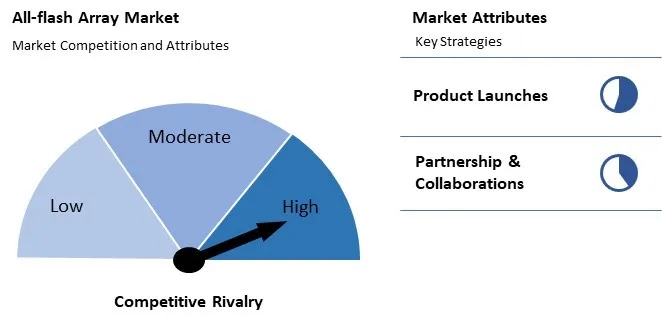
There is a lot of competition in the all-flash array market because companies are trying to meet rising business needs by providing faster performance, better scalability, and lower latency. Vendors stand out by coming up with new ways to reduce data, integrate with the cloud, and manage storage using AI. To get ahead, you need to use pricing strategies, value-added services, and solutions that put the customer first. Because technology is changing quickly and storage needs are changing, the competition is always changing. This forces participants to constantly improve their products and keep good relationships with customers.
| Report Attribute | Details |
|---|---|
| Market size value in 2025 | USD 21.38 Billion |
| Market size forecast in 2032 | USD 59.27 Billion |
| Base Year | 2024 |
| Historical Period | 2021 to 2023 |
| Forecast Period | 2025 to 2032 |
| Revenue Growth Rate | CAGR of 15.7% from 2025 to 2032 |
| Number of Pages | 543 |
| Number of Tables | 503 |
| Report coverage | Market Trends, Revenue Estimation and Forecast, Segmentation Analysis, Regional and Country Breakdown, Competitive Landscape, Market Share Analysis, Porter’s 5 Forces Analysis, Company Profiling, Companies Strategic Developments, SWOT Analysis, Winning Imperatives |
| Segments covered | Flash Media, Storage Architecture, By End-Use Industry, Storage System, Region |
| Country scope |
|
| Companies Included | Dell Technologies, Inc., Pure storage Inc., IBM Corporation, NetApp, Inc., Hewlett Packard Enterprise Company, Huawei Technologies Co., Ltd. (Huawei Investment & Holding Co., Ltd.), Cisco Systems, Inc., Oracle Corporation, Seagate Technology LLC, and Western Digital Corporation |
By Flash Media
By Storage Architecture
By End-Use Industry
By Storage System
By Geography
The market size is projected to reach USD 59.27 Billion billion by 2032.
The All-flash arrays market is projected to grow at a CAGR of 15.7 between 2025 and 2032.
Rising demand for high-performance, low-latency data access combined with a growing enterprise focus on data security and cyber-resilience is accelerating adoption of advanced storage and protection solutions.
Dell Technologies, Inc., Pure storage Inc., IBM Corporation, NetApp, Inc., Hewlett Packard Enterprise Company, Huawei Technologies Co., Ltd. (Huawei Investment & Holding Co., Ltd.), Cisco Systems, Inc., Oracle Corporation, Seagate Technology LLC, and Western Digital Corporation
The IT & Telecom segment led the maximum revenue in the Global All-flash Array Market by End-Use Industry in 2024, thereby, achieving a market value of $15.0 billion by 2032.
The North America region dominated the Global All-flash Array Market by Region in 2024, and would continue to be a dominant market till 2032; thereby, achieving a market value of $21.6 billion by 2032.
Our team of dedicated experts can provide you with attractive expansion opportunities for your business.












 Unique Offerings