“Global AI Watermarking Market to reach a market value of USD 2.37 Billion by 2032 growing at a CAGR of 23.6%”
The Global AI Watermarking Market size is expected to reach USD 2.37 billion by 2032, rising at a market growth of 23.6% CAGR during the forecast period.
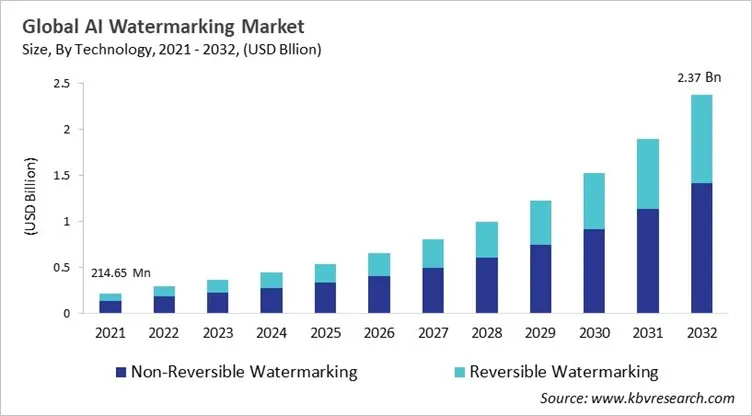
The AI watermarking market has recently evolved as an important pillar of digital trust, supported by regulatory requirements and industrial adoption. International bodies and governments, including the EU’s AI Act, G7’s multilateral frameworks, and NIST in the US, have surged the demand due to the requirement of provenance and transparency in synthetic content. Furthermore, technological advancements such as Meta’s AudioSeal, Google’s SynthID are also offering growth opportunities for single-based watermarking. AI watermarking solutions are now integrated into cameras from Sony, Leica and Nikon and other creative platforms such as Microsoft and Adobe are developing a verifiable chain of trust for content through publications.
The expansion of the AI watermarking market is driven by the growing usage of watermarking across video, audio, image, and text, the growth of interoperability standards, and the deployment of provenance features directly to hardware. Key players like Meta, Microsoft, Adobe, Google, and major camera manufacturers are framing strategies that balance proprietary innovations with open standards, aligning with both ecosystem and technical competitiveness. The market is witnessing intense competition with the shift of watermarking to a mandated infrastructure need. Software providers, AI developers, and OEMs align with shared principles of multimodal convergence, capture-level provenance, and interoperability, making watermarking an important part of digital infrastructure, thereby leading to market expansion.
The COVID-19 pandemic sped up the creation of digital content and the spread of fake media, which made people more worried about deepfakes and false information. False information about health spread quickly, which made governments, businesses, and news organizations focus on solutions like AI watermarking and provenance technologies. This time led to research projects and early partnerships that set the stage for future rules and standards. But problems in the global supply chain slowed the adoption of hardware-based watermarking, which delayed the release of cameras and OEMs. Instead, software companies worked on cloud-based tools for verifying identity that could be used from anywhere. The pandemic showed how important it is to have trust and openness in digital content, which made watermarking even more important in the long run. By the time restrictions eased, the experience of widespread online misinformation had created stronger demand for watermarking and provenance technologies, positioning the market for accelerated adoption in the years that followed.

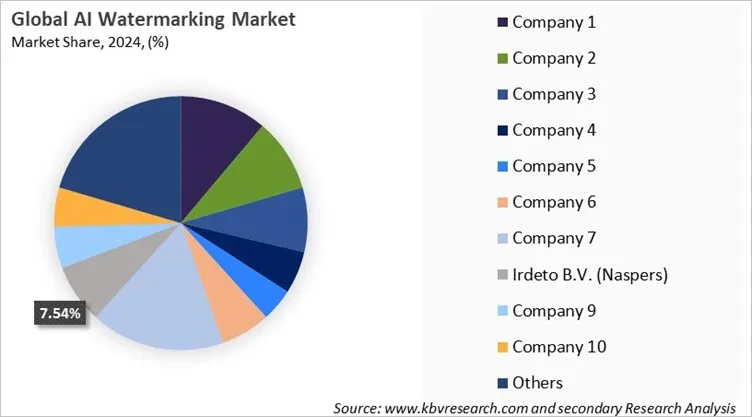
The leading players in the market are competing with diverse innovative offerings to remain competitive in the market. The above illustration shows the percentage of revenue shared by some of the leading companies in the market. The leading players of the market are adopting various strategies to cater demand coming from the different industries. The key developmental strategies in the market are Acquisitions, and Partnerships & Collaborations.
Based on technology, the AI watermarking Market is segmented into Non-Reversible Watermarking and Reversible Watermarking. The Reversible Watermarking segment procured 38.3% revenue share in the market in 2024. This technology allows the original content to be fully restored after the watermark is removed, making it highly valuable for applications where data integrity is essential. It is particularly beneficial in fields such as medical imaging, legal documentation, and sensitive government records, where even slight alterations to the original content are unacceptable.
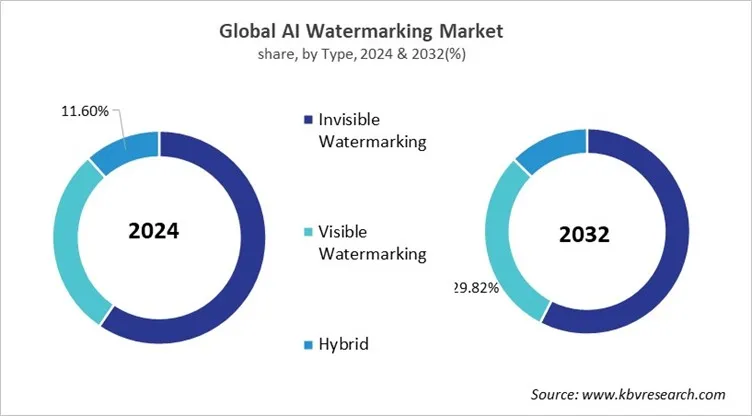
On the basis of type, the AI watermarking market is segmented into Invisible Watermarking, Visible Watermarking, and Hybrid. The Visible Watermarking segment recorded 28.9% revenue share in the market in 2024. This method involves placing watermarks that are easily noticeable, serving as a clear visual deterrent against unauthorized use. It is commonly used in photography, publishing, and online media platforms where ownership needs to be explicitly displayed. The growing need to visibly assert intellectual property rights continues to drive adoption of this technology.
Free Valuable Insights: Global AI Watermarking Market size to reach USD 2.37 Billion by 2032
Region-wise, the global AI watermarking market is analyzed across North America, Europe, Asia Pacific, and LAMEA. The North America segment recorded 36.2% revenue share in the market in 2024. In North America and Europe, the AI watermarking market is anticipated to have significant expansion. This is because of the presence of global tech-giants, and strong regulatory frameworks. In North America, the US is experiencing substantial adoption supported by NIST and federal focus on content provenance; however, corporations such as Adbobe, Meta, Microsoft, and Google are integrating watermarking into cloud services, AI platforms, and creative tools. Furthermore, Europe AI watermarking market is experiencing growth driven by the EU AI Act that mandates clean labelling of synthetic content and thus surges adoption in various industries like enterprise compliance, law enforcement, and media. Regional nations such as France, the UK and Germany are also encouraging use of provenance standards, supported by software and hardware integration.
The AI watermarking market in the Asia Pacific and LAMEA region is witnessing promising growth driven by favourable regulatory mandates and a rise in the adoption of digital infrastructure. The continued innovations in South Korea, India, Japan, and China are surging demand for multimodal watermarking, backed by regional government policies on AI security and transparency. In addition, the LAMEA region is estimated to offer positive opportunities in the AI watermarking market. This is supported by expanding government communication, enterprise sectors, and digital media. Also, collaborations with global tech-giants and regulatory developments are expected to support acceptance, thereby leading to the growth of the AI watermarking market.
| Report Attribute | Details |
|---|---|
| Market size value in 2025 | USD 539.19 Million |
| Market size forecast in 2032 | USD 2.37 Billion |
| Base Year | 2024 |
| Historical Period | 2021 to 2023 |
| Forecast Period | 2025 to 2032 |
| Revenue Growth Rate | CAGR of 23.6% from 2025 to 2032 |
| Number of Pages | 521 |
| Number of Tables | 551 |
| Report coverage | Market Trends, Revenue Estimation and Forecast, Segmentation Analysis, Regional and Country Breakdown, Market Share Analysis, Porter’s 5 Forces Analysis, Company Profiling, Companies Strategic Developments, SWOT Analysis, Winning Imperatives |
| Segments covered | Technology, Type, Deployment, Application, End Use, Region |
| Country scope |
|
| Companies Included | Google LLC, Microsoft Corporation, Meta Platforms, Inc., IBM Corporation, OpenAI, LLC, Amazon.com, Inc., Digimarc Corporation, Irdeto B.V. (Naspers), Signiant, Inc. and Imatag |
By Technology
By Type
By Deployment
By Application
By End Use
By Geography
The market size is projected to reach USD 2.37 Billion billion by 2032.
The AI watermarking market is projected to grow at a CAGR of 23.6% between 2025 and 2032.
Regulatory pressure and policy frameworks intensifying with the rise of synthetic media and misinformation.
Google LLC, Microsoft Corporation, Meta Platforms, Inc., IBM Corporation, OpenAI, LLC, Amazon.com, Inc., Digimarc Corporation, Irdeto B.V. (Naspers), Signiant, Inc. and Imatag
The Non-Reversible Watermarking segment is generating the maximum revenue share in the Global AI Watermarking Market by Technology in 2024; thereby, achieving a market value of $1.41 billion by 2032.
The North America region dominated the Global AI Watermarking Market by Region in 2024, and would continue to be a dominant market till 2032; thereby, achieving a market value of $813.8 million by 2032.
Our team of dedicated experts can provide you with attractive expansion opportunities for your business.








 Unique Offerings