“Global AI Vision Market to reach a market value of USD 85.53 Billion by 2032 growing at a CAGR of 23.8%”
The Global AI Vision Market size is expected to reach USD 85.53 billion by 2032, rising at a market growth of 23.8% CAGR during the forecast period.
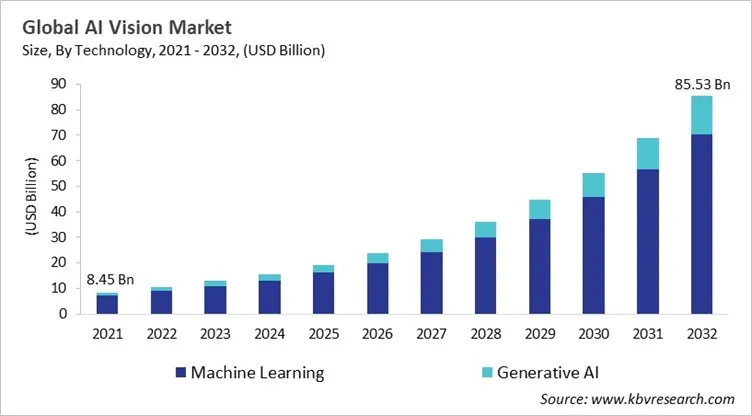
The transformation of AI vision began with early computer vision research, when limited hardware and basic algorithms restricted progress to simple laboratory tasks like edge or shape detection. Development accelerated with advances in color, depth, texture, and stereo-vision techniques, but the major expansion was observed with deep learning, especially Convolutional Neural Networks, allowing unprecedented accuracy in object detection, image classification, and scene understanding. AI vision has shifted firmly into real-world industries like manufacturing, automotive, retail, agriculture, smart cities, and healthcare, supported by better sensors, processors, cameras, and the growth of edge computing that allows on-device, low-latency video processing.
Modern AI vision is shaped by trends including rapid advancement of deep learning and generative AI for image intelligence, rising adoption of edge-based vision systems, and expansion into diverse verticals beyond automotive use cases. Market players are responding with strategies centered on cross-sector partnerships, innovations, and embedded and privacy-preserving vision solutions. The market competition is intensifying as both developed machine-vision vendors and agile startups leverage affordable sensors, scalable deployment models, and open-source frameworks. The market is showcasing positive opportunities for those combining technical excellence with regulatory compliance, strong domain adaptation, and scalable vision solutions-positioning AI vision as a transformative and rapidly expanding global market.
The major strategies followed by the market participants are Partnership as the key developmental strategy to keep pace with the changing demands of end users. For instance, In May, 2025, Amazon Web Services, Inc. and HUMAIN announced a major strategic partnership to establish an AI Zone in Saudi Arabia, enhancing AI infrastructure, training, and services to accelerate adoption of generative and vision-based AI technologies across key industries and government sectors. In May, 2025, Intel Corporation and Elliptic Labs partnered to integrate AI Virtual Smart Sensors into Intel’s next-gen laptops, enabling real-time user presence detection and adaptive features. This collaboration advances intuitive, on-device AI, contributing to the evolution of intelligent, vision-aware personal computing systems.
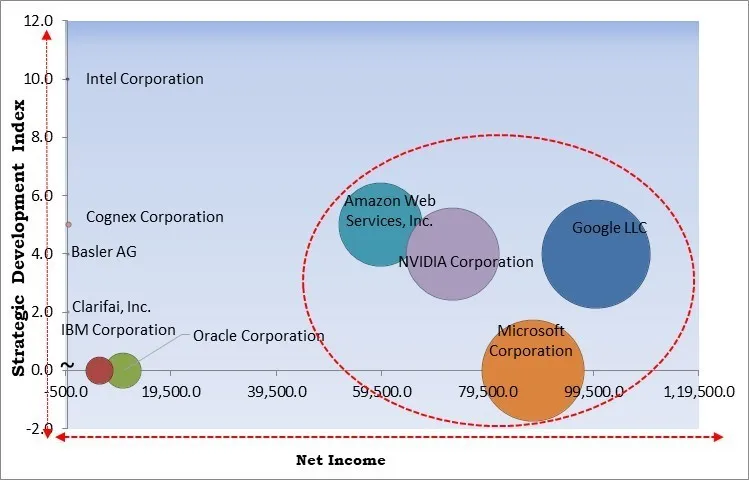
Based on the Analysis presented in the KBV Cardinal matrix; Google LLC, Microsoft Corporation, NVIDIA Corporation and Amazon Web Services, Inc. are the forerunners in the AI Vision Market. Companies such as Oracle Corporation and IBM Corporation are some of the key innovators in AI Vision Market. In May, 2025, Google LLC and Warby Parker came into partnership to develop AI-powered smart glasses designed for all-day wear. This marks the first Android XR eyewear collaboration, combining Warby Parker’s design expertise with Google’s AI technology to enhance everyday user experiences.
The AI Vision market was only slightly hurt by the Covid-19 pandemic because global supply chain problems made it harder to get important hardware like sensors, cameras, and processors. Many deployment dates were pushed back, and new investments slowed down for a short time because of lower capital spending in important areas like manufacturing, retail, and automotive. Workforce restrictions made it even harder to install, test, and maintain things on-site, which caused some projects to stop or move to later phases. Even though these problems arose, the downturn was limited because the pandemic sped up the need for automation, remote monitoring, and contactless operations. The market steadily recovered and regained its growth momentum as restrictions were lifted and industries resumed their plans for digital transformation. Thus, the COVID-19 pandemic had a mild negative impact on the market.

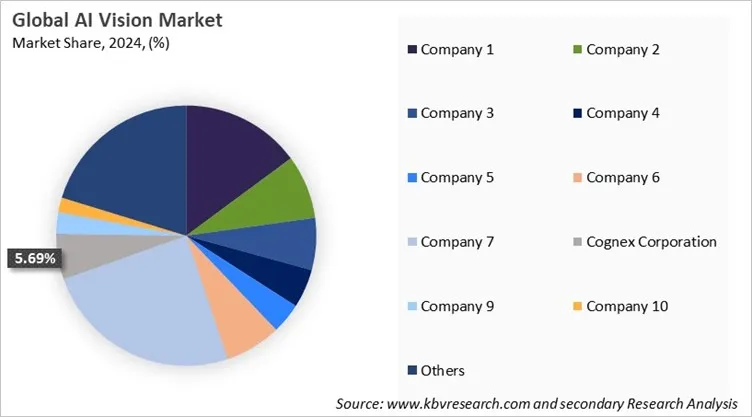
The leading players in the market are competing with diverse innovative offerings to remain competitive in the market. The above illustration shows the percentage of revenue shared by some of the leading companies in the market. The leading players of the market are adopting various strategies to cater demand coming from the different industries. The key developmental strategies in the market are Acquisitions, and Partnerships & Collaborations.
Free Valuable Insights: AI Vision Market size to reach USD 85.53 Billion by 2032
Based on technology, the AI vision market is characterized into machine learning and generative AI. The generative AI segment attained 16% revenue share in the AI vision market in 2024. The generative AI segment is gaining ground in the AI vision market as organizations explore new possibilities in synthetic data generation, enhanced image creation, and advanced visual augmentation. This technology enables models to simulate scenarios, generate high-quality training datasets, and support applications such as defect prediction, virtual prototyping, medical imaging enhancement, and creative content automation.
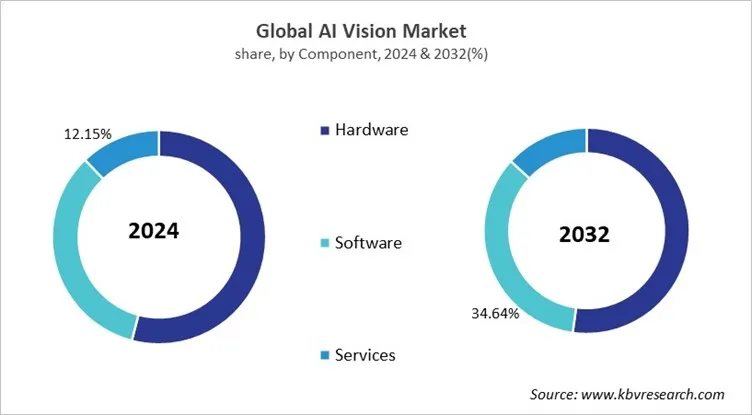
On the basis of component, the AI vision market is classified into hardware, software and services. The software segment recorded 34% revenue share in the AI vision market in 2024. The software segment drives the intelligence layer of the AI vision market, enabling data interpretation, decision-making, and deep learning-based analysis. AI vision platforms, model-training frameworks, analytics engines, and image-processing software help organizations extract meaningful insights from visual data streams. With the rise of cloud-native AI tools, low-code development environments, and vision-AI APIs, businesses can rapidly deploy scalable solutions tailored to their operations.
Region-wise, the AI Vision Market is analyzed across North America, Europe, Asia Pacific, and LAMEA. The AI vision market is predicted to grow at a significant rate in the North America and Europe region. The market is driven by strong R&D ecosystems, early adoption of computer vision technologies, and large investments in automation across retail, healthcare, security, manufacturing, and automotive. North America benefits from the presence of major AI innovators, developed edge-computing infrastructure, and the widespread usage of AI vision in automation, industrial automation, medical imaging, and smart retail. Moreover, the European AI vision market is experiencing accelerating adoption supported by strong demand in industrial robotics, smart city projects, automotive ADAS/AV systems, and healthcare imaging, supported by strict data-protection regulations that are surging adoption of embedded vision solutions. Both regions are also experiencing active partnerships among research institutes, industry leaders, and tech vendors, thereby accelerating market growth.
In the Asia Pacific and LAMEA region, the AI vision market is estimated to experience substantial growth in the upcoming years. The market is driven by expanding manufacturing bases, rapid industrialization, and rising deployment of AI-driven automation. Asia Pacific, especially Japan, China, India, and South Korea, is experiencing strong adoption of surveillance systems, e-commerce logistics, factory automation, and consumer electronics with embedded vision, driven by large scale investments in smart-infrastructure projects, and edge-AI hardware. Moreover, LAMEA’s AI vision market is expanding while showing increasing growth in industries like security and surveillance, retail analytics, transportation monitoring, and industrial safety as digital transformation accelerates. Both the Asia Pacific and LAMEA regions, reducing hardware costs, enhanced connectivity, and government-supported AI initiatives, are surging expansion of AI vision applications.
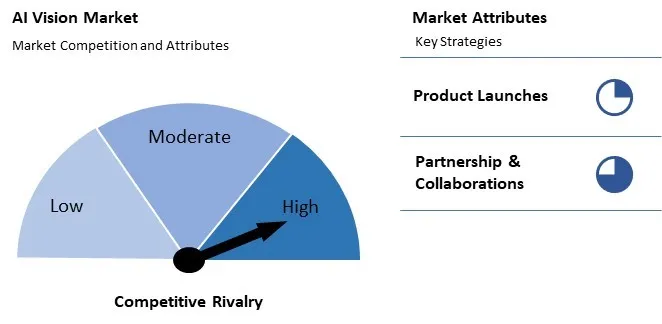
The AI vision market is experiencing intense competition as more vendors enter the space with advanced, scalable, and specialized solutions. Competition is driven by rapid innovation in machine learning models, edge computing, and real-time processing capabilities. Vendors differentiate themselves through accuracy, processing speed, cost efficiency, and customization for specific industries such as manufacturing automation, healthcare diagnostics, retail analytics, and smart surveillance. The rise of open-source frameworks and low-code platforms is further increasing competitive pressure by reducing entry barriers. As demand for automation and intelligent visual insights accelerates, the market is shifting toward integrated hardware-software ecosystems and AI-powered edge devices. This evolving landscape continues to create pressure for faster innovation, competitive pricing, and enhanced performance.
| Report Attribute | Details |
|---|---|
| Market size value in 2025 | USD 19.22 Billion |
| Market size forecast in 2032 | USD 85.53 Billion |
| Base Year | 2024 |
| Historical Period | 2021 to 2023 |
| Forecast Period | 2025 to 2032 |
| Revenue Growth Rate | CAGR of 23.8% from 2025 to 2032 |
| Number of Pages | 580 |
| Number of Tables | 483 |
| Report coverage | Market Trends, Revenue Estimation and Forecast, Segmentation Analysis, Regional and Country Breakdown, Competitive Landscape, Market Share Analysis, Porter’s 5 Forces Analysis, Company Profiling, Companies Strategic Developments, SWOT Analysis, Winning Imperatives |
| Segments covered | Technology, Component, Vertical, Region |
| Country scope |
|
| Companies Included | Intel Corporation, Amazon Web Services, Inc. (Amazon.com, Inc.), Google LLC, IBM Corporation, Basler AG, Microsoft Corporation, NVIDIA Corporation, Cognex Corporation, Oracle Corporation and Clarifai, Inc. |
By Technology
By Component
By Vertical
By Geography
The market size is projected to reach USD 85.53 Billion by 2032.
The AI vision market is projected to grow at a CAGR of 23.8% between 2025 and 2032.
The rise of edge computing, cloud AI, and high-performance computing ecosystems, combined with growing demand for autonomous technologies, robotics, and smart-mobility systems, is driving market growth.
Intel Corporation, Amazon Web Services, Inc. (Amazon.com, Inc.), Google LLC, IBM Corporation, Basler AG, Microsoft Corporation, NVIDIA Corporation, Cognex Corporation, Oracle Corporation and Clarifai, Inc.
The Consumer Electronics segment is leading the Global AI Vision Market by Vertical in 2024; thereby, achieving a market value of $16.04 billion by 2032.
The North America region dominated the Global AI Vision Market by Region in 2024, and would continue to be a dominant market till 2032; thereby, achieving a market value of $27.67 billion by 2032.
Our team of dedicated experts can provide you with attractive expansion opportunities for your business.












 Unique Offerings