“Global AI Server Market to reach a market value of USD 1.6 Trillion by 2032 growing at a CAGR of 37.5%”
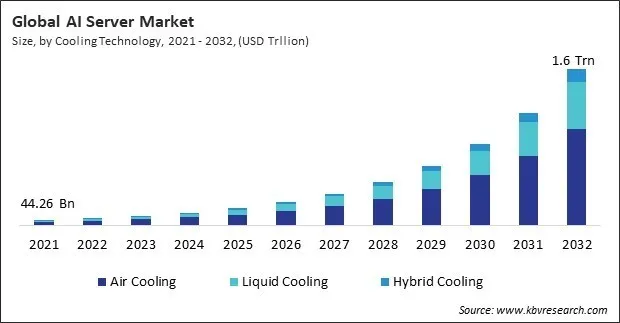
The Global AI Server Market size is expected to reach $1.6 trillion by 2032, rising at a market growth of 37.5% CAGR during the forecast period. Growth is driven by widespread AI adoption across sectors and government investments like the U.S. Department of Energy’s AI infrastructure funding. Leading firms such as Dell, HPE, and Lenovo are launching AI-optimized servers with advanced cooling and scalable designs.
The introduction of AI servers marked a pivotal shift in the industry. Companies like NVIDIA played a crucial role by providing GPUs that significantly enhanced the processing capabilities required for AI tasks. Simultaneously, cloud service providers (CSPs) such as Amazon Web Services, Microsoft Azure, and Google Cloud began offering AI-specific infrastructure, making AI more accessible to businesses of all sizes.
The proliferation of AI applications across various sectors—including healthcare, finance, automotive, and manufacturing—further fueled the demand for AI servers. These servers became essential for tasks ranging from natural language processing and image recognition to predictive analytics and autonomous driving.
Government initiatives also contributed to the market's growth. For instance, the U.S. Department of Energy invested in AI research and infrastructure, recognizing the strategic importance of AI in national security and economic competitiveness. Similarly, countries like China and the United Kingdom launched national AI strategies, emphasizing the development of AI infrastructure, including servers.
Original Equipment Manufacturers (OEMs) responded to this growing demand by developing AI-specific server solutions. Companies like Dell Technologies, Hewlett Packard Enterprise (HPE), and Lenovo introduced servers optimized for AI workloads, featuring advanced cooling systems, high-speed interconnects, and scalable architectures.
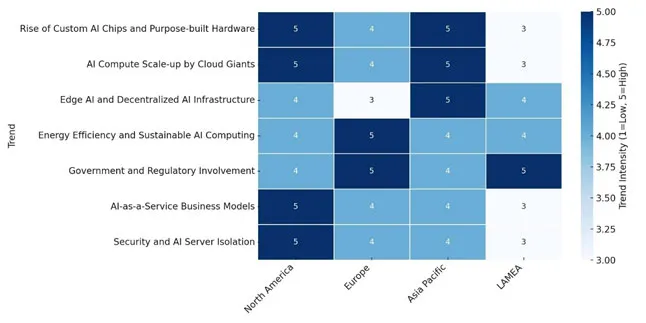
There is a significant shift towards the development and adoption of custom AI chips. Major cloud service providers like Microsoft, Google, and Amazon are investing in designing their own application-specific integrated circuits (ASICs) to optimize AI workloads. Secondly, the integration of AI servers into edge computing environments is gaining momentum. Edge AI servers enable real-time data processing closer to the data source, reducing latency and bandwidth usage.
The major strategies followed by the market participants are Partnerships as the key developmental strategy to keep pace with the changing demands of end users. For instance, In May, 2025, Cisco joined the AI Infrastructure Partnership with BlackRock, Microsoft, NVIDIA, and others to accelerate innovation and scale secure, efficient AI data center infrastructure, enhancing AI servers and supporting technologies to meet the growing demands of AI workloads. Moreover, In May, 2025, Cisco partnered with Saudi Arabia’s HUMAIN AI enterprise to build scalable, secure AI infrastructure, supporting the Kingdom’s Vision 2030 goals. This collaboration aims to advance digital innovation by deploying cloud-based AI servers and technologies for large-scale AI development.
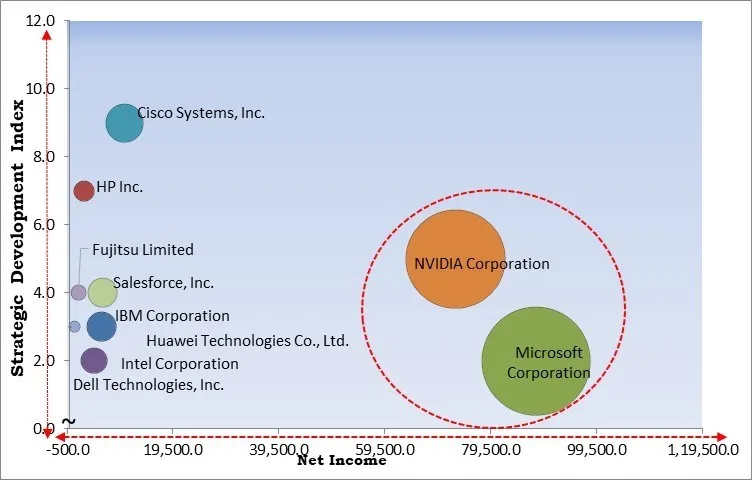
Based on the Analysis presented in the KBV Cardinal matrix; Microsoft Corporation and NVIDIA Corporation are the forerunners in the AI Server Market. In May, 2025, NVIDIA and HUMAIN partnered to build AI factories in Saudi Arabia powered by NVIDIA GPUs and supercomputers, aiming to train sovereign AI models and deploy digital twins using Omniverse, positioning the Kingdom as a global leader in AI and data infrastructure. Companies such as Cisco Systems, Inc. and Salesforce, Inc. are the key innovators in AI Server Market.
The unprecedented rise of artificial intelligence has fundamentally redefined the global computing landscape, placing AI servers at the heart of modern digital infrastructure. As enterprises and governments increasingly deploy AI-driven applications—from large language models to autonomous systems—the demand for high-performance, scalable server architectures has surged.
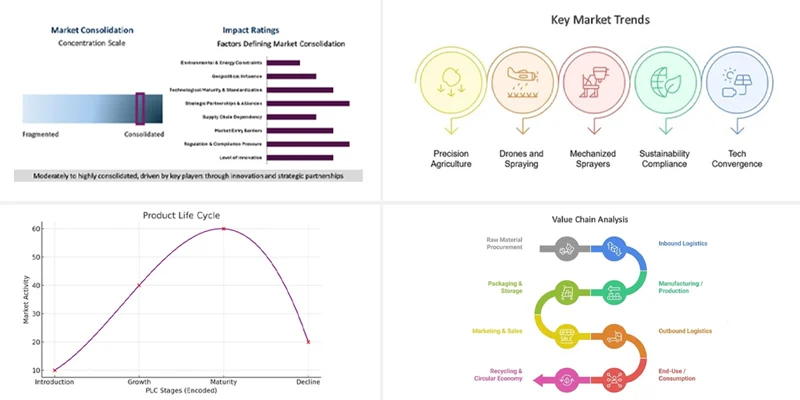
This chapter presents a detailed analysis of market consolidation dynamics within the global AI server sector. It evaluates the structural and strategic parameters shaping competitive intensity, innovation barriers, and vendor dominance. Drawing from publicly accessible sources such as government publications, OEM disclosures, and business technology insights, the analysis quantifies consolidation levels across key indicators—ranging from technological innovation, regulatory environments, and geopolitical influence, to supply chain dependencies and entry barriers.
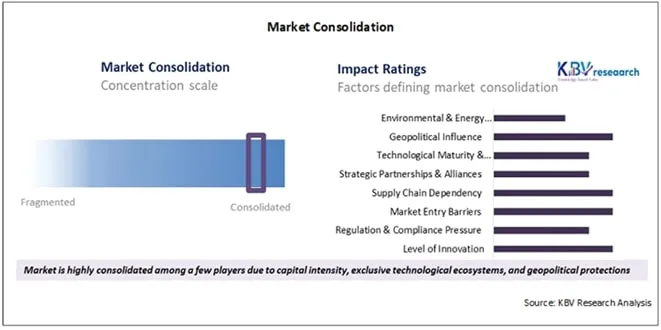
Innovation in the AI server market is accelerating rapidly—driven by breakthroughs in AI model training, high-performance computing (HPC), and custom chip development. However, this innovation is concentrated among a few dominant firms like NVIDIA, AMD, Intel, and Google (TPUs). These companies not only set the pace for innovation but also control much of the underlying infrastructure and intellectual property (IP), making it difficult for newcomers to compete meaningfully.
Because the innovation is locked within vertically integrated ecosystems, smaller firms struggle to match the scale, R&D spend, and access to training data. This imbalance pushes the consolidation score to its maximum.
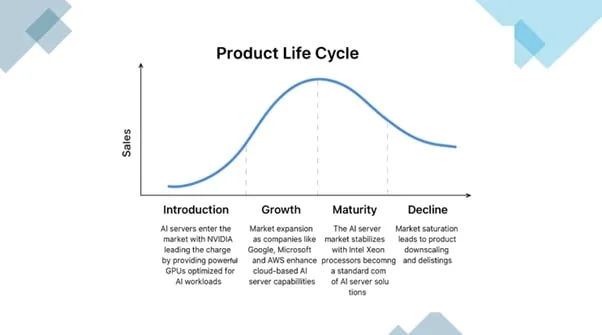
The AI Server Market is firmly in the growth stage, marked by rapid product innovation, widespread deployment, and major investment from both tech giants and governments. With key players such as NVIDIA, AMD, Intel, Google, AWS, and Microsoft leading the charge, the market is poised to enter maturity in the coming decade—but shows no signs of decline. Future competitiveness will rely on advancements in chip specialization, cooling efficiency, and AI stack integration.
The AI server market is currently in the growth phase, experiencing exponential demand due to the rise of generative AI, large language models (LLMs), and AI-as-a-Service offerings. Governments and corporations alike are building dedicated AI infrastructure, and innovation is shifting from feasibility to performance optimization.

The rapid integration of artificial intelligence (AI) across various sectors is a primary catalyst for the burgeoning demand for AI servers. Industries such as healthcare, finance, automotive, retail, and manufacturing are increasingly adopting AI to enhance operational efficiency, decision-making, and customer experiences. In healthcare, AI servers facilitate advanced diagnostics, predictive analytics, and personalized treatment plans by processing vast amounts of medical data. Financial institutions leverage AI for fraud detection, risk assessment, and algorithmic trading, necessitating robust server infrastructures to handle complex computations. Consequently, the rising reliance on AI across key industries is set to significantly propel the demand for high-performance AI servers.
Additionally, Technological innovations in AI-specific hardware components are significantly enhancing the performance and efficiency of AI servers. Developments in Graphics Processing Units (GPUs), Tensor Processing Units (TPUs), Application-Specific Integrated Circuits (ASICs), and Field-Programmable Gate Arrays (FPGAs) have revolutionized the capabilities of AI servers. GPUs and TPUs are designed for parallel processing, making them ideal for training complex AI models and handling large datasets. In summary, advancements in AI-specific hardware are driving unprecedented performance, efficiency, and accessibility, fueling the rapid growth of the AI server market.
The rapid expansion of AI applications has led to a significant increase in energy consumption by data centers. AI servers, particularly those used for training large models, require substantial computational power, resulting in higher electricity usage. For instance, a single query consumes approximately 2.9 watt-hours of electricity, compared to 0.3 watt-hours for a standard Google search. This surge in energy demand not only raises operational costs but also contributes to increased carbon emissions. A United Nations report highlighted that indirect carbon emissions from major tech companies like Amazon, Microsoft, Alphabet, and Meta rose by an average of 150% between 2020 and 2023, largely due to energy-intensive AI data centers. In light of these challenges, prioritizing energy-efficient innovations and sustainable practices is essential to ensure the responsible growth of AI technologies.
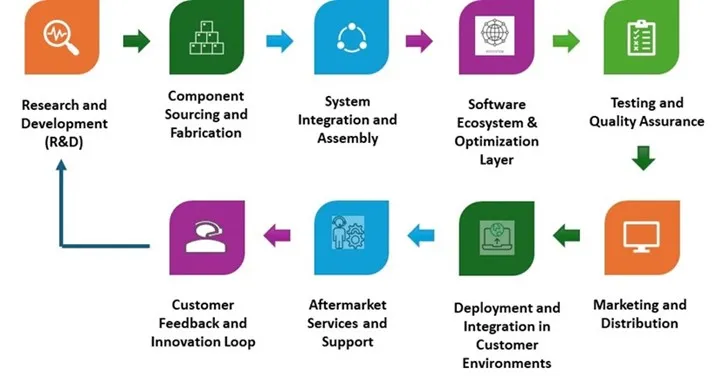
The value chain of the AI Server Market begins with research and development (R&D) to drive innovation in hardware and software capabilities. This is followed by component sourcing and fabrication, where essential server parts such as processors, GPUs, and memory modules are procured and manufactured. System integration and assembly combines these components into fully functional AI servers. The software ecosystem and optimization layer enhances AI workloads through tailored software. Subsequent stages include testing and quality assurance to ensure performance standards, and marketing and distribution to reach end-users. Post-deployment involves integration in customer environments, aftermarket services and support, and continuous customer feedback, which feeds back into the R&D process, fostering product improvement and innovation.
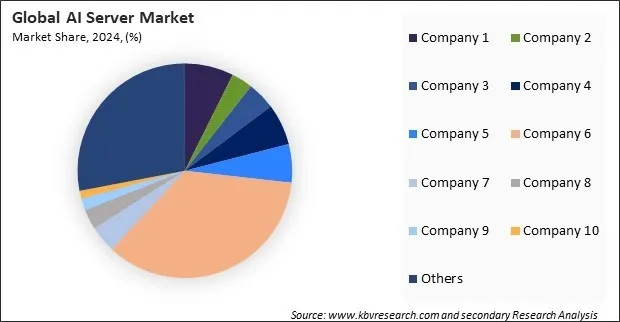
The leading players in the market are competing with diverse innovative offerings to remain competitive in the market. The above illustration shows the percentage of revenue shared by some of the leading companies in the market. The leading players of the market are adopting various strategies in order to cater demand coming from the different industries. The key developmental strategies in the market are Partnerships & Collaborations.
Free Valuable Insights: Global AI Server Market size to reach USD 1.6 Trillion by 2032
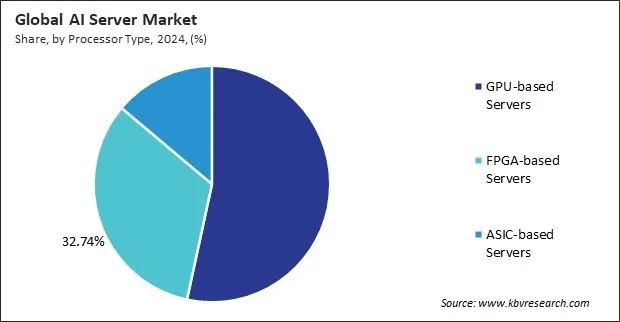
Based on the Processor Type, the AI server market is segmented into GPU-based, FPGA-based, and ASIC-based servers. The GPU-Based Servers held the largest market share among all the processor types in 2024 followed by FPGA-based Servers. The GPU-based servers continue to dominate AI training workloads, especially for large language models (LLMs) and generative AI applications.
Trend: GPU-based servers continue to dominate AI training workloads, especially for large language models (LLMs) and generative AI applications.
To illustrate:
The GPU is a special-purpose supercomputer. Its parallel architecture is precisely what artificial intelligence needs.
Jensen Huang, CEO of NVIDIA
Trend: FPGA-based servers offer customizable hardware acceleration, making them ideal for real-time AI inference tasks and adaptable to evolving workloads.
Supporting News:
When we founded Positron, it was focused on the fact that only two things matter—having a completely seamless experience going from Nvidia-based systems… and the failure point we saw for so many AI chip startups is they just took way too long and way too much to get to market.
Thomas Sohmers, Co-founder and CTO of Positron
Based on the Cooling Technology, the Global AI Server Market is segmented into Air Cooling, Liquid Cooling, and Hybrid Cooling segments. The Air Cooling segment registered the major share of 63.4% followed by Liquid Cooling segment in Global AI Server Market in 2024.
Trend: Air cooling remains a foundational method for thermal management in data centers, utilizing techniques like hot/cold aisle containment and computer room air conditioning (CRAC) units.
To illustrate:
The need to support hyperscale data centers, pervasive cloud services, and AI workloads is changing the data center paradigm. Today’s data centers need to be scalable, energy efficient, and advance sustainability.
Jeremy Foster, Senior Vice President, Cisco | Date: April 30, 2024
Trend:Liquid cooling, including direct-to-chip and immersion methods, is gaining traction for its efficiency in managing high-density computing environments.
To illustrate:
The infrastructure required for AI computer systems is a step up from what was required from standard internet cloud data centers. The latest AI graphics processing units from Nvidia, called Blackwell, generate a lot of heat and require liquid cooling systems to remove it. Traditional air cooling systems are insufficient.
Giordano Albertazzi, CEO, Vertiv, Cisco | Date: November 1, 2024
Based on Form Factor, the Global AI Server Market is segmented into Rack-mounted servers, Blade Servers, and Tower servers segment. The Rack mounted server segment registered the largest revenue share of 39.6% among others in 2024 in Global AI Server Market.
Trend:Rack-mounted servers are widely adopted globally due to their scalability and efficient space utilization, making them ideal for data centers and enterprise environments.
To illustrate:
The pace of innovation sparked by generative AI has been breakneck and it's only just beginning. This AI wave is a major technology disruption, and we've learned from past technology disruptions (cloud, mobility, the internet) that networks need fundamental transformation to support these changes.
Cisco, CEO, | Date: June 11, 2025
Trend:Blade servers are gaining traction globally, particularly in environments requiring high-density computing and efficient resource utilization, such as virtualization and cloud computing.
To illustrate:
We achieved first-quarter record servers and networking revenue of $6.3 billion, and we’re experiencing unprecedented demand for our AI-optimized servers.
Vice Chairman and COO, Dell Technologies | Date: May 21, 2025
Based on the End Use, the Global AI Server Market is segmented into IT & Telecommunication, BFSI, Retail & E-commerce, Healthcare & Pharmaceutical, Automotive and Other End Use. The IT & Telecommunication segment garnered the highest revenue share of 25.7% in global market followed by BFSI and Retail & E-commerce among all other end use verticals.
Trend:Telecom operators are investing in AI-ready data centers to enhance network performance and service delivery.
To illustrate:
Trend:Financial institutions are adopting AI servers to enhance operational efficiency and customer service.
To illustrate:
Based on the Region, the market is segmented into North America, Europe, Asia Pacific, and LAMEA. North America leads with a 37.20% share in 2024, propelled by early AI adoption, robust cloud infrastructure, and heavy investment in AI-specific server farms. The U.S. remains the largest contributor due to the presence of major technology firms, hyperscalers, and AI chip manufacturers.
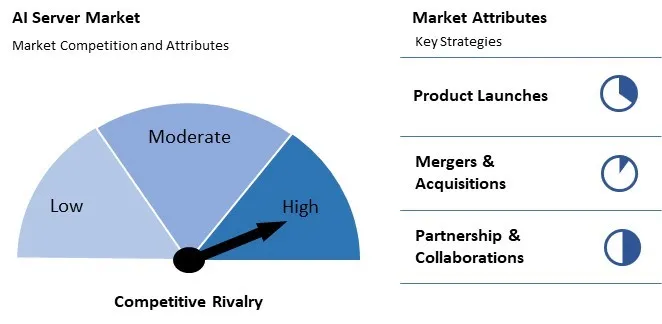
The AI Server Market remains Highly competitive, driven by regional manufacturers, startups, and niche technology providers. These companies focus on specialized AI workloads, energy-efficient designs, and affordable solutions. The absence of dominant brands creates opportunities for innovation and market entry, though limited resources and scalability challenges constrain the ability of smaller firms to capture significant market share.
| Report Attribute | Details |
|---|---|
| Market size value in 2024 | USD 129.06 Billion |
| Market size forecast in 2032 | USD 1.6 Trillion |
| Base Year | 2024 |
| Historical Period | 2021 to 2023 |
| Forecast Period | 2025 to 2032 |
| Revenue Growth Rate | CAGR of 37.5% from 2025 to 2032 |
| Number of Pages | 553 |
| Number of Tables | 475 |
| Report coverage | Market Trends, Revenue Estimation and Forecast, Segmentation Analysis, Regional and Country Breakdown, Competitive Landscape, Market Share Analysis, Porter’s 5 Forces Analysis, Company Profiling, Companies Strategic Developments, SWOT Analysis, Winning Imperatives |
| Segments covered | Processor Type, Cooling Technology, Form Factor, End Use, Region |
| Country scope |
|
| Companies Included | Dell Technologies, Inc., Cisco Systems, Inc., IBM Corporation, HP Inc., Huawei Technologies Co., Ltd. (Huawei Investment & Holding Co., Ltd.), NVIDIA Corporation, Fujitsu Limited, Intel Corporation, Microsoft Corporation, and Salesforce, Inc. |
| Date | Strategy | News |
|---|---|---|
| May-2025 | Acquisition | Salesforce acquired UK-based AI firm Convergence to boost next-gen AI agents development and expand its AI research presence in London, supporting autonomous workflows and enterprise AI innovation. |
| May-2025 | Product Launch | Huawei introduced its RASTM framework to develop next-gen AI data centers in Uzbekistan, focusing on reliability, modular construction, and AI-driven energy efficiency, supporting the nation's AI strategy and sustainable transformation. |
| May-2025 | Product Launch | NVIDIA launched DGX Spark and DGX Station with Dell, HP, and Acer, offering desktop AI systems with server-grade performance, powered by Grace Blackwell chips for advanced AI workloads and scalable development. |
| May-2025 | Product Launch | IBM launched LinuxONE 5, a high-performance AI server platform processing 450 billion AI inferences daily, with AI accelerators and hybrid cloud tools for scalable, cost-efficient enterprise AI workloads. |
| Apr-2025 | Partnership | HP and Reincubate formed a multi-year partnership to enhance AI-powered video conferencing using NPUs, enabling secure, low-latency, and efficient video experiences for hybrid work on next-gen AI PCs. |
| Apr-2025 | Partnership | Fujitsu and Supermicro expanded their collaboration to launch PRIMERGY GX2570 M8s GPU servers with advanced cooling, management tools, and services, allowing secure, efficient generative AI infrastructure deployment without asset ownership. |
By Processor Type
By Cooling Technology
By Form Factor
By End Use
By Geography
This Market size is expected to reach $1.6 trillion by 2032.
Proliferation Of AI-Driven Applications Across Industries are driving the Market in coming years, however, Escalating Energy Consumption And Environmental Impact restraints the growth of the Market.
Dell Technologies, Inc., Cisco Systems, Inc., IBM Corporation, HP Inc., Huawei Technologies Co., Ltd. (Huawei Investment & Holding Co., Ltd.), NVIDIA Corporation, Fujitsu Limited, Intel Corporation, Microsoft Corporation, and Salesforce, Inc.
The expected CAGR of this Market is 37.5% from 2023 to 2032.
The GPU-based Servers segment captured the maximum revenue in the Market by Processor Type in 2024, thereby, achieving a market value of $845.2 billion by 2032.
The North America region dominated the Market by Region in 2024, and would continue to be a dominant market till 2032; thereby, achieving a market value of $581.8 billion by 2032.
Our team of dedicated experts can provide you with attractive expansion opportunities for your business.







 Unique Offerings