“Global AI-powered Emotion Analytics Platform Market to reach a market value of USD 26.54 Billion by 2032 growing at a CAGR of 17.7%”
The Global AI-powered Emotion Analytics Platform Market size is expected to reach USD 26.54 billion by 2032, rising at a market growth of 17.7% CAGR during the forecast period
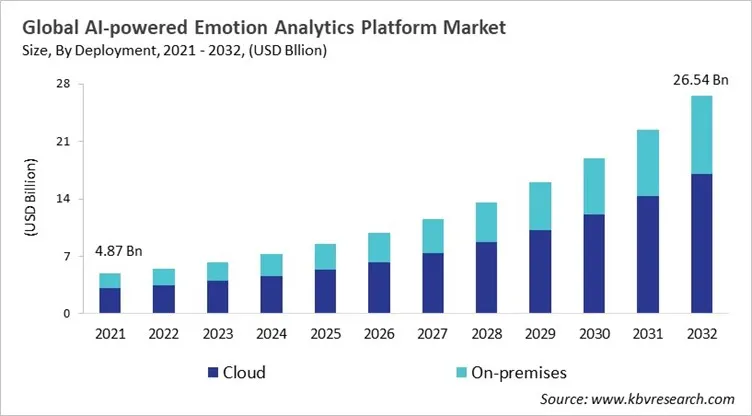
Artificial intelligence (AI) emotion analytics, also known as affective computing, has come a long way since the early days of sentiment analysis and facial recognition. Now, it can use facial, voice, physiological, and behavioral signals to figure out how someone is feeling. Technology started out as an experiment, but now it's used in real-world applications in fields like healthcare, automotive safety, customer service, media, and education. Deep learning, computer vision, natural language processing, and sensor technology have all improved. This has made it possible to put strong, real-time, and privacy-aware systems in cars, smart devices, and digital platforms. One important trend is the shift toward multimodal, edge-based analytics that make things more accurate, faster, and private. At the same time, ethical and legal issues about privacy, consent, and bias are affecting development. Governments and businesses are putting more emphasis on openness, fairness, and accountability.
Personalization and adaptive experiences are two more ways to define the market. For example, emotion analytics changes healthcare interventions, customer journeys in retail, and vehicle safety and comfort. To get access to specialized algorithms and embed capabilities into hardware, leading companies use strategies like acquisitions and partnerships. They also invest in research and development to make their models more robust and proactive governance to build trust. Large technology OEMs, niche startups, sensor makers, and vertical specialists are all competing more fiercely with each other. Success depends on being accurate, following the rules, and gaining the trust of users. Cross-industry partnerships and quick progress in adaptive feedback, multimodal analytics, and edge computing keep opening new possibilities while also dealing with the challenges of working with emotional data.
As companies adjusted to working from home and dealing with customers online during the COVID-19 pandemic, the use of emotion analytics grew faster. Businesses used AI-powered platforms to read emotions digitally, which improved communication between employees and customers because face-to-face contact was limited. These tools gave us useful information about how people behave online, which let us offer personalized services and keep an eye on how well employees are doing. The technology spread to schools and hospitals, where it helped measure how engaged students were in online learning and improve communication between doctors and patients in telemedicine. Real-time emotional data became very important for making quick, smart decisions in marketing, HR, and customer service. Overall, the pandemic made emotion analytics much more visible, in demand, and useful in many fields. Thus, the COVID -19 pandemic had a Positive impact on the market.

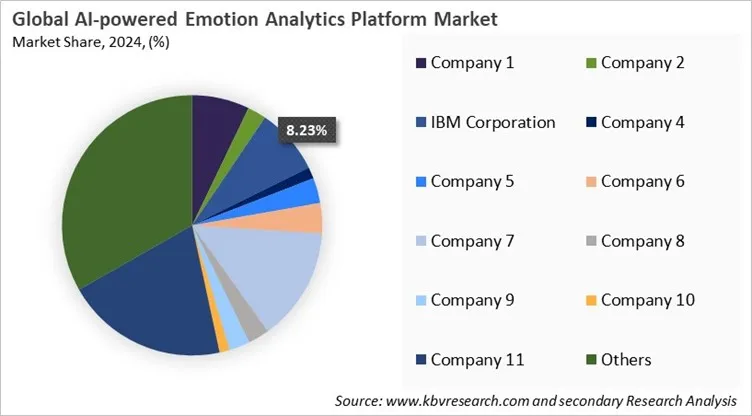
The leading players in the market are competing with diverse innovative offerings to remain competitive in the market. The above illustration shows the percentage of revenue shared by some of the leading companies in the market. The leading players of the market are adopting various strategies in order to cater demand coming from the different industries. The key developmental strategies in the market are Acquisitions, and Partnerships & Collaborations.
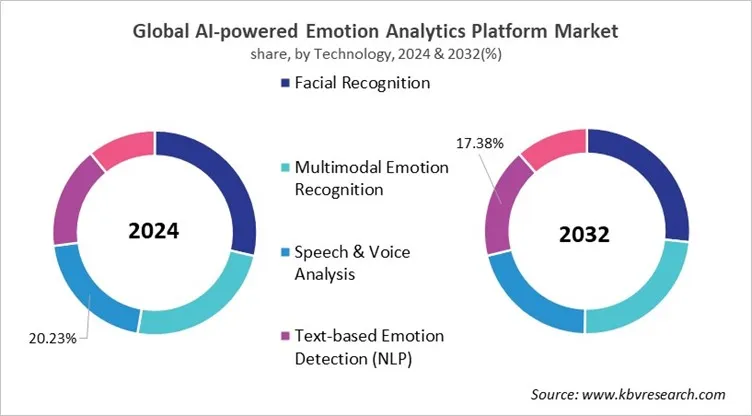
Based on Technology, the AI-powered Emotion Analytics Platform Market is segmented into Facial Recognition, Multimodal Emotion Recognition, Speech & Voice Analysis, Text-based Emotion Detection (NLP), and Physiological Monitoring (wearables, biometrics). The Multimodal Emotion Recognition segment witnessed 24% revenue share in the market in 2024. Multimodal emotion recognition emerged as a sophisticated approach by integrating data from multiple sources such as facial expressions, voice tone, text inputs, and physiological signals. This technology provided a holistic view of emotions, overcoming the limitations of relying on a single channel of detection. Organizations found immense value in combining multimodal signals to achieve more accurate interpretations, particularly in complex environments like healthcare, education, and human resources. By leveraging a diverse set of data points, businesses could detect nuances such as mixed emotions or subtle discrepancies between spoken words and facial expressions.
Based on End-User, the AI-powered Emotion Analytics Platform Market is segmented into Healthcare, Retail & E-commerce, Automotive & Transportation, Media & Entertainment, IT (tech firms, CX platforms, enterprise apps), Education, Government & Public Safety, BFSI, and Others. The Retail & E-commerce segment witnessed 20% revenue share in the market in 2024. Retail and e-commerce enterprises utilized emotion analytics to gain deeper insight into customer behavior, preferences, and reactions across digital and physical touchpoints. Online shopping platforms leveraged text, voice, and facial analytics to measure satisfaction levels and personalize product recommendations. Physical retail spaces integrated video-based emotion recognition to track customer responses to store layouts, product displays, or advertisements.
Free Valuable Insights: Global AI-powered Emotion Analytics Platform Market size to reach USD 26.54 Billion by 2032
Region-wise, the AI-powered Emotion Analytics Platform Market is analyzed across North America, Europe, Asia Pacific, and LAMEA. The North America segment recorded 38% revenue share in the market in 2024. North America and Europe are the top regions in the AI emotion analytics market. This is because they have strong technology infrastructure, a lot of people use advanced AI systems, and there are strict rules about data privacy. In North America, especially the US, emotion analytics is widely used in areas like healthcare, automotive safety, customer experience, and media, with support from both big tech companies and new businesses. On the other hand, Europe has a well-regulated environment, and the EU's focus on ethical AI, data protection, and openness encourages responsible use. Germany, the UK, and France are all working to include emotion analytics in their cars, healthcare, and public services while also making sure they follow GDPR and new AI rules.
Asia-Pacific and LAMEA (not including Mexico) are growing quickly because more people are using technology and the markets for these systems are getting bigger. In Asia-Pacific, countries like China, Japan, South Korea, and India are using emotion analytics in cars, schools, stores, and mental health apps. This is possible because of government-led AI projects and strong consumer electronics industries. Brazil, Saudi Arabia, the UAE, and South Africa are all using emotion AI more and more in projects to make cities smarter, engage customers, and keep people safe. Adoption is still growing here, but not as quickly as in North America and Europe. However, the growing focus on AI-driven innovation and the growing investments in digital infrastructure make these areas great places for emotion analytics providers to grow.
| Report Attribute | Details |
|---|---|
| Market size value in 2025 | USD 8.48 Billion |
| Market size forecast in 2032 | USD 26.54 Billion |
| Base Year | 2024 |
| Historical Period | 2021 to 2023 |
| Forecast Period | 2025 to 2032 |
| Revenue Growth Rate | CAGR of 17.7% from 2025 to 2032 |
| Number of Pages | 636 |
| Number of Tables | 422 |
| Report coverage | Market Trends, Revenue Estimation and Forecast, Segmentation Analysis, Regional and Country Breakdown, Market Share Analysis, Porter’s 5 Forces Analysis, Company Profiling, Companies Strategic Developments, SWOT Analysis, Winning Imperatives |
| Segments covered | Deployment, Technology, End-User, Region |
| Country scope |
|
| Companies Included | Runtime Collective Limited (Brandwatch), Sprout Social, Inc., IBM Corporation, Apple, Inc., NEC Corporation, OpenText Corporation, iMotions A/S (Smart Eye A/S), Lexalytics, Inc., NVISO SA, Emotibot Technologies Limited, Microsoft Corporation |
By Deployment
By Technology
By End User
By Geography
The market size is projected to reach USD 26.54 Billion by 2032.
The AI-powered emotion analytics platform market is projected to grow at a CAGR of 17.7% between 2025 and 2032.
Rising demand for personalized customer experiences is driving the growth of omnichannel customer interactions.
Runtime Collective Limited (Brandwatch), Sprout Social, Inc., IBM Corporation, Apple, Inc., NEC Corporation, OpenText Corporation, iMotions A/S (Smart Eye A/S), Lexalytics, Inc., NVISO SA, Emotibot Technologies Limited, Microsoft Corporation
The Facial Recognition market dominated the Global AI-powered Emotion Analytics Platform Market by Technology in 2024; thereby, achieving a market value of $7.09 billion by 2032.
The North America region dominated the Global AI-powered Emotion Analytics Platform Market by Region in 2024, and would continue to be a dominant market till 2032; thereby, achieving a market value of $9.75 billion by 2032.
Our team of dedicated experts can provide you with attractive expansion opportunities for your business.







 Unique Offerings