“Global AI In Mining Market to reach a market value of USD 435.94 Billion by 2032 growing at a CAGR of 40.6%”
The Global AI In Mining Market size is expected to reach USD 435.94 billion by 2032, rising at a market growth of 40.6% CAGR during the forecast period.
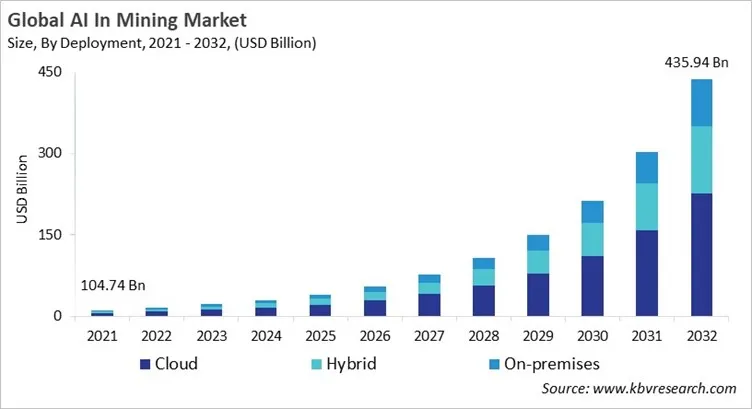
AI has transformed the mining industry by making it better protected, more productive and tech-savvy. The mining industry used smart fleet management tools such as Modular Mining’s DISPATCH system in the 1980s, now the industry is incorporating advanced applications like real-time ore sorting, predictive maintenance, and large-scale autonomous operations. Currently, AI is being used in exploration backed with satellite data, geophysical surveys, and drill logs, decreeing the cost and time in identifying deposits. Government and companies across the globe are adopting AI in mining through public initiatives, such as national plans focused on mapping critical minerals like lithium and rare earths in Rajasthan, India.
The competitive scenario is highly robust, with mining giants, OEMs, tech companies, and all startups are contributing in it. Corporates like BHP, Rio Tinto, Vale, and Glencore are at the forefront of the AI adoption in mining with smart fleet systems and predictive platforms, meanwhile Komatsu, Caterpillar, and Sandvik emphasizes on digital twin technologies and AI-powered autonomous machinery. Technology suppliers like IBM, Microsoft, and Google are penetrating with cloud-based AI solutions, while starts are working on the innovations related to the geological modeling and resource estimation. Furthermore, governments globally are also investing heavily in AI to secure critical minerals and modernize exploration.
By interfering with operations through lockdowns, health restrictions, and site access limitations, the COVID-19 pandemic had a detrimental effect on the mining industry's adoption of AI. Due to financial uncertainty, businesses prioritized essential operations over digital innovation, which resulted in the cancellation or delay of numerous AI projects. Automation, predictive maintenance, and data analytics projects were put on hold when it was decided that investing in AI technologies—which require a large amount of infrastructure, software, and trained workers—was not necessary. Deployment and maintenance were further hampered by shortages and delays in vital hardware, including sensors, drones, and computer equipment, brought on by the global supply chain crisis. Progress was also slowed by limitations on training and workforce mobility. All things considered, the pandemic produced an unfavorable climate for integrating AI, which led to a halt in the digital transformation of the mining industry. Thus, the COVID-19 pandemic had a Negative impact on the market.

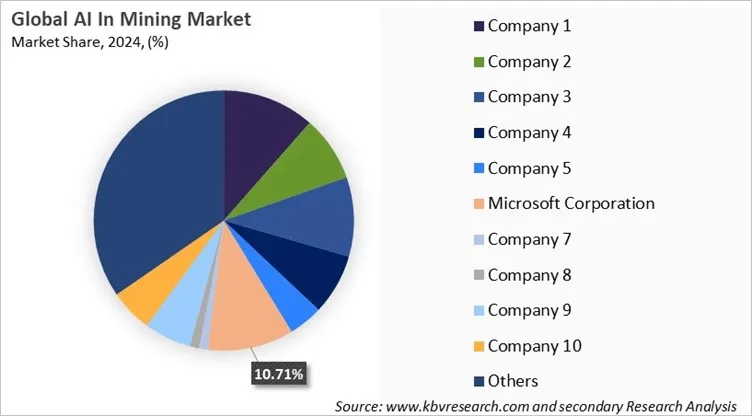
The leading players in the market are competing with diverse innovative offerings to remain competitive in the market. The above illustration shows the percentage of revenue shared by some of the leading companies in the market. The leading players of the market are adopting various strategies to cater demand coming from the different industries. The key developmental strategies in the market are Acquisitions, and Partnerships & Collaborations.
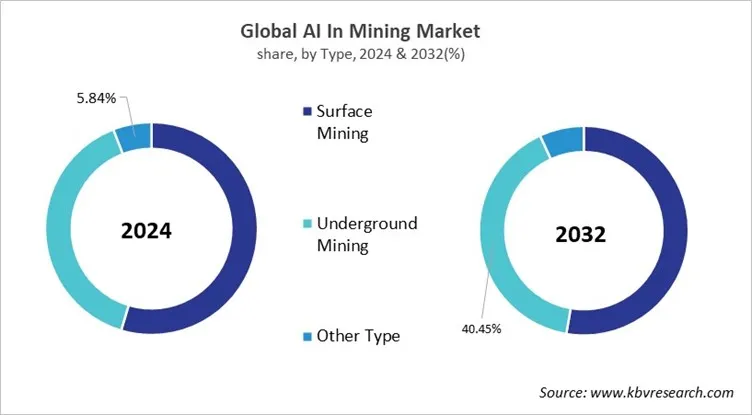
Based on type, the AI in mining market is characterized into surface mining, underground mining, and others. The underground mining segment attained 39% revenue share in the market in 2024. This segment benefits from AI-enabled solutions that address the complex challenges of subterranean operations, such as limited visibility, constrained space, and heightened safety risks. Technologies such as intelligent ventilation systems, autonomous drilling machinery, and AI-assisted geospatial mapping have significantly improved operational outcomes in underground mining. Moreover, AI contributes to better decision-making through the analysis of geological data, helping mining companies navigate intricate underground structures while minimizing risks and improving yield efficiency.
By technology, the AI in mining market is divided into machine learning & deep learning, robotics & automation, computer vision, NLP, and others. The robotics & automation segment attained 27% revenue share in the market in 2024. These technologies support the automation of repetitive and hazardous tasks, significantly enhancing worker safety and operational precision. Autonomous haulage systems, robotic drilling, and unmanned aerial vehicles are examples of robotics applications that streamline processes, reduce human error, and lower operational costs. Automation technologies also improve ore handling and transport systems, resulting in optimized productivity and reduced energy consumption. As mining sites often operate in remote and high-risk environments, robotics and automation are increasingly being adopted to enable continuous operations with minimal human intervention.
Free Valuable Insights: Global AI In Mining Market size to reach USD 435.94 Billion by 2032
Region-wise, the AI in mining market is analyzed across North America, Europe, Asia Pacific, and LAMEA. The North America segment recorded 37% revenue share in the market in 2024. Strong technology adoption and advanced infrastructure are shaping AI in mining market in North America. Autonomous haulage systems, predictive maintenance platforms, and AI-powered exploration tools are already being used by mining companies in the U.S. and Canada. Digital transformation is mostly about making operations safer, hiring more workers, and boosting productivity in this area. In Europe, strict rules about sustainability and following environmental laws drive the market. European miners are putting money into AI to make their operations more energy-efficient, keep track of emissions, and find robotic mining solutions. The government is also helping them build sustainable mining ecosystems.
AI is being used more in mining in the Asia-Pacific region because of the fast growth of the industry, the availability of mineral resources, and government-backed programs to digitize. Countries like Australia, China, and India are using AI-powered autonomous machines, real-time ore processing, and exploration platforms to improve efficiency and ensure they have enough important minerals. In LAMEA, on the other hand, AI adoption is still in its early stages but has significant potential. In Latin America, AI is being used to make large-scale mining safer and more efficient. In the Middle East and Africa, AI is being used increasingly to improve energy use, resource management, and remote monitoring in difficult mining areas.
| Report Attribute | Details |
|---|---|
| Market size value in 2024 | USD 29.44 Billion |
| Market size forecast in 2032 | USD 435.94 Billion |
| Base Year | 2024 |
| Historical Period | 2021 to 2023 |
| Forecast Period | 2025 to 2032 |
| Revenue Growth Rate | CAGR of 40.6% from 2025 to 2032 |
| Number of Pages | 493 |
| Number of Tables | 371 |
| Report coverage | Market Trends, Revenue Estimation and Forecast, Segmentation Analysis, Regional and Country Breakdown, Market Share Analysis, Porter’s 5 Forces Analysis, Company Profiling, Companies Strategic Developments, SWOT Analysis, Winning Imperatives |
| Segments covered | Type, Deployment, Technology, Region |
| Country scope |
|
| Companies Included | IBM Corporation, Komatsu Ltd., Caterpillar, Inc., Sandvik AB, SAP SE, Microsoft Corporation, Datarock Pty Ltd, Earth AI Inc., BHP Group Limited and Rio Tinto PLC (Rio Tinto International Holdings Limited) |
By Type
By Deployment
By Technology
By Geography
This Market size is expected to reach $435.94 billion by 2032.
Growing Need for Operational Efficiency and Cost Optimization are driving the Market in coming years, however, Regulatory Uncertainty and Ethical Concerns restraints the growth of the Market.
IBM Corporation, Komatsu Ltd., Caterpillar, Inc., Sandvik AB, SAP SE, Microsoft Corporation, Datarock Pty Ltd, Earth AI Inc., BHP Group Limited and Rio Tinto PLC (Rio Tinto International Holdings Limited)
The expected CAGR of this Market is 40.6% from 2023 to 2032.
The Surface Mining segment is leading the Market by Type in 2024, and would continue to be a dominant market till 2032; thereby, growing at a CAGR of 40 % during the forecast period.
The North America region dominated the Market by Region in 2024, and would continue to be a dominant market till 2032; thereby, achieving a market value of $154.14 Billion by 2032.
Our team of dedicated experts can provide you with attractive expansion opportunities for your business.








 Unique Offerings