“Global AI-Based Climate Modelling Market to reach a market value of USD 1.48 Billion by 2032 growing at a CAGR of 20.6%”
The Global AI-Based Climate Modelling Market size is expected to reach USD1.48 billion by 2032, rising at a market growth of 20.6% CAGR during the forecast period.
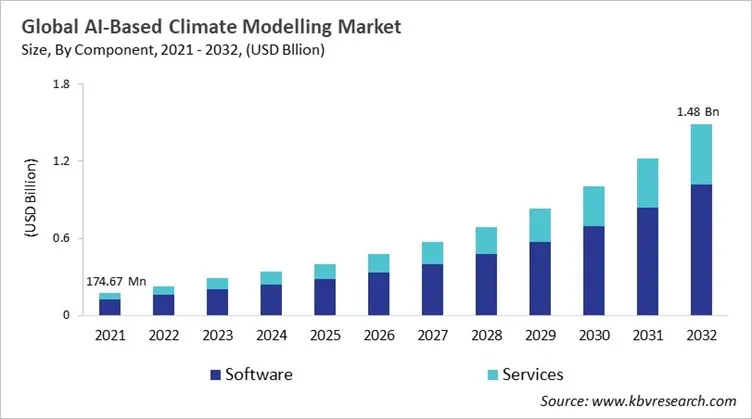
Artificial Intelligence (AI) has transformed climate modelling by shifting from traditional physics-based simulations to data-driven and hybrid approaches that combine physical laws with AI’s pattern-recognition capabilities. Initially used to support scientists, AI is now central to next-generation climate models, enabling faster, more granular, and scalable predictions of extreme weather, sea-level rise, and other climate phenomena. Global government initiatives, such as Earth’s digital twins, integrate AI with satellite data, IoT sensors, and high-performance computing to simulate complex environmental systems and support policymaking. These advancements have fostered collaborations among academic institutions, public agencies, and environmental organizations to refine climate models for disaster preparedness, infrastructure planning, and regional resilience.
The AI-based climate modelling market is shaped by the rise of hybrid AI-physics techniques and large-scale foundational models trained on climate datasets, capable of tasks like long-range forecasting, high-resolution downscaling, and nowcasting. Beyond research, AI-driven forecasts are increasingly embedded into industries such as agriculture, urban planning, and logistics to assess risks, optimize operations, and build resilience against extreme weather. Public agencies are investing in AI-focused computational infrastructure, open-source ecosystems, and real-time digital platforms to democratize climate intelligence. The competitive landscape is defined by collaboration rather than rivalry, with governments, universities, and technology providers working together to develop interoperable AI systems that empower informed decision-making and climate-resilient strategies across sectors.
The major strategies followed by the market participants are Product Launches as the key developmental strategy to keep pace with the changing demands of end users. In June, 2025, NVIDIA Corporation unveiled cBottle, a generative AI model within its Earth-2 platform to create an interactive digital twin of Earth’s climate. Trained on 50 years of data, cBottle produces high-resolution, energy-efficient climate simulations to improve prediction, understanding, and response to extreme weather and climate change. Additionally, In June, 2025, Google LLC unveiled a hybrid AI-physics model that merges traditional climate simulations with generative AI to produce detailed, local climate risk forecasts at 10 km resolution. This innovative downscaling method improves accuracy, reduces computational costs by up to 85%, and supports better regional climate planning and disaster preparedness.
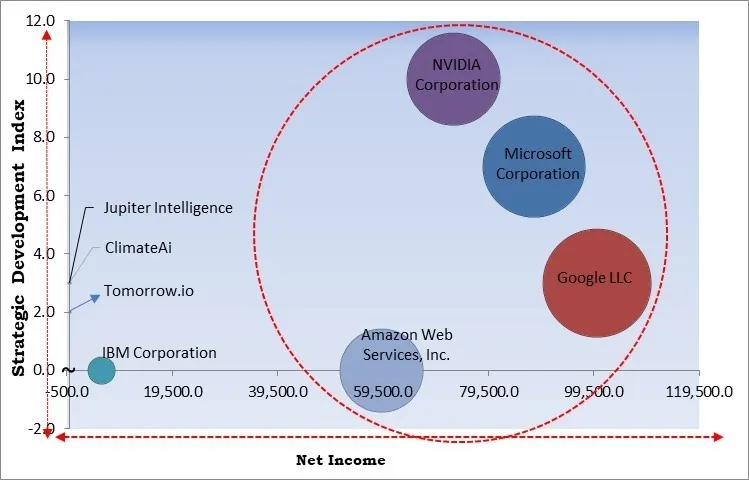
Based on the Analysis presented in the KBV Cardinal matrix; Google LLC, Microsoft Corporation, NVIDIA Corporation, and Amazon Web Services, Inc. are the forerunners in the AI-Based Climate Modelling Market. Companies such as IBM Corporation, ClimateAi, and Jupiter Intelligence are some of the key innovators in AI-Based Climate Modelling Market. In May, 2025, ClimateAi unveiled FICE, the world’s first AI model linking climate and economic data to predict how extreme weather impacts consumer spending and business revenue. Combining hyper-local weather insights with macroeconomic trends, FICE helps companies and governments plan for climate risks, drive resilience, and uncover growth opportunities.
The COVID-19 pandemic messed up the AI-based climate modeling market by stopping field research, data collection, and infrastructure development because of lockdowns and travel restrictions. This made it harder to calibrate and validate models. Even though these problems arose, the crisis sped up the shift to digital technologies, with more reliance on historical datasets, satellite images, cloud computing, and machine learning platforms to keep climate simulations going from a distance. Governments and policymakers are putting more emphasis on AI-driven climate models for planning for resilience. At the same time, partnerships between public agencies, researchers, and technology providers are making open-access platforms more popular. In general, the pandemic made climate modeling stronger in terms of innovation, remote operability, and long-term adaptability, even though short-term disruptions slowed progress. In conclusion, the COVID-19 pandemic, though disruptive, accelerated digital transformation in AI-based climate modelling, enhancing long-term resilience and adaptability in global climate research.

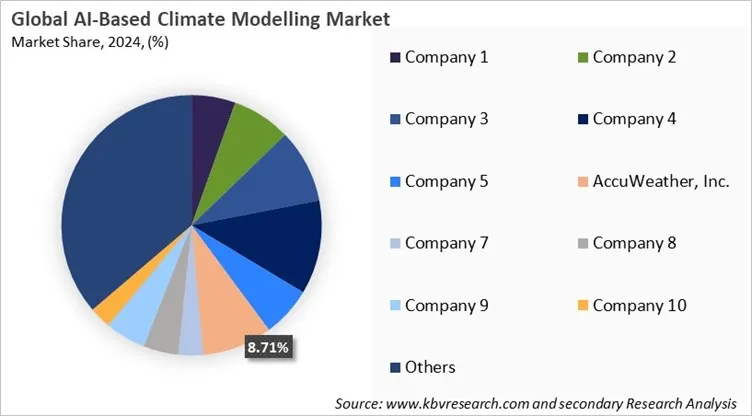
The leading players in the market are competing with diverse innovative offerings to remain competitive in the market. The above illustration shows the percentage of revenue shared by some of the leading companies in the market. The leading players of the market are adopting various strategies to cater to demand coming from the different industries. The key developmental strategies in the market are Acquisitions, Product Launches and Product Expansions, and Partnerships & Collaborations.
Free Valuable Insights: Global AI-Based Climate Modelling Market size to reach USD 1.48 Billion by 2032
Based on Component, the Global AI-Based Climate Modelling Market is segmented into Software and Services. The services segment procured 30.2% revenue share in the market in 2024. Services are vital for organizations that lack the technical expertise to deploy and operate advanced AI tools independently. Service providers assist clients in integrating modelling tools into existing systems, training personnel, and ensuring continuous system optimization. With the growing need for localized climate insights and strategic climate risk planning, demand for professional services is expected to remain robust across both public and private sector applications.
On the Basis of Application, the market is segmented into Weather Forecasting, Disaster Prediction, Climate Risk Assessment, Carbon Emission Tracking, and Other Application. The disaster prediction segment recorded 18.3% revenue share in the market in 2024. AI-powered climate models can identify early warning signals, simulate impact scenarios, and support emergency response planning. Governments and humanitarian organizations are increasingly adopting these tools to enhance preparedness and reduce loss of life and property during extreme weather events.

Region-wise, the market is analyzed across North America, Europe, Asia Pacific, and LAMEA. The North America segment recorded 39.3% revenue share in the market in 2024. The AI-Based Climate Modelling Market is witnessing prominent growth in North America and the European region because of advanced research infrastructure, significant funding from governments, collaborations between universities, private tech firms, and public agencies. Market in North American countries also benefits from programs held by organizations like NOAA, NASA, AI for wildfire prediction, disaster response, and high-resolution weather forecasting. Furthermore, Europe is also having a promising rise in the market with initiatives like Destination Earth, European Green Deal that promote the development of AI-based “digital-twins” with aim of planning climate-neutral strategies. Both North America as well as Europe are witnessing high adoption in agriculture, energy, and insurance industries with a major focus on transparency, model interpretability and ethical use of AI in environmental decision-making.
The Asia-Pacific and LAMEA region are also seeing the expansion of the AI-Based Climate Modelling Market because of increasing climate vulnerability and rising infrastructure investments. In Asian countries such as Japan, India, Australia, and China, AI-based modelling is being used for monsoon forecasting, agricultural optimization, flood prediction, and urban climate resilience planning. In addition to this, the requirement to address droughts, water scarcity, and heatwaves is raising the usage of AI-based climate models in the LAMEA region. Artificial intelligence is being implemented in the region for regional agricultural planning systems and disaster management. Rising collaborations between cloud-based AI platforms, global agencies, and donor-funded climate projects are supporting the expanding adoption of AI-based climate modelling and capacity building.
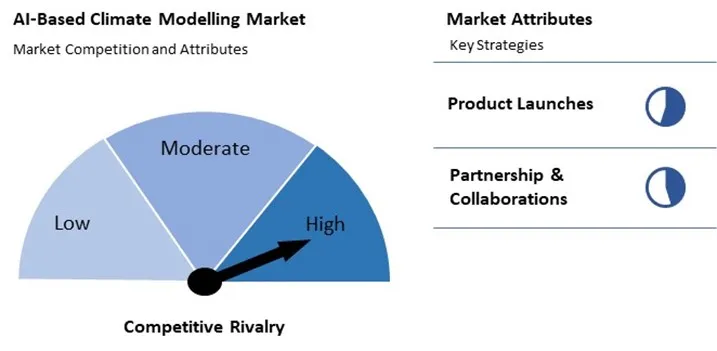
The AI-based climate modelling market is witnessing intensifying competition as both established technology providers and emerging innovators strive to deliver advanced solutions for accurate forecasting, risk assessment, and sustainability planning. Competition is driven by the growing demand for precise climate predictions to address extreme weather events, policy compliance, and corporate sustainability initiatives. Players are differentiating themselves through specialized AI algorithms, high-performance computing integration, and the ability to process large, complex datasets from satellites, sensors, and historical records. The market also sees rising collaboration with academic institutions and government bodies to improve model transparency and reliability. With increasing emphasis on decarbonization and ESG reporting, the competitive landscape is shaped by innovation, scalability, and the ability to provide actionable, real-time insights.
| Report Attribute | Details |
|---|---|
| Market size value in 2024 | USD 339.08 Million |
| Market size forecast in 2032 | USD 1.48 Billion |
| Base Year | 2024 |
| Historical Period | 2021 to 2023 |
| Forecast Period | 2025 to 2032 |
| Revenue Growth Rate | CAGR of 20.6% from 2025 to 2032 |
| Number of Pages | 405 |
| Number of Tables | 373 |
| Report coverage | Market Trends, Revenue Estimation and Forecast, Segmentation Analysis, Regional and Country Breakdown, Competitive Landscape, Market Share Analysis, Porter’s 5 Forces Analysis, Company Profiling, Companies Strategic Developments, SWOT Analysis, Winning Imperatives |
| Segments covered | Component, Technology, Application, Region |
| Country scope |
|
| Companies Included | NVIDIA Corporation, IBM Corporation, Microsoft Corporation, Google LLC, Amazon Web Services, Inc. (Amazon.com, Inc.), AccuWeather, Inc., ClimateAi, Tomorrow.io, The Climate Corporation and Jupiter Intelligence |
By Component
By Application
By Technology
By Geography
This Market size is expected to reach $1.48 billion by 2032.
Increasing Frequency of Extreme Weather Events Driving Demand for Accurate Predictive Models are driving the Market in coming years, however, Data Quality, Standardization, and Interoperability Challenges restraints the growth of the Market.
NVIDIA Corporation, IBM Corporation, Microsoft Corporation, Google LLC, Amazon Web Services, Inc. (Amazon.com, Inc.), AccuWeather, Inc., ClimateAi, Tomorrow.io, The Climate Corporation and Jupiter Intelligence
The expected CAGR of this Market is 20.6% from 2023 to 2032.
The Software segment is leading the Market by Component in 2024; thereby, achieving a market value of $1.01 Billion by 2032.
The North America region dominated the Market by Region in 2024, and would continue to be a dominant market till 2032; thereby, achieving a market value of $563.9 million by 2032.
Our team of dedicated experts can provide you with attractive expansion opportunities for your business.








 Unique Offerings