“Global AI Annotation Market to reach a market value of USD 8.68 Billion by 2032 growing at a CAGR of 25.7%”
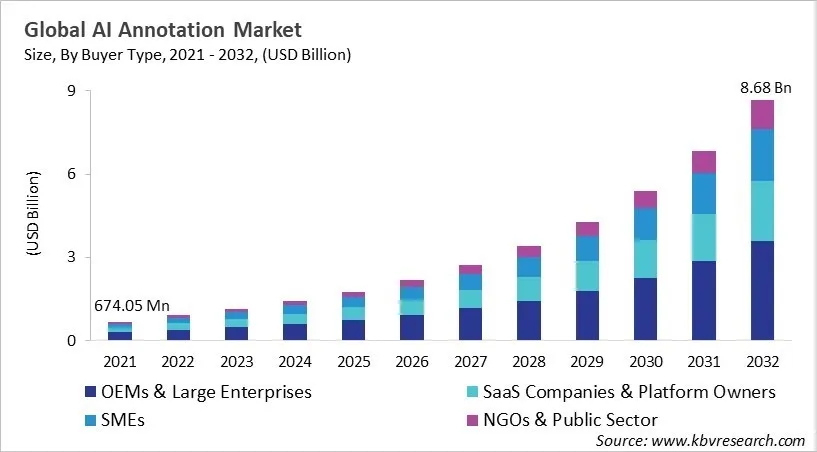
The Global AI Annotation Market size is expected to reach $8.68 billion by 2032, rising at a market growth of 25.7% CAGR during the forecast period
The AI annotation market has developed into a technology-driven ecosystem that reinforces the entire AI value chain. Annotation has become a large-scale industrial function as AI applications expanded into industries such as e-commerce, surveillance, healthcare, and autonomous vehicles, which were once limited to academic research in computer vision and language processing. With the rising focus on trustworthy and explainable AI, annotation has evolved from a basic pre-processing task to a key element of quality assurance, bias mitigation, and model governance. The AI annotation now spans diverse data types, including LiDAR, 3D, and sensor fusion, and combines human expertise with AI-assisted and semi-automated techniques to scale efficiently.
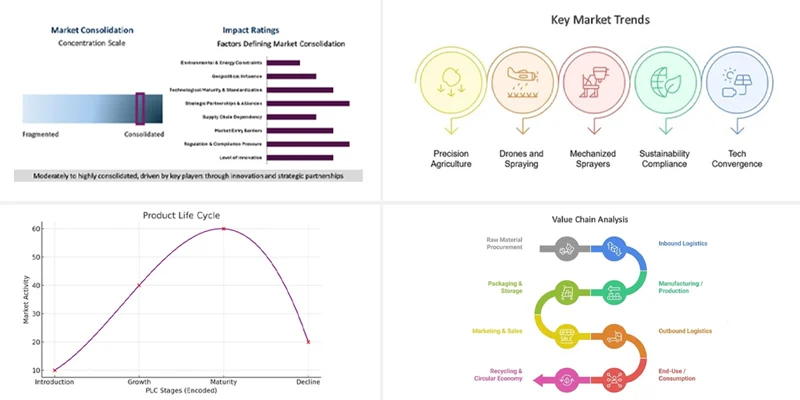
The AI annotation market is driven by key trends, including a decisive transition from volume-based to quality-and domain-based annotation, representing the requirement for consistency, traceability, and accuracy in high-stakes industries. Key market players are emphasizing automation, domain expertise, and hybrid human-machine workflows to deliver secure, scalable, and compliant annotation solutions. With the integration of annotation with broader AI-lifecycle services like data curation, model retaining, and edge-case identification-key players are developing from low-margin service vendors into strategic AI partners. Rising regulation, increasing client-switching costs, and data-sovereignty concerns are elements driving consolidation and underpin the importance of security, quality, and domain alignment as the market grows.
The COVID-19 pandemic had a big effect on the global AI annotation market, making it harder to do business, get things done, and make money. Lockdowns and the switch to remote work made it harder to get to annotation tools, pushed back project deadlines, and limited the number of people who could work together, especially in developing economies that depend on outsourced data-labeling. Limited access to real-world data, problems with quality control, and smaller budgets for businesses all made it harder to develop AI models. This hurt small and medium-sized businesses the most. The crisis showed how weak centralized operations can be, and supply-chain problems and rising infrastructure costs put more pressure on finances. As a result, companies started looking into hybrid human-plus-AI annotation models to make their systems more resilient. However, the overall market momentum stayed low in 2020 and 2021. Thus, the COVID-19 pandemic had a Negative impact on the market.

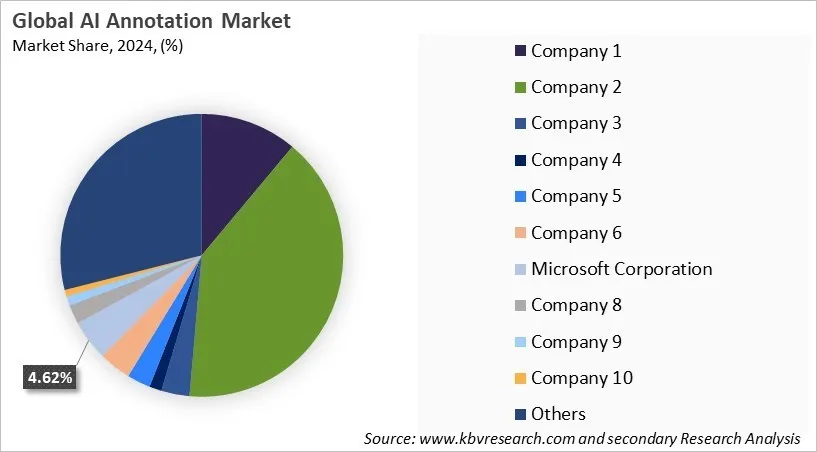
The leading players in the market are competing with diverse innovative offerings to remain competitive in the market. The above illustration shows the percentage of revenue shared by some of the leading companies in the market. The leading players of the market are adopting various strategies in order to cater demand coming from the different industries. The key developmental strategies in the market are Acquisitions, and Partnerships & Collaborations.
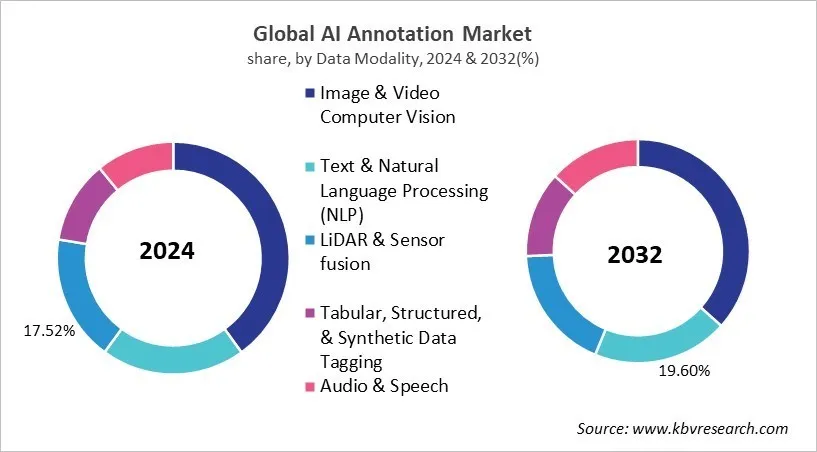
Based on Data Modality, the market is segmented into Image & Video Computer Vision, Text & Natural Language Processing (NLP), LiDAR & Sensor fusion, Tabular, Structured, & Synthetic Data Tagging and Audio & Speech. The text & natural language processing (NLP) segment attained 20% revenue share in the AI annotation market in 2024. The text and natural language processing (NLP) segment involves annotation workflows such as entity tagging, sentence classification, sentiment analysis, dialogue transcription, and intent recognition. These services support chatbots, search engines, content-moderation systems and other AI applications that process large volumes of unstructured text.
Based on Buyer Type, the market is segmented into OEMs & Large Enterprises, SaaS Companies & Platform Owners, SMEs and NGOs & Public Sector. The SaaS companies & platform owners segment recorded 25% revenue share in the AI annotation market in 2024. The SaaS companies & platform owners segment covers those firms that build, deliver and maintain software platforms or cloud-based AI services, and therefore require annotated data to train, validate and refine their models. These platform owners typically operate recurring-service models and leverage annotation to support model updates, feature launches, user-behaviour analytics and personalization.
Free Valuable Insights: AI Annotation Market size to reach USD 8.68 Billion by 2032
Region-wise, the AI Annotation Market is analyzed across North America, Europe, Asia Pacific, and LAMEA. The North America segment recorded 33% revenue share in the AI Annotation Market in 2024. In North America and Europe, the AI annotation market is predicted to witness prominent growth in the forecast period. This growth is supported by extensive AI adoption across sectors like healthcare, retail, government services, and autonomous vehicles. In North America, especially the US, the presence of well-established AI research hubs, leading tech giants, and regulatory frameworks encouraging responsible AI practices has accelerated high demand for domain-specific and secure annotation services. Public sector initiatives, such as government contracts for smart cities, compliance-driven AI systems, smart cities, and defense, compliance-based AI systems, further support market expansion. Additionally, Europe market is expanding, supported by strict data privacy regulations like GDPR and an emphasis on ethical AI governance, encouraging demand for transparent annotation workflows. The region’s AI annotation market is witnessing growth backed by increasing investment in industrial automation, healthcare imaging, and language technologies, with the increasing preferences for regional annotation providers that meet stringent data-sovereignty needs.
The AI annotation market is estimated to experience substantial expansion in the Asia Pacific and LAMEA. The market is driven by expanding research and development for AI, cost-efficient workforce availability, and rapid digital transformation. The Asia Pacific region has become a global hub for large-scale annotation operations, offering both offshore delivery and regional support in industries such as manufacturing, e-commerce, and mobility. The region is also witnessing a surge in AI annotation automation platforms and government-supported AI initiatives, particularly in Japan, South Korea, and other countries. In LAMEA, the AI annotation market is gaining traction through rising collaborations with global AI developers and growing government investment in surveillance, smart infrastructure, and digital public services. As enterprises in these regions advance through AI maturity, the emphasis is shifting to building regional capabilities in domain-specific, high-quality, and ethically governed annotation services.
| Report Attribute | Details |
|---|---|
| Market size value in 2025 | USD 1.75 Billion |
| Market size forecast in 2032 | USD 8.68 Billion |
| Base Year | 2024 |
| Historical Period | 2021 to 2023 |
| Forecast Period | 2025 to 2032 |
| Revenue Growth Rate | CAGR of 25.7% from 2025 to 2032 |
| Number of Pages | 534 |
| Number of Tables | 411 |
| Report coverage | Market Trends, Revenue Estimation and Forecast, Segmentation Analysis, Regional and Country Breakdown, Market Share Analysis, Porter’s 5 Forces Analysis, Company Profiling, Companies Strategic Developments, SWOT Analysis, Winning Imperatives |
| Segments covered | Data Modality, Buyer Type, Vertical, Region |
| Country scope |
|
| Companies Included | Appen Limited, Scale AI, Inc., Labelbox, Inc., Alegion, Inc., Google LLC, Amazon Web Services, Inc. (Amazon.com, Inc.), Microsoft Corporation, IBM Corporation, OpenAI, LLC, and Cogito Tech LLC. |
By Data Modality
By Buyer Type
By Vertical
By Geography
This Market size is expected to reach USD 8.68 billion by 2032.
The AI annotation market is projected to grow at a CAGR of 25.7% between 2025 and 2032.
Rapid expansion of AI-ML applications coupled with the rising volume and complexity of unstructured, multi-modal data is driving strong market growth.
Appen Limited, Scale AI, Inc., Labelbox, Inc., Alegion, Inc., Google LLC, Amazon Web Services, Inc. (Amazon.com, Inc.), Microsoft Corporation, IBM Corporation, OpenAI, LLC, and Cogito Tech LLC.
The OEMs & Large Enterprises segment led the maximum revenue in the Global AI Annotation Market by Buyer Type in 2024, thereby, achieving a market value of $3.6 billion by 2032.
The North America region dominated the Global AI Annotation Market by Region in 2024, and would continue to be a dominant market till 2032; thereby, achieving a market value of $2.8 billion by 2032.
Our team of dedicated experts can provide you with attractive expansion opportunities for your business.







 Unique Offerings