“Global Agriculture Spraying Equipment Market to reach a market value of USD 4.70 Billion by 2032 growing at a CAGR of 7.5%”
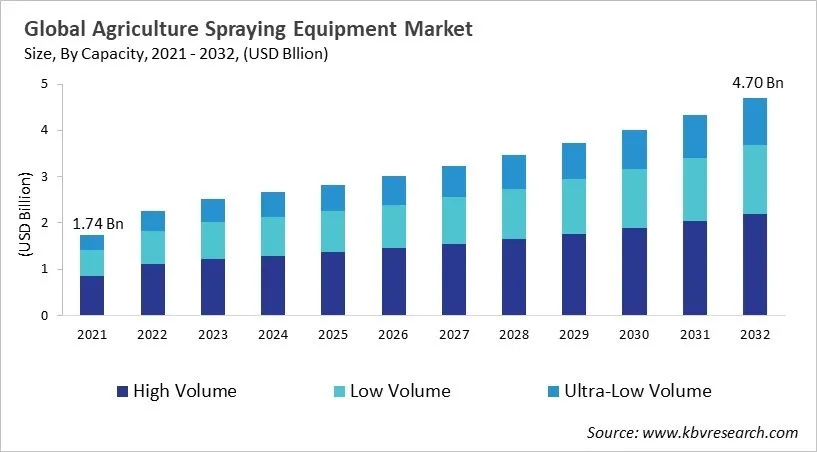
The Global Agriculture Spraying Equipment Market size is expected to reach $4.70 billion by 2032, rising at a market growth of 7.5% CAGR during the forecast period.
Precision agriculture and global food security have propelled the fast evolution of agricultural spraying equipment from crude manual instruments to highly sophisticated, GPS-driven systems. Efficiency has been redefined by innovations like LiDAR-enabled Smart Apply, variable-rate nozzles, and UAV-based sprayers, which minimize chemical waste, enable real-time canopy detection, and drastically lower operating costs. These developments, which are the result of partnerships between commercial OEMs like John Deere and public research institutes, demonstrate the industry's shift toward sustainability and digital integration. Precision spraying has evolved from a supporting to a crucial part of contemporary, high-output farming as the globe struggles to feed more than 9 billion people by 2050.
The agricultural spraying equipment market is experiencing a rapid evolution from basic manual instruments to very sophisticated and GPS-driven systems. The growing emphasis on food security worldwide and the precision agriculture have driven this evolution in the market. Innovations such as LiDAR-enabled Smart Apply, variable-rate nozzles, and UAV-based sprayers has led to the significant reduction in chemical waste and operating costs and enable real-time canopy identification thereby redefining the efficiency. Such developments are accredited to the partnerships between commercial OEMs such as John Deere and public research institutes and are also the representative of the transition of the industry towards the digital integration and sustainability.
Automation, electrification, and regional growth strategies targeting both large-scale and smallholder farmers are all changing the market at the same time. While OEMs and ag-tech startups compete and work together to provide scalable, tech-enabled solutions—from robotic sprayers and RTK-GPS drones to packaged Agriculture Spraying-as-a-Service (ASaaS) models—governments in emerging nations are using subsidies to encourage automation. Prominent companies are investing in sustainability, education, and regulatory compliance while using low-cost, modular technology to reach underserved populations. In order to satisfy the growing need for sustainable agricultural production, success in this dynamic environment depends on the capacity to combine engineering prowess, software intelligence, ecosystem alliances, and user-centric design.
Growth strategies with orientation towards automation, electrification and regional growth having focus on both large-scale and small-scale farmers are shaping the market. The OEMS and ag-tech startups are engaging together to develop and offer scalable and tech-enabled solutions ranging from robotic sprayers and RTK-GPS drones to packaged Agricultural Spraying-as-a-Service (ASaaS) models. Also, the government across countries are also providing subsidies to boost automation. Leading companies are investing in education, sustainability and regulatory compliance. These companies also reaching the underserved society using economic modular technology. The success roadmap to cater the rising requirement for sustainable agricultural production is influenced by the capacity to combine software intelligence, engineering prowess, user-centric design and ecosystem alliances.
The major strategies followed by the market participants are Product Launches as the key developmental strategy to keep pace with the changing demands of end users. For instance, In June, 2025, CNH Industrial N.V. unveiled advanced AI sprayer technology offering precision application beyond traditional boom boundaries. Using vision systems and machine learning, it enables real-time weed detection and targeted spraying, minimizing chemical use and environmental impact. This innovation reflects CNH’s strategic push for smart agricultural spraying equipment and sustainable farming practices. Moreover, In March, 2025, Yamaha Motor Co., Ltd. unveiled advancements in autonomous technology to boost agricultural efficiency. By enhancing field robotics and automation systems, Yamaha aims to optimize operations such as spraying and seeding, reinforcing its position in precision agriculture and contributing to the evolution of the agricultural spraying equipment market.
Product launches emerged as the major strategy adopted by the market participants in order to match the dynamic demand of the end-users. For e.g. in June 2025, CNH Industrial N.V. revealed innovative AI sprayer technology providing precision application afar conventional boom boundaries. The real-time weed identification and targeted spraying thereby significantly reducing the chemical usage and hence the environmental impact is facilitated by the vision systems and machine learning. Such innovations display CNH’s strategic commitment for smart agricultural spraying equipment and sustainable farming practices. Similarly, in March 2025, Yamaha Motor Co., Ltd. revealed the progress in autonomous technology to fuel the efficiency in agriculture sector. The optimization of the operations like seeding and spraying is the focus area of Yamaha thereby Strengthening its foothold in precision agriculture contributing to the evolution of this market.
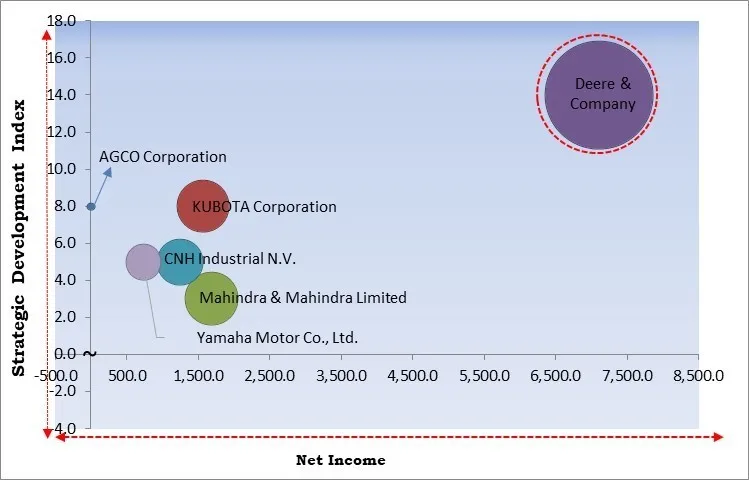
Based on the Analysis presented in the KBV Cardinal matrix; Deere & Company is the forerunner in the Agriculture Spraying Equipment Market. In June, 2025, Deere & Company unveiled its R975i, the largest self-propelled sprayer in its European range. Featuring a 55-meter boom and a 9,000-liter tank, it’s designed for high-efficiency operations. The R975i features advanced technologies, such as ExactApply and AutoTrac, enabling precise application and boosting productivity in large-scale agricultural spraying. Companies such as Mahindra & Mahindra Limited, KUBOTA Corporation, and CNH Industrial N.V. are some of the key innovators in Agriculture Spraying Equipment Market.
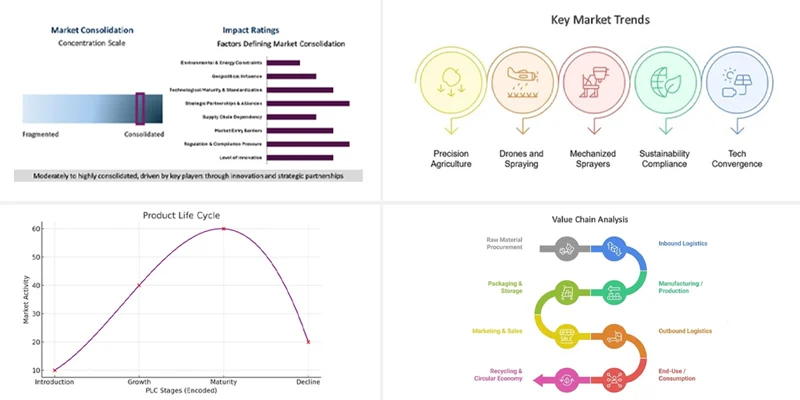

The precision agriculture is proving itself as a ground breaking method of farming enabling the enhancement of input efficiency, improvements in crop yields and reduction in environmental impact. Basically, this advance method utilizes data analytics, sensors, GPS-based instruments and automation to manage field fluctuations. The requirement to enhance the agricultural productivity with same farm has become more pertinent demand as the global population continues to rise. Hence, the precision agriculture is the suitable solution for producing more with less and advanced agriculture spraying equipment is one of the major components which makes this transformation possible.
Traditional agricultural practices have always been based on the availability of labor. However, urban migration, aging rural populations, and the diminishing attraction of physical agricultural labor have all contributed to the severe labor shortage now plaguing the agriculture industry. Farms are having trouble finding enough labor at critical times like planting, weeding, and harvesting as more young people from rural areas move to cities in quest of better prospects. In nations like Brazil, China, India, and even some regions of North America and Europe, the labor shortage is especially acute.
As one of the most influential restraint limiting the widespread adoption of agricultural spraying equipment, the high investment required for the procurement and deployment of the agricultural spraying equipment poses a serious restraint in its widespread adoption across the regions. Though with the advancement of the technology which further cut down the costs, still the level of investment is substantial for the small and marginal farmers representing the majority share in developing countries. For instance, the self-propelled boom sprayers, drone sprayers and autonomous robotic units may cost thousands to tens of thousands of dollars. Additionally, the incremental costs related to the base machine accessories, fuel and other modifications etc further makes the condition more challenging.
Free Valuable Insights: Global Agriculture Spraying Equipment Market size to reach USD 4.70 Billion by 2032
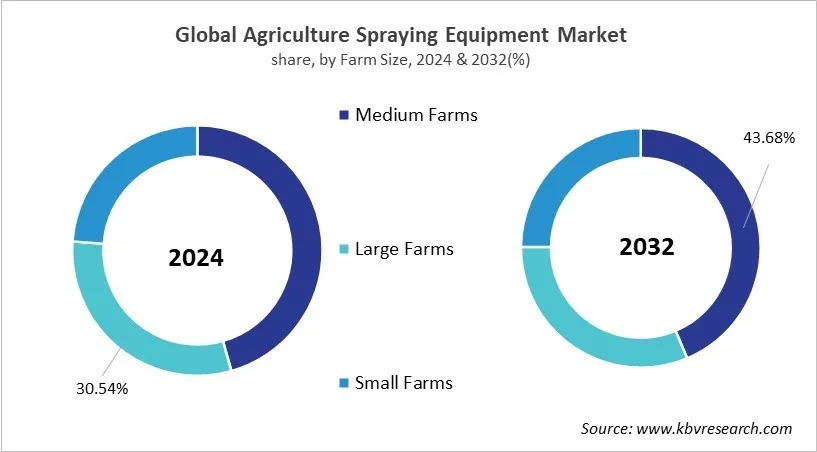
Based on Farm Size, the market is segmented into Medium Farms, Large Farms, and Small Farms. The large farms segment procured 31% revenue share in the agriculture spraying equipment market in 2024. These farms usually have a lot of acres to work with, so they need powerful machines that can swiftly and effectively cover large areas. Due to this, big farms are more likely to spend money on new technologies that offer speed, accuracy, and data-driven application methods, such as self-propelled machines, drone-based sprayers, and autonomous systems.
Based on Capacity, the market is segmented into High Volume, Low Volume, and Ultra-Low Volume.
Most of the time, large-scale farms employ high-volume sprayers since they can cover a lot of land in one refill cycle. These devices can hold hundreds of liters of fluid, which lets them spray without stopping. They are great for growing maize, wheat, and soybeans since they are strong and fast. They require more chemicals and water, but improvements in precision delivery systems are helping to cut down on overuse. The necessity for operational scale, especially in nations such as the U.S., Brazil, and China, where farming is very mechanized, is the reason that makes them so dominant in the market.
High volume sprayers are progressively equipped with GPS-based systems and variable rate application (VRA) technologies. Such equipment facilitate the farmers to apply pesticides, fertilizers, or herbicides more proficiently by regulating the flow rate in real time. The deployment of such solution is intended to maximize productivity by reducing operational costs and environmental waste. Such a trend is quite relevant for row crop farming thereby facilitating the quick and uniform coverage of large areas.
Supporting News:
At Colorado’s Commodity Classic (April 2025), John Deere unveiled updates to its sprayers featuring “See & Spray Select variable rate technology and AutoTrac automation,” enabling nozzle-level adjustments based on biomass detected by cameras.
“High‑volume systems are the backbone of large‑area application—where speed and throughput cannot be compromised.”
— Dr. Elena Marquez, Senior Analyst, Global AgriTech Insights
Low-volume sprayers are outstanding for mid-sized farms and specialist crop applications including vineyards, orchards, and vegetable farms since they balance coverage and resource use. They usually use 50 to 200 L/ha of liquid, which gives them enough coverage without using as many resources as high-volume systems. More people are using them because they work well with ecologically friendly activities and stricter rules about how chemicals can be used. Farmers also like them better since they don't have to refill the tank as often, they are easier to move around, and they apply more accurately, which is especially important in areas where over-spraying could cause runoff or damage to crops.
Low volume sprayers are gradually integrating advanced nozzle control systems which can identify target zones, minimize drift, and remove overlapping. These comprise pulse-width modulation (PWM) systems and AI-powered boom section controllers, that permit precise application even in uneven shaped fields.
Supporting News:
The World Ag Expo 2025 featured Ecorobotix’s ARA Ultra-High Precision sprayer, a robotic unit capable of treating individual plants with 95% reductions in chemical use—yet showcasing how cutting-edge tech trickles into low-volume contexts.
“Low‑volume units are evolving into smart delivery systems—precision-focused, environmentally aware, and perfect for targeted application.”
— Priya Singh, Director of Sustainability, AgriWorld Research
Based on Type, the market is segmented into Self-propelled, Tractor-mounted, Trailed, Aerial, and Handheld. The tractor-mounted segment garnered 25% revenue share in the agriculture spraying equipment market in 2024. The important contribution is the tractor-mounted category, which medium and large farms particularly like. This kind of sprayer is mounted directly to the front or back of a tractor and runs on the tractor's engine. With their versatility, affordability, and ease of use, tractor-mounted sprayers are appropriate for a variety of crops and spraying jobs.
Region-wise, the market is analyzed across North America, Europe, Asia Pacific, and LAMEA. The Asia Pacific segment procured 38% revenue share in the agriculture spraying equipment market in 2024. The key reasons for such a significant rise are the large amount of farming that is going on and the growing focus on mechanization in countries like China, India, and Japan. Since the area has a lot of people and food needs are growing, it is now vital to adopt effective and scalable farming methods. Government programs that promote modernization of agriculture, incentives to buy equipment, and a greater knowledge of precision farming are all helping this market sector thrive.
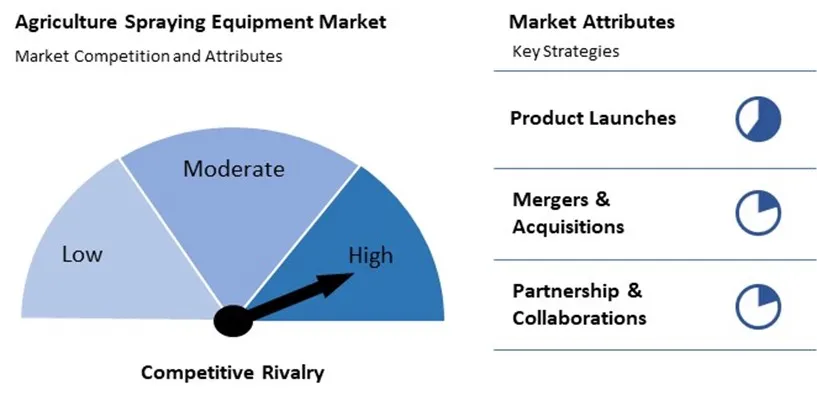
The agricultural spraying equipment market is particularly competitive since technology is changing quickly and there is a growing requirement for accuracy, automation, and sustainability. Agile agri-tech entrepreneurs are placing more and more pressure on established machinery makers with their smart, cheap solutions. As competition heats up in different sectors, companies are focusing on innovation, combining services, and adapting to local needs in order to acquire market share and meet a wide range of farming needs.
| Report Attribute | Details |
|---|---|
| Market size value in 2024 | USD 2.66 Billion |
| Market size forecast in 2032 | USD 4.70 Billion |
| Base Year | 2024 |
| Historical Period | 2021 to 2023 |
| Forecast Period | 2025 to 2032 |
| Revenue Growth Rate | CAGR of 7.5% from 2025 to 2032 |
| Number of Pages | 440 |
| Number of Tables | 380 |
| Report coverage | Market Trends, Revenue Estimation and Forecast, Segmentation Analysis, Regional and Country Breakdown, Competitive Landscape, Porter’s 5 Forces Analysis, Company Profiling, Companies Strategic Developments, SWOT Analysis, Winning Imperatives |
| Segments covered | Farm Size, Capacity, Type, Region |
| Country scope |
|
| Companies Included | Deere & Company, CNH Industrial N.V., AGCO Corporation, KUBOTA Corporation, Andreas Stihl AG and Co KG, Buhler Industries Inc., Yamaha Motor Co., Ltd., ISEKI & Co., Ltd., Mahindra & Mahindra Limited (Mahindra Group), and SZ DJI Technology Co., Ltd. |
By Farm Size
By Capacity
By Type
By Geography
This Market size is expected to reach $4.70 Billion by 2032.
Rising Global Demand For Precision Agriculture are driving the Market in coming years, however, High Initial Investment And Ownership Costs restraints the growth of the Market.
Deere & Company, CNH Industrial N.V., AGCO Corporation, KUBOTA Corporation, Andreas Stihl AG and Co KG, Buhler Industries Inc., Yamaha Motor Co., Ltd., ISEKI & Co., Ltd., Mahindra & Mahindra Limited (Mahindra Group), and SZ DJI Technology Co., Ltd.
The expected CAGR of this Market is 7.5% from 2023 to 2032.
The High Volume segment led the maximum revenue in the Market by Capacity in 2024, thereby, achieving a market value of $2.2 billion by 2032.
The Asia Pacific region dominated the Market by Region in 2024, and would continue to be a dominant market till 2032; thereby, achieving a market value of $1.8 billion by 2032.
Our team of dedicated experts can provide you with attractive expansion opportunities for your business.












 Unique Offerings