US Work Lights Market Size, Share & Trends Analysis Report By Power Source, By Type (Portable, Tripod, Handheld & Retractable), By Light Technology (Halogen, Integrated LED, and Fluorescent), By End-Use, and Forecast, 2023 - 2030
Published Date : 17-May-2024 |
Pages: 60 |
Report Format: PDF + Excel |
COVID-19 Impact on the US Work Lights Market
The United States (US) Work Lights Market Market size is expected to reach $8.4 Billion by 2030, rising at a market growth of 3.5% CAGR during the forecast period. In the year 2022, the market attained a volume of 104233.4 thousand units, experiencing a growth of 4.1% (2019-2022).
The work lights market in the United States has experienced significant growth and diversification in recent years, driven by the expanding industrial, construction, and automotive sectors. The automotive industry also contributes significantly to the demand for work lights in the U.S. The need for well-lit workspaces in auto repair shops, garages, and manufacturing facilities has increased the adoption of specialized work lights designed for automotive applications. The adoption of smart technology is also making its way into the work lights market. Some products feature Bluetooth connectivity or remote-control capabilities, allowing American users to adjust brightness levels, set timers, or even change light colors using mobile devices.
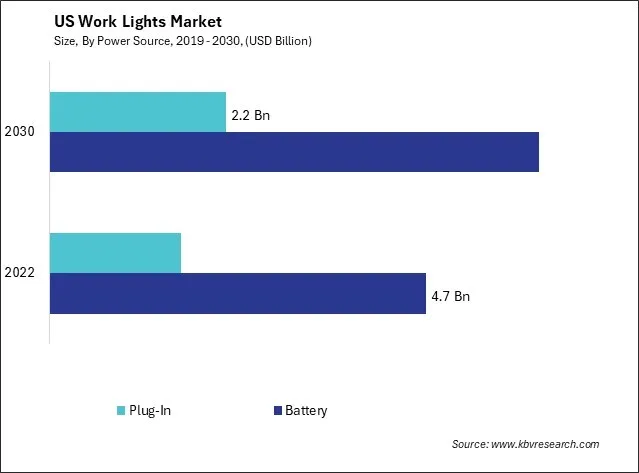
Moreover, the rise of the DIY culture among American consumers has further fueled the demand for work lights. As more individuals engage in home improvement projects and outdoor activities, portable and versatile work lights become essential tools. The versatility of these lights, often featuring adjustable brightness levels and various mounting options, caters to the diverse needs of DIY enthusiasts and professionals alike. Workplace safety regulations and initiatives have fueled the adoption of advanced work lights. U.S. industries are increasingly investing in lighting solutions that improve visibility and adhere to safety standards, reducing the risk of accidents and injuries.
The COVID-19 pandemic has caused disruptions in supply chains, leading to challenges in manufacturing and distribution. Lockdowns and restrictions on construction activities have temporarily slowed down the demand for work lights in the U.S. Additionally, economic uncertainties have influenced purchasing decisions, with some businesses delaying non-essential expenditures, including investments in new lighting equipment.
Market Trends
Expansion of the construction industry
The construction industry in the United States has experienced significant growth in recent years, driving expansion in the work lights market. The demand for efficient and reliable illumination solutions has become paramount as construction activities extend beyond daylight hours. As construction projects across the U.S. continue to rise, there is a heightened need for effective lighting solutions to ensure uninterrupted workflow and, more importantly, the safety of workers. Work lights have become indispensable tools on construction sites, providing visibility in poorly lit areas and aiding in precision tasks during evening shifts in the U.S.
Expanding the construction industry, particularly in urban development projects, commercial infrastructure, and residential construction, has fueled the demand for advanced, energy-efficient work lights. Urban development projects, such as office buildings, residential complexes, and retail spaces, have been particularly instrumental in shaping the construction landscape. The need for round-the-clock construction activities to meet deadlines and optimize project timelines has intensified the reliance on work lights in the U.S.
According to the U.S. Census Bureau, construction spending during November 2023 was estimated at a seasonally adjusted annual rate of $2,050.1 billion, 0.4 % above the revised October estimate of $2,042.5 billion. The November figure is 11.3 % above the November 2022 estimate of $1,842.2 billion. During the first eleven months of this year, construction spending amounted to $1,817.1 billion, 6.2 % above the $1,711.1 billion for the same period in 2022. The upward trend in construction spending underscores the industry's robust performance and its impact on the burgeoning work lights market in the U.S.
Government initiatives and regulations pertaining to workplace safety have also played a pivotal role in shaping the work lights market in the U.S. Strict adherence to safety standards has made it imperative for construction sites to incorporate high-quality lighting systems, ensuring optimal visibility and reducing the risk of accidents. Thus, the surge in construction activities in the United States, driven by urban development and infrastructure projects, has propelled the demand for advanced and energy-efficient work lights.
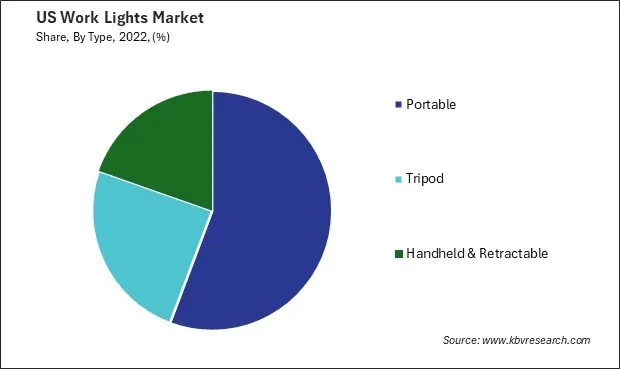
Increasing demand for tripods in the U.S.
The work lights market in the United States is experiencing a substantial surge in demand for tripods, reflecting a growing trend in the industry. As workplaces and job sites become increasingly dynamic, the need for versatile and adjustable lighting solutions has intensified. One of the driving factors behind the increasing demand for tripods in the U.S. work lights market is the emphasis on enhanced visibility and safety in various industries. Workers across construction, manufacturing, and maintenance sectors require adequate illumination for intricate tasks and hazard recognition. Tripods provide a convenient and efficient solution by allowing Americans to position lights at optimal angles and heights, ensuring comprehensive work area coverage.
Furthermore, the U.S. work lights market is witnessing a rise in LED technology adoption, contributing to the tripod's popularity. LED work lights offer energy efficiency, longevity, and superior brightness, making them the preferred choice for many professionals. Tripods complement these advanced lighting solutions by providing a stable base for mounting powerful LED work lights, catering to the need for reliable and efficient illumination.
The shift towards remote and flexible work arrangements has also fueled the demand for portable lighting solutions. As businesses and individuals prioritize eco-friendly practices, the efficiency of LED work lights becomes a significant factor in their adoption. Therefore, the surge in demand for tripods in the U.S. work lights market is driven by the growing emphasis on enhanced visibility and safety, particularly in dynamic workplaces.
Competition Analysis
The work lights market in the United States is a dynamic and competitive industry driven by the diverse needs of various sectors such as construction, automotive, manufacturing, and outdoor activities. In this thriving industry, several companies have established themselves as key players, each bringing unique offerings to cater to the specific demands of American consumers.
One prominent player in the U.S. work lights market is Milwaukee Tool. Renowned for its high-quality and durable products, Milwaukee Tool has become a go-to choice for professionals and DIY enthusiasts. The company's extensive range of work lights encompasses corded and cordless options, providing versatility for job sites and applications. Milwaukee Tool's commitment to innovation and advanced LED technology has solidified its position in the industry.
Ingersoll Rand, a global industrial company, has a significant presence in the U.S. work lights market. Leveraging its expertise in compressed air systems and power tools, Ingersoll Rand offers a range of work lights that align with the needs of professionals across industries. The company's emphasis on efficiency and user-friendly features contributes to its success in the competitive industry.
Another noteworthy participant in the U.S. work lights sector is DEWALT. As a well-known brand in the power tools industry, DEWALT brings its reputation for reliability to the work lights market. The company offers a broad spectrum of lighting solutions designed to meet the stringent requirements of construction professionals and tradespeople. DEWALT's focus on rugged design and functionality resonates with users seeking durable and efficient work lights for their projects.
An emerging player making strides in the U.S. work lights segment is CAT (Caterpillar Inc.). CAT has expanded its product offerings to include durable and reliable work lights, leveraging its brand recognition in the construction and heavy equipment industry. The company's focus on delivering robust lighting solutions suitable for challenging work environments positions it as a notable contender in the industry. With a focus on innovation, durability, and meeting the diverse needs of professionals, these companies shape the landscape of the U.S. work lights market, providing consumers with many options to illuminate their workspaces effectively.
List of Key Companies Profiled
- Bayco Products, Inc.
- Peterson Manufacturing, Inc.
- Ericson Manufacturing Company
- Scangrip A/S (Hultafors group)
- KIRA Leuchten GmbH
- Hugo Brennenstuhl GmbH & Co Kommanditgesellschaft
US Work Lights Market Report Segmentation
By Power Source
- Battery
- Plug-In
By Type
- Portable
- Tripod
- Handheld & Retractable
By Light Technology
- Halogen
- Integrated LED
- Fluorescent
By End-Use
- Construction
- Warehouses
- Manufacturing
- Mining
- Others
1.1 Market Definition
1.2 Objectives
1.3 Market Scope
1.4 Segmentation
1.4.1 USA Work Lights Market, by Power Source
1.4.2 USA Work Lights Market, by Type
1.4.3 USA Work Lights Market, by Light Technology
1.4.4 USA Work Lights Market, by End-Use
1.5 Methodology for the research
Chapter 2. Market Overview
2.1 Introduction
2.1.1 Overview
2.1.1.1 Market Composition and Scenario
2.2 Key Factors Impacting the Market
2.2.1 Market Drivers
2.2.2 Market Opportunities
2.2.3 Market Restraints
2.2.4 Market Challenges
2.2.5 Market Trends
2.3 Porter’s Five Forces Analysis
Chapter 3. US Work Lights Market
3.1 US Work Lights Market by Power Source
3.2 US Work Lights Market by Type
3.3 US Work Lights Market by Light Technology
3.4 US Work Lights Market by End-Use
Chapter 4. Company Profiles – Global Leaders
4.1 Bayco Products, Inc.
4.1.1 Company Overview
4.1.2 SWOT Analysis
4.2 Peterson Manufacturing, Inc.
4.2.1 Company overview
4.2.2 SWOT Analysis
4.3 Ericson Manufacturing Company
4.3.1 Company Overview
4.3.2 SWOT Analysis
4.4 Scangrip A/S (Hultafors group)
4.4.1 Company Overview
4.4.2 SWOT Analysis
4.5 KIRA Leuchten GmbH
4.5.1 Company Overview
4.5.2 SWOT Analysis
4.6 Hugo Brennenstuhl GmbH & Co Kommanditgesellschaft
4.6.1 Company Overview
4.6.2 SWOT Analysis
TABLE 2 US Work Lights Market, 2023 - 2030, USD Million
TABLE 3 US Work Lights Market, 2019 - 2022, Thousand Units
TABLE 4 US Work Lights Market, 2023 - 2030, Thousand Units
TABLE 5 US Work Lights Market by Power Source, 2019 - 2022, USD Million
TABLE 6 US Work Lights Market by Power Source, 2023 - 2030, USD Million
TABLE 7 US Work Lights Market by Power Source, 2019 - 2022, Thousand Units
TABLE 8 US Work Lights Market by Power Source, 2023 - 2030, Thousand Units
TABLE 9 US Work Lights Market by Type, 2019 - 2022, USD Million
TABLE 10 US Work Lights Market by Type, 2023 - 2030, USD Million
TABLE 11 US Work Lights Market by Type, 2019 - 2022, Thousand Units
TABLE 12 US Work Lights Market by Type, 2023 - 2030, Thousand Units
TABLE 13 US Work Lights Market by Light Technology, 2019 - 2022, USD Million
TABLE 14 US Work Lights Market by Light Technology, 2023 - 2030, USD Million
TABLE 15 US Work Lights Market by Light Technology, 2019 - 2022, Thousand Units
TABLE 16 US Work Lights Market by Light Technology, 2023 - 2030, Thousand Units
TABLE 17 US Work Lights Market by End-Use, 2019 - 2022, USD Million
TABLE 18 US Work Lights Market by End-Use, 2023 - 2030, USD Million
TABLE 19 US Work Lights Market by End-Use, 2019 - 2022, Thousand Units
TABLE 20 US Work Lights Market by End-Use, 2023 - 2030, Thousand Units
TABLE 21 Key Information – Bayco Products, Inc.
TABLE 22 Key Information – Peterson Manufacturing, Inc.
TABLE 23 Key Information – Ericson Manufacturing Company
TABLE 24 Key Information – Scangrip A/S
TABLE 25 Key Information – kira leuchten gmbh
TABLE 26 Key Information – Hugo Brennenstuhl GmbH & Co Kommanditgesellschaft
List of Figures
FIG 1 Methodology for the research
FIG 2 US Work Lights Market, 2019 - 2030, USD Million
FIG 3 Key Factors Impacting Work Lights Market
FIG 4 Porter’s Five Forces Analysis - Work Lights Market
FIG 5 US Work Lights Market share by Power Source, 2022
FIG 6 US Work Lights Market share by Power Source, 2030
FIG 7 US Work Lights Market by Power Source, 2019 - 2030, USD Million
FIG 8 US Work Lights Market share by Type, 2022
FIG 9 US Work Lights Market share by Type, 2030
FIG 10 US Work Lights Market by Type, 2019 - 2030, USD Million
FIG 11 US Work Lights Market share by Light Technology, 2022
FIG 12 US Work Lights Market share by Light Technology, 2030
FIG 13 US Work Lights Market by Light Technology, 2019 - 2030, USD Million
FIG 14 US Work Lights Market share by End-Use, 2022
FIG 15 US Work Lights Market share by End-Use, 2030
FIG 16 US Work Lights Market by Power Source, 2019 - 2030, USD Million
FIG 17 SWOT Analysis: Bayco Products, Inc.
FIG 18 SWOT Analysis: Peterson Manufacturing, inc.
FIG 19 SWOT Analysis: Ericson Manufacturing Company
FIG 20 SWOT Analysis: Scangrip A/S
FIG 21 SWOT Analysis: KIRA Leuchten GmbH
FIG 22 SWOT Analysis: Hugo Brennenstuhl GmbH & Co Kommanditgesellschaft