The Work Order Management Systems Market is Predict to reach USD 1.35 Billion by 2032, at a CAGR of 8.0%
Special Offering :
Industry Insights | Market Trends | Highest number of Tables | 24/7 Analyst Support
Work Order Management Systems Market Growth, Trends and Report Highlights
According to a new report, published by KBV research, The Global Work Order Management Systems Market size is expected to reach $1.35 billion by 2032, rising at a market growth of 8.0% CAGR during the forecast period.
Innovation is at the heart of the market, with continuous advancements in technology driving the development of more sophisticated and efficient solutions. AI and machine learning are transforming WOMS by enabling predictive maintenance, automated scheduling, and intelligent resource allocation. These technologies analyze vast amounts of data to identify patterns, optimize workflows, and improve decision-making.
The Large Enterprise segment captured the maximum revenue in the Global Work Order Management Systems Market by Organization Size in 2024, thereby, achieving a market value of $763.2 million by 2032. This is primarily due to the complex operational structures and extensive asset bases that require robust and scalable work order management solutions. Large organizations often invest in comprehensive systems to streamline maintenance tasks, ensure compliance, and enhance productivity across multiple departments and locations.
The Solution segment is experiencing a CAGR of 7.6 % during the forecast period. This growth is primarily driven by the widespread adoption of centralized platforms that automate and streamline work order processes, including task assignment, tracking, and reporting. Businesses across industries are increasingly leveraging these software solutions to improve operational efficiency, reduce downtime, and enhance resource utilization.
The Cloud segment led the maximum revenue in the Global Work Order Management Systems Market by Deployment Mode in 2024, thereby, achieving a market value of $917.2 million by 2032. The dominance of this segment is attributed to the scalability, flexibility, and cost-efficiency offered by cloud-based solutions. Organizations are increasingly adopting cloud deployment to enable remote access, real-time collaboration, and seamless integration with other digital systems.
The Manufacturing segment is growing at a CAGR of 6.8 % during the forecast period. Work order management systems enable manufacturers to automate and streamline maintenance workflows, track machinery health in real-time, and schedule preventive maintenance effectively. This reduces unplanned downtime and increases equipment lifespan, allowing manufacturers to maintain continuous production cycles and meet growing demand while controlling costs.
Full Report: https://www.kbvresearch.com/work-order-management-systems-market/
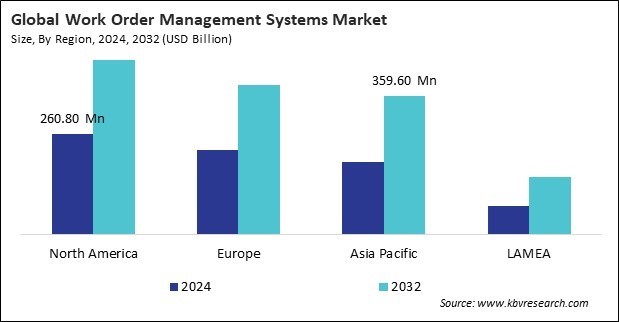
The North America region dominated the Global Work Order Management Systems Market by Region in 2024, thereby, achieving a market value of $453.7 million by 2032. The Europe region is anticipated to grow a CAGR of 7.6% during (2025 - 2032). Additionally, The Asia Pacific region would witness a CAGR of 8.6% during (2025 - 2032).
List of Key Companies Profiled
- Salesforce, Inc.
- IBM Corporation
- Microsoft Corporation
- Oracle Corporation
- SAP SE
- Infor, Inc. (Koch Industries)
- ServiceNow, Inc.
- UpKeep Technologies, Inc.
- Lula Smarter Property Maintenance, Inc.
- PTC, Inc.
Work Order Management Systems Market Report Segmentation
By Organization Size
- Large Enterprise
- Small & Medium Enterprise (SME)
By Component
- Solution
- Services
By Deployment Mode
- Cloud
- On-premises
By End Use
- Manufacturing
- Transportation & Logistics
- Energy & Utilities
- Construction & Real Estate
- Consumer Goods & Retail
- Telecom and IT
- Healthcare & Life Sciences
- BFSI
- Other End Use
By Geography
- North America
- US
- Canada
- Mexico
- Rest of North America
- Europe
- Germany
- UK
- France
- Russia
- Spain
- Italy
- Rest of Europe
- Asia Pacific
- China
- Japan
- India
- South Korea
- Australia
- Malaysia
- Rest of Asia Pacific
- LAMEA
- Brazil
- Argentina
- UAE
- Saudi Arabia
- South Africa
- Nigeria
- Rest of LAMEA
Related Reports: