The Robotics System Integration Market is Predict to reach USD 150.84 Billion by 2032, at a CAGR of 9.4%
Special Offering :
Industry Insights | Market Trends | Highest number of Tables | 24/7 Analyst Support
Robotics System Integration Market Growth, Trends and Report Highlights
According to a new report, published by KBV research, The Global Robotics System Integration Market size is expected to reach $150.84 billion by 2032, rising at a market growth of 9.4% CAGR during the forecast period.
These robots are programmed to interact safely with humans and carry out certain tasks without any risk of harm to the human worker. Cobots can be used to automate labour-intensive or hazardous tasks for humans, such as welding and soldering. Industrial Internet of Things (IIoT), is a fast-growing technology that enables industrial equipment to be connected to the internet and automated.
The Industrial Robots segment is experiencing a CAGR of 8.8 % during the forecast period. This dominance is primarily driven by the increasing automation across manufacturing industries such as automotive, electronics, and heavy machinery. Industrial robots are widely used for assembly, welding, painting, and material handling, helping companies improve productivity, precision, and workplace safety.
The Material Handling & Packaging segment led the maximum revenue in the Global Robotics System Integration Market by Application in 2024, thereby, achieving a market value of $48.2 billion by 2032. Industries are increasingly deploying robotic systems to automate repetitive and labour-intensive tasks like lifting, transferring, and packaging products. These systems enhance speed, accuracy, and safety while optimizing floor space and workflow.
The Automotive segment is growing at a CAGR of 8.4 % during the forecast period. This is largely due to the extensive use of industrial robots for tasks such as welding, painting, assembly, and quality inspection in automotive manufacturing. Mass production demand for precision, speed, and cost-efficiency has increasingly led automotive companies to rely on integrated robotic solutions.
Full Report: https://www.kbvresearch.com/robotics-system-integration-market/
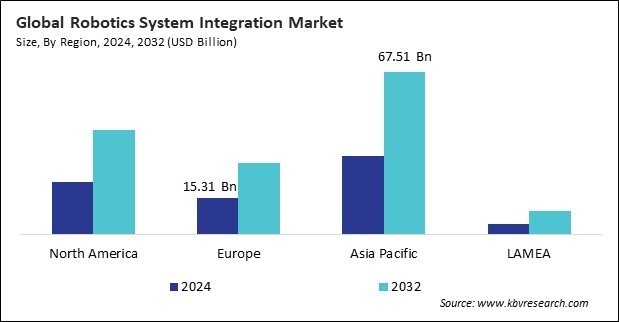
The Asia Pacific region dominated the Global Robotics System Integration Market by Region in 2024, and would continue to be a dominant market till 2032; thereby, achieving a market value of $67.5 billion by 2032. The North America region is anticipated to grow at a CAGR of 9.2% during (2025 - 2032). Additionally, The Europe region would witness a CAGR of 8.9% during (2025 - 2032).
List of Key Companies Profiled
- Hitachi High-Technologies Corporation (Hitachi Ltd.)
- IPG Photonics Corporation
- JH Robotics, Inc.
- ABB Ltd.
- FANUC Corporation
- Teradyne, Inc.
- Kuka AG (Midea Group Co., Ltd.)
- Siemens AG
- Rockwell Automation, Inc.
- Omron Corporation
Robotics System Integration Market Report Segmentation
By Type
- Industrial Robots
- Autonomous Robots
- Service Robots
- Collaborative Robots
By Application
- Material Handling & Packaging
- Logistics & Warehouse Automation
- Welding & Assembly
- Painting & Dispensing
- Inspection & Quality Control
- Other Application
By End-Use
- Automotive
- Electronics & Semiconductor
- Aerospace & Defense
- Food & Beverage
- Pharmaceuticals & Healthcare
- E-commerce & Retail
- Energy & Utilities
- Agriculture
- Other End-use
By Geography
- North America
- US
- Canada
- Mexico
- Rest of North America
- Europe
- Germany
- UK
- France
- Russia
- Spain
- Italy
- Rest of Europe
- Asia Pacific
- China
- Japan
- India
- South Korea
- Singapore
- Malaysia
- Rest of Asia Pacific
- LAMEA
- Brazil
- Argentina
- UAE
- Saudi Arabia
- South Africa
- Nigeria
- Rest of LAMEA
Related Reports: