The MicroLED Interconnect Market is Predict to reach USD 555.7 Million by 2032, at a CAGR of 18.4%
Special Offering :
Industry Insights | Market Trends | Highest number of Tables | 24/7 Analyst Support
MicroLED Interconnect Market Growth, Trends and Report Highlights
According to a new report, published by KBV research, The Global MicroLED Interconnect Market size is expected to reach $555.7 Million by 2032, rising at a market growth of 18.4% CAGR during the forecast period.
The MicroLED Interconnect Market is swiftly emerging as a critical enabling in the evolution of next-generation display and optoelectronic technologies. MicroLEDs (Micro Light-Emitting Diodes) have gained tremendous momentum due to their ability to offer brighter, more energy-efficient, and longer-lasting displays compared to OLED and LCD alternatives. However, for these ultra-small, micron-scale LEDs to achieve their full commercial potential, the role of interconnecting the intricate system of microscopic electrical links that connect MicroLEDs to control circuitry—becomes vital.
The GPU-to-GPU segment is anticipating a CAGR of 18.9% during (2025 - 2032). The GPU-to-GPU segment plays a vital role in enabling parallel processing and high computational performance within MicroLED systems. This type of interconnect is primarily used in scenarios where intensive graphical rendering and image processing are needed—such as in gaming, automotive HUDs, and industrial visualization tools. By enabling communication between multiple GPUs, this interconnect ensures a unified and synchronized output, which is essential for rendering high-resolution content in real time. The increasing use of MicroLED displays in high-end visual applications has driven attention toward optimizing GPU-to-GPU pathways for minimal latency and maximum throughput.
The Less than 1 meter segment is leading the Global MicroLED Interconnect Market by Distance in 2024; thereby, achieving a market value of $205.5 Million by 2032. The less than 1 meter segment represents the most dominant category in the MicroLED interconnect market, largely driven by the compact nature of most MicroLED-based devices. This distance range is ideal for tightly integrated electronic systems where internal component communication—such as between chips, modules, and internal drivers—requires short, high-speed, and low-latency interconnects. Common use cases include smartphones, AR/VR headsets, smartwatches, and other wearable devices where the proximity between components allows for ultra-short but highly efficient connections. The demand for miniaturized and portable electronics continues to reinforce the strength of this segment.
The 25 - 50 GBPS segment is registering a CAGR of 18.7% during (2025 - 2032). The 25 – 50 GBPS segment caters to more advanced applications where moderate to high bandwidth is essential. This includes mid-range televisions, industrial monitors, and entry-level augmented reality systems that require smoother rendering and faster data throughput than lower-tier solutions can provide. The balance between performance and energy efficiency in this category makes it a favorable choice for manufacturers seeking to enhance user experience without incurring the high costs associated with ultra-high-speed interconnects. It represents a critical transition tier for products moving toward high-definition and real-time responsiveness.
Full Report: https://www.kbvresearch.com/microled-interconnect-market/
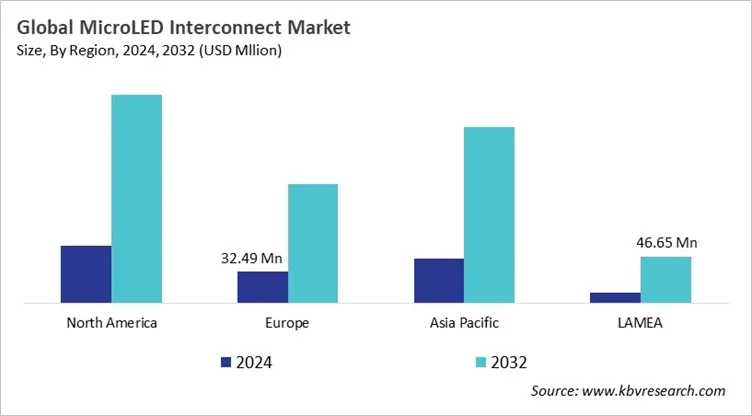
The North America region dominated the Global MicroLED Interconnect Market by Region in 2024, and would continue to be a dominant market till 2032; thereby, achieving a market value of $210.5 Million by 2032. The Asia Pacific region is exhibiting a CAGR of 19.2% during (2025 - 2032). Additionally, The Europe region would showcase a CAGR of 18.2% during (2025 - 2032).
List of Key Companies Profiled
- Samsung Electronics Co., Ltd. (Samsung Group)
- Apple, Inc.
- Sony Corporation
- LG Electronics, Inc. (LG Corporation)
- AU Optronics Corporation
- BOE Technology Group Co., Ltd.
- AvicenaTech, Corp.
- Aledia
- Ayar Labs, Inc.
- EPISTAR Corporation
MicroLED Interconnect Market Report Segmentation
By Product Type
- Chip-to-Chip
- GPU-to-GPU
- GPU-to-Memory
By Data Rate
- Less than 25 GBPS
- 25 - 50 GBPS
- More than 100 Gbps
- 50 - 100 Gbps
By Distance
- Less than 1 meter
- 1 - 5 meter
- More than 5 meter
By Geography
- North America
- US
- Canada
- Mexico
- Rest of North America
- Europe
- Germany
- UK
- France
- Russia
- Spain
- Italy
- Rest of Europe
- Asia Pacific
- China
- Japan
- India
- South Korea
- Singapore
- Malaysia
- Rest of Asia Pacific
- LAMEA
- Brazil
- Argentina
- UAE
- Saudi Arabia
- South Africa
- Nigeria
- Rest of LAMEA
Related Reports: